
CAS No. 1397-89-3
Batch:
Purity:99.61
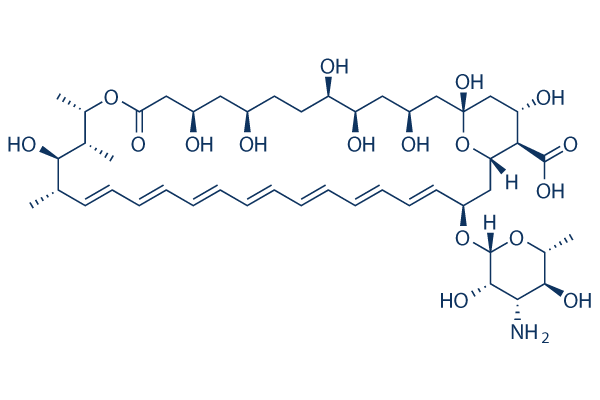
Chemical Structure
Check the
Amphotericin B
product page for in-depth specifications, including solubility, stock solutions, MOA, and working concentrations.
| IUPAC Name | (1R,3S,5R,6R,9R,11R,15S,16R,17R,18S,19E,21E,23E,25E,27E,29E,31E,33R,35S,36R,37S)-33-[(2R,3S,4S,5S,6R)-4-amino-3,5-dihydroxy-6-methyloxan-2-yl]oxy-1,3,5,6,9,11,17,37-octahydroxy-15,16,18-trimethyl-13-oxo-14,39-dioxabicyclo[33.3.1]nonatriaconta-19,21,23,25,27,29,31-heptaene-36-carboxylic acid | |
|---|---|---|
| CAS Number | 1397-89-3 | |
| Molecular Formula |
C47H73NO17 |
|
| Molecular Weight (MW) | 924.08 | |
| SMILES | CC1C=CC=CC=CC=CC=CC=CC=CC(CC2C(C(CC(O2)(CC(CC(C(CCC(CC(CC(=O)OC(C(C1O)C)C)O)O)O)O)O)O)O)C(=O)O)OC3C(C(C(C(O3)C)O)N)O | |
| InChIKey | APKFDSVGJQXUKY-INPOYWNPSA-N |
Amphotericin B is an amphipathic polyene antifungal antibiotic that directly targets and binds ergosterol in fungal cell membranes. This interaction disrupts cell membrane integrity by forming ion channels and transmembrane pores, leading to rapid intracellular potassium leakage. Consequently, membrane permeabilization severely impairs osmotic balance and essential metabolic pathway functions, ultimately driving fungal cell death across various pathogenic strains. [1]
|
Concentration
Volume
Mass
|
|---|
Batch:
All in vitro solubility values are batch-tested experimental data (non-literature values).
| Solvent | Solubility & Note |
|---|---|
| DMSO |
4.5 mg/mL
(4.86 mM)
(Moisture-contaminated DMSO may reduce solubility. Use fresh, anhydrous DMSO.) |
| Water | 4.5 mg/mL |
| Ethanol | Insoluble |
| DMSO |
50 mg/mL
(54.1 mM)
(Moisture-contaminated DMSO may reduce solubility. Use fresh, anhydrous DMSO. The recommended stock concentration is 10 mM in DMSO.) |
| Water | Insoluble |
| Ethanol | Insoluble |
| DMSO |
22 mg/mL
(23.8 mM)
(Moisture-contaminated DMSO may reduce solubility. Use fresh, anhydrous DMSO. The recommended stock concentration is 10 mM in DMSO.) |
| Water | Insoluble |
| Ethanol | Insoluble |
| DMSO |
26 mg/mL
(28.13 mM)
(Moisture-contaminated DMSO may reduce solubility. Use fresh, anhydrous DMSO. The recommended stock concentration is 10 mM in DMSO.) |
| Water | Insoluble |
| Ethanol | Insoluble |
| DMSO |
22 mg/mL
(23.8 mM)
(Moisture-contaminated DMSO may reduce solubility. Use fresh, anhydrous DMSO. The recommended stock concentration is 10 mM in DMSO.) |
| Water | Insoluble |
| Ethanol | Insoluble |
Q: Why does a DMSO stock precipitate in media/saline?
A: It is caused by unheated aqueous media (supersaturation), local solvent shock, or incorrect mixing sequence.
How to fix it?
- Preheat media/saline to 37°C.
- Mix rapidly (pipette/vortex) upon addition.
- For complex mixes, always add the aqueous phase last.
- Re-dissolve minor precipitates with a 37°C water bath and sonication (≤30 min).
Note: Technical data last updated: Sep 1, 2026.