
|
How to Cite 1. For In-Text Citation (Materials & Methods): 2. For Key Resources Table: |
||
|
Toll Free: (877) 796-6397 -- USA and Canada only -- |
Fax: +1-832-582-8590 Orders: +1-832-582-8158 |
Tech Support: +1-832-582-8158 Ext:3 Please provide your Order Number in the email. We strive to reply to |
Technical Data
| Formula | C14H12O3 |
||||||||||
| Molecular Weight | 228.24 | CAS No. | 501-36-0 | ||||||||
| Solubility (25°C)* | In vitro | DMSO | 300 mg/mL (1314.4 mM) | ||||||||
| Water | Insoluble | ||||||||||
| Ethanol | Insoluble | ||||||||||
| In vivo (Add solvents to the product individually and in order) |
|
||||||||||
|
* <1 mg/ml means slightly soluble or insoluble. * Please note that Selleck tests the solubility of all compounds in-house, and the actual solubility may differ slightly from published values. This is normal and is due to slight batch-to-batch variations. * Room temperature shipping (Stability testing shows this product can be shipped without any cooling measures.) |
|||||||||||
Preparing Stock Solutions
Biological Activity
| Description | Resveratrol has a wide spectrum of targets including cyclooxygenases(i.e. COX, IC50=1.1 μM), lipooxygenases(LOX, IC50=2.7 μM), kinases, sirtuins and other proteins. It has anti-cancer, anti-inflammatory, blood-sugar-lowering and other beneficial cardiovascular effects. Resveratrol induces mitophagy/autophagy and autophagy-dependent apoptosis. | |||||||||||
|---|---|---|---|---|---|---|---|---|---|---|---|---|
| Targets |
|
|||||||||||
| In vitro | Resveratrol inhibits the activity of Cyclooxygenase and lipooxygenase, PKCs and p56lck, ERK1, JNK1, p38, IKK β, Src, STAT3, Ribonucleotide Reductase, DNA polymerases α and δ, PKD, PKC α, Quinone reductase 2, and Aromatase with IC50 of from 0.035-60 μM. This compound is also an activator of Adenylyl cyclase and AMPK with EC50 of 0.8 μM and 50 μM, respectively. The roles of this compound as inhibitor or activator enable its effects on decreasing cell inflammatory associated behaviors, growth inhibition and induction of apoptosis in cancer cells, reversal of endothelin-1 stimulated cell responses, inhibition of phorbol ester-induced expression of COX-2, inhibition of DNA synthesis in cell, resistance to menadione-induced cell death, and improvement of cell mitochondrial function and glucose/lipid metabolism. It is also an activator of sirtuins. This chemical lowers the Michaelis constant of SIRT1 for both the acetylated substrate and NAD+, and increases cell survival by stimulating SIRT1-dependent deacetylation of p53. In yeast, it mimics calorie restriction by stimulating Sir2, increasing DNA stability and extending lifespan. This compound is effective at protecting isolated rat hearts against ischemia/reperfusion injury via its antioxidant activity, with improved recovery of developed pressure and aortic flow, reduction of malondialdehyde concentrations and reduction of infarct size. | |||||||||||
| In vivo | Resveratrol improves health and survival of mice on a high-calorie diet. This compound (22.4 mg/kg/day) shifts the physiology of middle-aged mice on a high-calorie diet towards that of mice on a standard diet and significantly increases their survival. It produces changes associated with longer lifespan, including increased insulin sensitivity, reduced insulin-like growth factor-1 (IGF-I) levels, increased AMP-activated protein kinase (AMPK) and peroxisome proliferator-activated receptor-γcoactivator 1α(PGC-1α) activity, increased mitochondrial number, and improved motor function. The substance opposed the effects of the high-calorie diet in 144 out of 153 significantly altered pathways. It has been shown to inhibit the initiation and growth of tumors in a wide variety of rodent cancer models. Dose of this chemical as low as 200 μg/kg daily already shows efficacy in a rat model of colon carcinogenesis. At higher dose of 40 mg/kg, it increases the survival of mice with subcutaneous neuroblastomas from 0% to 70%. This compound inhibits vascularization in the corneal micropocket assay in mice at a dose of only 48 μg/kg when administered daily. It shows beneficial effects on heart disease. The substance blocks the increase in platelet aggregation induced by a hypercholesterolaemic diet. It increase expression of both endothelial and inducible nitric oxide synthase. In stroke-prone, spontaneously hypertensive rats, resveratrol significantly reduces markers of oxidative stress such as glycated albumin in serum, and 8-hydroxyguanos-ine in urine. Providing this chemical in drinking water for 15 days (1 mg/kg) is sufficient to improve the recovery in function and coronary flow of isolated hearts. It displays anti-inflammatory activity in vivo. This compound significantly reduces both acute and chronic chemically induced oedema, lipopolysaccharide-induced airway inflammation and osteoarthritis, and helps to prevent allograft rejection. Intravenously administered resveratrol decreases inflammation induced by ischaemia/reperfusion, oxidants generated by hypoxanthine/xanthine oxidase (HX/XO) or platelet-activating factor, but not leukotriene B4 in rats. It shows beneficial effects on stroke and brain damage. The substance administered intravenously significantly decreased ischaemic volume and brain water content at the extremely low doses of 100 ng/kg and 1 μg/kg after middle cerebral artery occlusion in rats. |
Protocol (from reference)
| Cell Assay: |
|
|---|---|
| Animal Study: |
|
References
|
Customer Product Validation
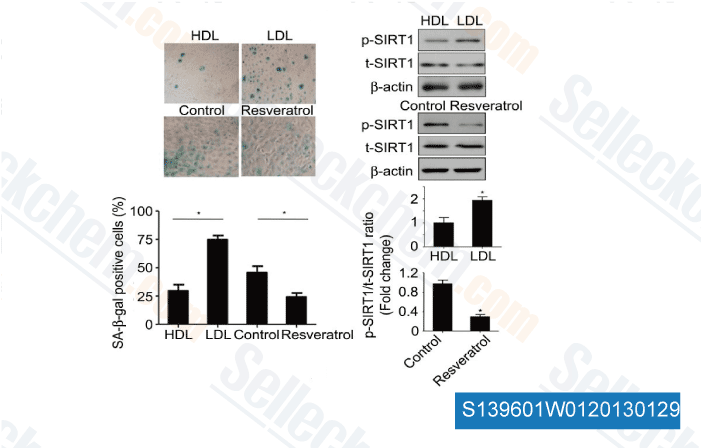
-
, , Dr. Johanna Weiss of University Hospital Heidelberg
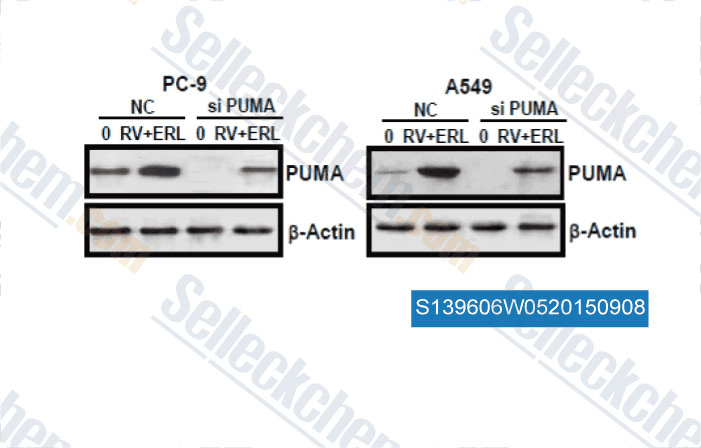
-
Data from [ , , Cell Physiol Biochem, 2015, 35: 2255-2271 ]
Selleck's Resveratrol (trans-Resveratrol) Has Been Cited by 92 Publications
| Multi-omics analysis identifies CCNB1 as a cell cycle factor driving glioblastoma progression and its inhibition by resveratrol [ PLoS One, 2026 Mar 16, e0344872] | PubMed: 41838760 |
| Multi-omics analysis identifies CCNB1 as a cell cycle factor driving glioblastoma progression and its inhibition by resveratrol [ PLoS One, 2026 Mar 16, e0344872] | |
| H3K18 lactylation-mediated SPHK1-SIRT1 feedback loop accelerates pyroptosis of tubular epithelial cells in sepsis-associated acute kidney injury [ Theranostics, 2026, 16(9):4768-4786] | PubMed: 41799201 |
| ITGA5 as a Dual Regulator of Epithelial-Mesenchymal Transition and Epithelial Cell Anoikis Resistance: Functional Validation and Drug Prediction [ Cell Prolif, 2026, e70190.] | PubMed: 41772919 |
| Multi-omics analysis identifies CCNB1 as a cell cycle factor driving glioblastoma progression and its inhibition by resveratrol [ PLoS One, 2026, 21(3):e0344872] | PubMed: 41838760 |
| Resveratrol Alleviates Effects of LPS on Estrogen Synthesis, Oxidative Stress, Inflammation, and Pyroptosis of Goat Granulosa Cells by Activating the PPARG/NRF2/HO-1 Signaling Pathway [ Antioxidants, 2025 Oct 29, 1300] | PubMed: 41300457 |
| Identifying Age-Modulating Compounds Using a Novel Computational Framework for Evaluating Transcriptional Age [ Aging Cell, 2025, e70075] | PubMed: 40307992 |
| MIT-001 ameliorates ferroptosis-induced mitochondrial dysfunction and enhances embryo quality in preimplantation embryos from aged female mice [ Biomed Pharmacother, 2025, 190:118393] | PubMed: 40784125 |
| The nonsteroidal anti-inflammatory drug sulindac reverses obesity-driven immunosuppression and triple-negative breast cancer progression [ Breast Cancer Res, 2025, 27(1):186] | PubMed: 41137072 |
| Resveratrol contributes to NK cell-mediated breast cancer cytotoxicity by upregulating ULBP2 through miR-17-5p downmodulation and activation of MINK1/JNK/c-Jun signaling [ Front Immunol, 2025, 16:1515605] | PubMed: 39963142 |
RETURN POLICY
Selleck Chemical’s Unconditional Return Policy ensures a smooth online shopping experience for our customers. If you are in any way unsatisfied with your purchase, you may return any item(s) within 7 days of receiving it. In the event of product quality issues, either protocol related or product related problems, you may return any item(s) within 365 days from the original purchase date. Please follow the instructions below when returning products.
SHIPPING AND STORAGE
Selleck products are transported at room temperature. If you receive the product at room temperature, please rest assured, the Selleck Quality Inspection Department has conducted experiments to verify that the normal temperature placement of one month will not affect the biological activity of powder products. After collecting, please store the product according to the requirements described in the datasheet. Most Selleck products are stable under the recommended conditions.
NOT FOR HUMAN, VETERINARY DIAGNOSTIC OR THERAPEUTIC USE.
Jump to:
- Resveratrol (trans-Resveratrol) Mechanism of Action: mTOR Inhibition in Senescent Cells Research
- Resveratrol (trans-Resveratrol) Working Concentration | Cell Culture | Treatment
- Resveratrol (trans-Resveratrol) Solubility in DMSO
- Resveratrol (trans-Resveratrol) Combination Database
- Resveratrol (trans-Resveratrol) Molecular Weight | Chemical Structure | Stock Solution
- Resveratrol (trans-Resveratrol) IC50 for Cell-based and Cell-free Assays
- Resveratrol (trans-Resveratrol) Cayman (70675)? Try a better option.
- Resveratrol (trans-Resveratrol) Sigma (R5010)? Try a better option.
- Resveratrol (trans-Resveratrol) MedChemExpress (HY-16561)? Try a better option.
- Resveratrol (trans-Resveratrol) STEMCELL (72862)? Try a better option.
- Resveratrol (trans-Resveratrol) APExBIO (A4182)? Try a better option.
- Resveratrol (trans-Resveratrol) SDS|MSDS