
-
 Australia
-
 Austria
-
 Belgium
-
 Brazil
-
 Canada
-
 China
China
-
 Czech Republic
-
 Denmark
-
 Finland
-
 France
-
 Germany
-
 Greece
-
 Hong Kong
-
 Hungary
-
 Iceland
-
 India
India
-
 Ireland
-
 Israel
-
 Italy
Italy
-
 Japan
Japan
-
 Korea
Korea
-
 Luxembourg
-
 Malaysia
-
 Netherlands
-
 New Zealand
-
 Norway
-
 Poland
-
 Qatar
Qatar
-
 Romania
-
 Saudi Arabia
-
 Singapore
-
 Spain
Spain
-
 Sweden
-
 Switzerland
-
 Taiwan
-
 Turkey
-
 United Kingdom
-
 United States
research use only
UQCRC2 Antibody [C21D5]
Cat.No.: F5996
Application:
Reactivity:
-
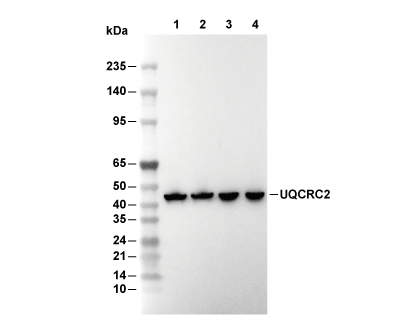 Lane 1: HepG2, Lane 2: Huh7, Lane 3: A172, Lane 4: 293T
Usage Information
| Dilution |
|---|
|
| Application |
|---|
| WB, IP |
| Reactivity |
|---|
| Human, Mouse, Rat |
| Source |
|---|
| Rabbit Monoclonal Antibody |
| Storage Buffer |
|---|
| PBS, pH 7.2+50% Glycerol+0.05% BSA+0.01% NaN3 |
| Storage (from the date of receipt) |
|---|
| -20°C (avoid freeze-thaw cycles), 2 years |
| Predicted MW |
|---|
| 48 kDa |
| Positive Control | Mouse heart; Mouse skeletal muscle; Mouse testis; Mouse placenta; Mouse lung; NCI-H460 cells; MTLn3 cells; H-4-II-E cells; RBL-2H3 cells; RBL-1 cells; NBT-II cells; C6 cells; A-10 cells; KNRK cells; PC-12 cells; Hep G2 cells; NCI-H460 cells; HuH-7 cells; A-172 cells |
|---|---|
| Negative Control |
Experimental Methods
| WB |
|---|
Experimental Protocol:
Sample preparation
1. Tissue: Lyse the tissue sample by adding an appropriate volume of ice-cold RIPA/NP-40 Lysis Buffer (containing Protease Inhibitor Cocktail),and homogenize the tissue at a low temperature. 2. Adherent cell: Aspirate the culture medium and wash the cells with ice-cold PBS twice. Lyse the cells by adding an appropriate volume of RIPA/NP-40 Lysis Buffer (containing Protease Inhibitor Cocktail) and put the sample on ice for 5 min. 3. Suspension cell: Transfer the culture medium to a pre-cooled centrifuge tube. Centrifuge and aspirate the supernatant. Wash the cells with ice-cold PBS twice. Lyse the cells by adding an appropriate volume of RIPA/NP-40 Lysis Buffer (containing Protease Inhibitor Cocktail) and put the sample on ice for 5 min. 4. Place the lysate into a pre-cooled microcentrifuge tube. Centrifuge at 4°C for 15 min. Collect the supernatant;
5. Remove a small volume of lysate to determine the protein concentration;
6. Combine the lysate with protein loading buffer. Boil 20 µL sample under 95-100°C for 5 min. Centrifuge for 5 min after cool down on ice.
Electrophoretic separation
1. According to the concentration of extracted protein, load appropriate amount of protein sample and marker onto SDS-PAGE gels for electrophoresis. Recommended separating gel (lower gel) concentration: 10%. Reference Table for Selecting SDS-PAGE Separation Gel Concentrations 2. Power up 80V for 30 minutes. Then the power supply is adjusted (110 V~150 V), the Marker is observed, and the electrophoresis can be stopped when the indicator band of the predyed protein Marker where the protein is located is properly separated. (Note that the current should not be too large when electrophoresis, too large current (more than 150 mA) will cause the temperature to rise, affecting the result of running glue. If high currents cannot be avoided, an ice bath can be used to cool the bath.)
Transfer membrane
1. Take out the converter, soak the clip and consumables in the pre-cooled converter;
2. Activate PVDF membrane with methanol for 1 min and rinse with transfer buffer;
3. Install it in the order of "black edge of clip - sponge - filter paper - filter paper - glue -PVDF membrane - filter paper - filter paper - sponge - white edge of clip"; 4. The protein was electrotransferred to PVDF membrane. ( 0.45 µm PVDF membrane is recommended ) Reference Table for Selecting PVDF Membrane Pore Size Specifications Recommended conditions for wet transfer: 200 mA, 120 min. ( Note that the transfer conditions can be adjusted according to the protein size. For high-molecular-weight proteins, a higher current and longer transfer time are recommended. However, ensure that the transfer tank remains at a low temperature to prevent gel melting.)
Block
1. After electrotransfer, wash the film with TBST at room temperature for 5 minutes;
2. Incubate the film in the blocking solution for 1 hour at room temperature;
3. Wash the film with TBST for 3 times, 5 minutes each time.
Antibody incubation
1. Use 5% skim milk powder to prepare the primary antibody working liquid (recommended dilution ratio for primary antibody 1:1000), gently shake and incubate with the film at 4°C overnight; 2. Wash the film with TBST 3 times, 5 minutes each time;
3. Add the secondary antibody to the blocking solution and incubate with the film gently at room temperature for 1 hour;
4. After incubation, wash the film with TBST 3 times for 5 minutes each time.
Antibody staining
1. Add the prepared ECL luminescent substrate (or select other color developing substrate according to the second antibody) and mix evenly;
2. Incubate with the film for 1 minute, remove excess substrate (keep the film moist), wrap with plastic film, and expose in the imaging system. |
Biological Description
| Specificity |
|---|
| UQCRC2 Antibody [C21D5] detects endogenous levels of total UQCRC2 protein. |
| Subcellular Location |
|---|
| Membrane, Mitochondrion, Mitochondrion inner membrane |
| Uniprot ID |
|---|
| P22695 |
| Clone |
|---|
| C21D5 |
| Synonym(s) |
|---|
| Cytochrome b-c1 complex subunit 2, mitochondrial; Complex III subunit 2; Core protein II; Ubiquinol-cytochrome-c reductase complex core protein 2; UQCRC2 |
| Background |
|---|
| UQCRC2 (ubiquinol‑cytochrome c reductase core protein 2) is a nuclear‑encoded structural subunit of the mitochondrial cytochrome b‑c1 complex (Complex III) that is embedded in the inner mitochondrial membrane and contributes to the assembly, stability, and electron‑transport activity of the ubiquinol‑cytochrome c oxidoreductase complex. Within the electron transport chain, UQCRC2‑containing Complex III transfers electrons from ubiquinol to cytochrome c, coupling this redox reaction to proton translocation across the inner membrane and supporting the electrochemical gradient that drives ATP synthesis and mitochondrial integrity. UQCRC2 expression is transcriptionally regulated by AMP‑activated protein kinase (AMPK) through activation of the transcription factor NFE2L2/NRF2, and this AMPK‑NRF2–UQCRC2 axis enhances UQCRC2 levels and promotes mitophagy, the selective clearance of damaged mitochondria, thereby protecting hepatocytes against alcohol‑induced liver injury. UQCRC2 is downregulated in tumor tissue compared with adjacent non‑carcinoma tissue, and its expression correlates inversely with lymph node metastasis, relapse, and tumor grade; UQCRC2 overexpression suppresses gastric cancer cell proliferation, migration, and invasion in vitro and in vivo, whereas reduction of UQCRC2 by upstream miRNAs such as miR‑370 enhances tumor aggressiveness. |
| References |
|---|
|
Tech Support
Tel: +1-832-582-8158 Ext:3
If you have any other enquiries, please leave a message.

Products are for research use only. Not for human use. We do not sell to patients.
©Copyright 2013 Selleck Chemicals. All Rights Reserved.