
-
 Australia
-
 Austria
-
 Belgium
-
 Brazil
-
 Canada
-
 China
China
-
 Czech Republic
-
 Denmark
-
 Finland
-
 France
-
 Germany
-
 Greece
-
 Hong Kong
-
 Hungary
-
 Iceland
-
 India
India
-
 Ireland
-
 Israel
-
 Italy
Italy
-
 Japan
Japan
-
 Korea
Korea
-
 Luxembourg
-
 Malaysia
-
 Netherlands
-
 New Zealand
-
 Norway
-
 Poland
-
 Qatar
Qatar
-
 Romania
-
 Saudi Arabia
-
 Singapore
-
 Spain
Spain
-
 Sweden
-
 Switzerland
-
 Taiwan
-
 Turkey
-
 United Kingdom
-
 United States
research use only
SEC61A Antibody [G23E7]
Cat.No.: F8410
Application:
Reactivity:
-
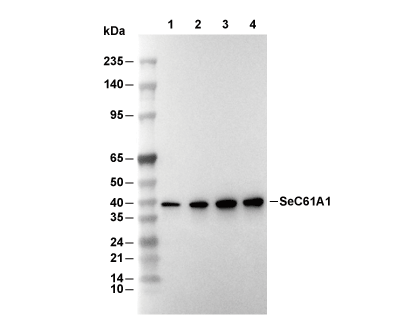 Lane 1: Hela, Lane 2: U-87MG, Lane 3: 3T3, Lane 4: C6
Usage Information
| Dilution |
|---|
|
| Application |
|---|
| WB, IP |
| Reactivity |
|---|
| Human, Mouse, Rat |
| Source |
|---|
| Rabbit Monoclonal Antibody |
| Storage Buffer |
|---|
| PBS, pH 7.2+50% Glycerol+0.05% BSA+0.01% NaN3 |
| Storage (from the date of receipt) |
|---|
| -20°C (avoid freeze-thaw cycles), 2 years |
| Predicted MW Observed MW |
|---|
| 52 kDa 40 kDa |
| *Why do the predicted and actual molecular weights differ? The following reasons may explain differences between the predicted and actual protein molecular weight. Post-translational modifications(e.g., phosphorylation, glycosylation); Splice variants and isoforms; Relative charge; Multimerization. |
| Positive Control | U-87 MG cells; NIH/3T3 cells; C6 cells; HeLa cells |
|---|---|
| Negative Control |
Biological Description
| Specificity |
|---|
| SEC61A Antibody [G23E7] detects endogenous levels of total SEC61A protein. |
| Clone |
|---|
| G23E7 |
| Synonym(s) |
|---|
| HNFJ4; HSEC61; protein transport protein SEC61 alpha subunit; S61A1; SEC61; Sec61 alpha 1 subunit; SEC61 translocon alpha 1 subunit; SEC61A; SEC61A1 |
| Background |
|---|
| SEC61A (Sec61 alpha subunit) constitutes the central pore-forming component of the heterotrimeric Sec61 translocon complex embedded in the endoplasmic reticulum membrane, assembling with Sec61 beta and gamma subunits to mediate cotranslational and post-translational translocation of secretory and membrane proteins across or into the ER membrane. SEC61A adopts a characteristic architecture comprising ten transmembrane helices organized into two pseudo-symmetrical halves connected by a large cytoplasmic loop, with transmembrane helices 2 and 7 forming a lateral gate that opens toward the lipid bilayer to enable insertion of hydrophobic transmembrane segments during membrane protein biogenesis. The protein functions as a gated aqueous pore with an hourglass shape featuring a cytoplasmic funnel, a central constriction formed by a pore ring of hydrophobic residues, and a luminal funnel occluded by a short alpha-helix termed the plug domain that maintains ER membrane impermeability in the idle state. SEC61A mediates ribosome binding through cytoplasmic loops 6/7 and 8/9 that contact ribosomal RNA and ribosomal proteins uL23 and eL29 adjacent to the polypeptide exit tunnel, positioning the translocon directly beneath the translating ribosome to receive nascent polypeptide chains. The protein regulates the GTP hydrolysis cycle of the signal recognition particle (SRP) and SRP receptor during targeting of ribosome-nascent chain complexes to the ER membrane—SEC61A engagement with the signal sequence emerging from the ribosome-bound SRP triggers dissociation of SRP54 from the signal peptide, enabling completion of the GTPase cycle and productive handoff of the ribosome-nascent chain complex from the SRP machinery to the SEC61 channel. Displacement of the plug domain occurs upon signal sequence or nascent transmembrane domain interaction with hydrophobic residues lining the channel interior, opening the translocation pore to permit passage of hydrophilic polypeptide segments into the ER lumen while allowing hydrophobic transmembrane segments to exit laterally through the gate formed between helices 2 and 7 into the lipid bilayer. SEC61A cooperates with auxiliary proteins, including SEC62, SEC63, and the ER-resident Hsp70 chaperone BiP/HSPA5, to mediate post-translational translocation of small presecretory proteins, with BiP providing the driving force for unidirectional translocation through ATP-dependent cycles of substrate binding and release. The translocon associates with the membrane protein TRAM1 to facilitate import of specific classes of nascent proteins, and following initial transmembrane segment insertion by SEC61A, subsequent transmembrane helices of multi-pass membrane proteins become inserted through the multi-pass translocon complex rather than SEC61 itself. SEC61A controls passive calcium leak from the ER lumen to the cytosol when not engaged in active translocation, with BiP and calmodulin binding to SEC61A inhibiting this leak pathway to maintain ER calcium stores essential for protein folding, calcium signaling, and cellular homeostasis. The channel coordinates protein translocation with cotranslational modifications, including N-glycosylation and signal peptide cleavage by recruiting oligosaccharyltransferase complex and signal peptidase to the translocon vicinity, ensuring temporal coupling of translocation with enzymatic processing. SEC61A exhibits essential developmental functions with roles in nephrogenesis, where it localizes to proximal and distal tubules, and expression patterns suggest a ubiquitous requirement across tissues for maintenance of secretory pathway function. Mutations disrupting SEC61A function impair antigen presentation by affecting major histocompatibility complex class I peptide loading and ER-associated degradation pathways that eliminate misfolded proteins, linking SEC61A to immune surveillance mechanisms. The protein participates in quality control by enabling retrograde translocation of terminally misfolded proteins from the ER lumen back to the cytosol for proteasomal degradation, functioning bidirectionally to both import nascent proteins and export defective polypeptides. |
| References |
|---|
|
Tech Support
Tel: +1-832-582-8158 Ext:3
If you have any other enquiries, please leave a message.

Products are for research use only. Not for human use. We do not sell to patients.
©Copyright 2013 Selleck Chemicals. All Rights Reserved.