
-
 Argentina
-
 Australia
-
 Austria
-
 Belgium
-
 Brazil
-
 Canada
-
 China
China
-
 Czech Republic
-
 Denmark
-
 Finland
-
 France
-
 Germany
-
 Greece
-
 Hong Kong
-
 Hungary
-
 Iceland
-
 India
India
-
 Ireland
-
 Israel
-
 Italy
Italy
-
 Japan
Japan
-
 Korea
Korea
-
 Luxembourg
-
 Malaysia
-
 Netherlands
-
 New Zealand
-
 Norway
-
 Poland
-
 Portugal
-
 Qatar
Qatar
-
 Romania
-
 Saudi Arabia
-
 Singapore
-
 Spain
Spain
-
 Sweden
-
 Switzerland
-
 Taiwan
-
 Turkey
-
 United Kingdom
-
 United States
research use only
EphA3/A4/A5 Antibody (Rabbit mAb) [A18J10]
CatNo: F8255
-
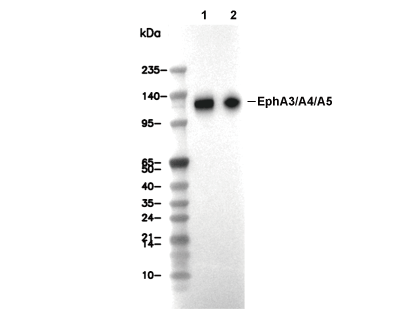 Lane 1: MOLT-4, Lane 2: NIH/3T3
Experiment Essentials
Recommended SDS-PAGE separating gel concentration: 5%.
Usage Information
| Dilution |
|---|
|
| Application |
|---|
| WB, IP |
| Reactivity |
|---|
| Human, Mouse |
| Source |
|---|
| Rabbit Monoclonal Antibody |
| Storage Buffer |
|---|
| PBS, pH 7.2+50% Glycerol+0.05% BSA+0.01% NaN3 |
| Storage (from the date of receipt) |
|---|
| -20°C (avoid freeze-thaw cycles), 2 years |
| Predicted MW Observed MW |
|---|
| 115 kDa 135 kDa |
| *Why do the predicted and actual molecular weights differ? The following reasons may explain differences between the predicted and actual protein molecular weight. Post-translational modifications(e.g., phosphorylation, glycosylation); Splice variants and isoforms; Relative charge; Multimerization. |
| Positive Control | SNB19 cells; MOLT-4 cells; mIMCD-3 cells; NIH/3T3 cells |
|---|---|
| Negative Control |
Experimental Methods
| WB |
|---|
Experimental Protocol:
Sample preparation
1. Tissue: Lyse the tissue sample by adding an appropriate volume of ice-cold RIPA/NP-40 Lysis Buffer (containing Protease Inhibitor Cocktail),and homogenize the tissue at a low temperature or lyse it by sonication on ice, then incubate on ice for 30 minutes. 2. Adherent cell: Aspirate the culture medium and wash the cells with ice-cold PBS twice. Lyse the cells by adding an appropriate volume of RIPA/NP-40 Lysis Buffer (containing Protease Inhibitor Cocktail), sonicate to lyse the cells, and incubate on ice for 30 minutes. 3. Suspension cell: Transfer the culture medium to a pre-cooled centrifuge tube. Centrifuge and aspirate the supernatant. Wash the cells with ice-cold PBS twice. Lyse the cells by adding an appropriate volume of RIPA/NP-40 Lysis Buffer (containing Protease Inhibitor Cocktail), sonicate to lyse the cells, and incubate on ice for 30 minutes. 4. Place the lysate into a pre-cooled microcentrifuge tube. Centrifuge at 4°C for 15 min. Collect the supernatant;
5. Remove a small volume of lysate to determine the protein concentration;
6. Combine the lysate with protein loading buffer. Boil 20 µL sample under 95-100°C for 5 min. Centrifuge for 5 min after cool down on ice.
Electrophoretic separation
1. According to the concentration of extracted protein, load appropriate amount of protein sample and marker onto SDS-PAGE gels for electrophoresis. Recommended separating gel (lower gel) concentration: 5%. Reference Table for Selecting SDS-PAGE Separation Gel Concentrations 2. Power up 80V for 30 minutes. Then the power supply is adjusted (110 V~150 V), the Marker is observed, and the electrophoresis can be stopped when the indicator band of the predyed protein Marker where the protein is located is properly separated. (Note that the current should not be too large when electrophoresis, too large current (more than 150 mA) will cause the temperature to rise, affecting the result of running glue. If high currents cannot be avoided, an ice bath can be used to cool the bath.)
Transfer membrane
1. Take out the converter, soak the clip and consumables in the pre-cooled converter;
2. Activate PVDF membrane with methanol for 1 min and rinse with transfer buffer;
3. Install it in the order of "black edge of clip - sponge - filter paper - filter paper - glue -PVDF membrane - filter paper - filter paper - sponge - white edge of clip"; 4. The protein was electrotransferred to PVDF membrane. ( 0.45 µm PVDF membrane is recommended ) Reference Table for Selecting PVDF Membrane Pore Size Specifications Recommended conditions for wet transfer: 200 mA, 120 min. ( Note that the transfer conditions can be adjusted according to the protein size. For high-molecular-weight proteins, a higher current and longer transfer time are recommended. However, ensure that the transfer tank remains at a low temperature to prevent gel melting.)
Block
1. After electrotransfer, wash the film with TBST at room temperature for 5 minutes;
2. Incubate the film in the blocking solution for 1 hour at room temperature;
3. Wash the film with TBST for 3 times, 5 minutes each time.
Antibody incubation
1. Use primary antibody dilution buffer to prepare the primary antibody working liquid (recommended dilution ratio for primary antibody 1:1000), gently shake and incubate with the film at 4°C overnight; 2. Wash the film with TBST 3 times, 5 minutes each time;
3. Add the secondary antibody to the blocking solution and incubate with the film gently at room temperature for 1 hour;
4. After incubation, wash the film with TBST 3 times for 5 minutes each time.
Antibody staining
1. Add the prepared ECL luminescent substrate (or select other color developing substrate according to the second antibody) and mix evenly;
2. Incubate with the film for 1 minute, remove excess substrate (keep the film moist), wrap with plastic film, and expose in the imaging system. |
Biological Description
| Specificity |
|---|
EphA3/A4/A5 Antibody (Rabbit mAb) [A18J10] detects endogenous levels of total EphA3, EphA4, and EphA5 proteins. |
| Subcellular Location |
|---|
| Cell membrane, Cell projection, Secreted, Cell junction, Endosome, Postsynaptic cell membrane, Synapse |
| Uniprot ID |
|---|
| P54756; P29320; P54764 |
| Clone |
|---|
| A18J10 |
| Synonym(s) |
|---|
| Brain-specific kinase | BSK | CEK7 | EHK-1 | EHK1 | EK4 | EK7 | EK8 | EPH homology kinase 1 | Eph homology kinase-1 | EPH receptor A3 | EPH receptor A4 | EPH receptor A5 | EPH-like kinase 4 | EPH-like kinase 7 | EPH-like kinase 8 | eph-like tyrosine kinase 1 | EPHA3 | EPHA4 | EPHA5 | ephrin receptor EphA3 | ephrin receptor EphA4 | ephrin receptor EphA5 | Ephrin type-A receptor 3 | Ephrin type-A receptor 4 | Ephrin type-A receptor 5 | epididymis secretory sperm binding protein | ETK | ETK1 | HEK | hEK4 | HEK7 | HEK8 | Human embryo kinase | human embryo kinase 1 | receptor protein-tyrosine kinase HEK7 | receptor protein-tyrosine kinase HEK8 | SEK | testicular tissue protein Li 64 | TYRO1 | TYRO1 protein tyrosine kinase | TYRO4 | TYRO4 protein tyrosine kinase | tyrosine-protein kinase receptor EHK-1 | Tyrosine-protein kinase receptor ETK1 | Tyrosine-protein kinase receptor SEK | Tyrosine-protein kinase TYRO1 | Tyrosine-protein kinase TYRO4 |
| Background |
|---|
EphA3/A4/A5 receptors belong to the Eph family of receptor tyrosine kinases, specifically the EphA subclass that preferentially engages GPI-anchored ephrin-A ligands to orchestrate cell-cell repulsion and topographic mapping during development. These receptors share an extracellular ligand-binding domain, cysteine-rich region, and intracellular kinase domain with SAM and PDZ-binding motifs that recruit adaptors like Nck and Crk for signal propagation. Ligand binding induces receptor clustering and autophosphorylation, activating PI3K-AKT and MAPK/ERK cascades alongside Rho GTPase modulation through ephexin and Vav exchange factors that drive actin cytoskeleton contraction and lamellipodial retraction essential for contact repulsion. EphA3 preferentially pairs with ephrin-A5 through a tilted high-affinity interface where the ephrin G-H loop inserts into the receptor pocket, stabilizing a conformation that enhances kinase activation compared to EphA2 while EphA4 and A5 exhibit overlapping specificities that fine-tune retinotectal projections and callosal axon guidance via graded signaling gradients. Forward signaling suppresses AKT to promote apoptosis and cell cycle arrest in tumor contexts, while somatic mutations in kinase or ligand-binding domains disrupt this tumor-suppressive function, permitting unchecked proliferation and metastasis in lung, colorectal, and breast cancers. EphA3 governs cardiac mesenchyme migration, and EphA4 coordinates hindbrain segmentation alongside vascular patterning through repulsive cues that prevent aberrant tissue fusion. Dysregulation through inactivating mutations correlates with lung cancer progression and angiogenesis in gastric carcinoma, while EphA5 maintains topographic retinal projections. |
| References |
|---|
|
Tech Support
Tel: +1-832-582-8158 Ext:3
If you have any other enquiries, please leave a message.

Products are for research use only. Not for human use. We do not sell to patients.
©Copyright 2013 Selleck Chemicals. All Rights Reserved.