
|
How to Cite 1. For In-Text Citation (Materials & Methods): 2. For Key Resources Table: |
||
|
Toll Free: (877) 796-6397 -- USA and Canada only -- |
Fax: +1-832-582-8590 Orders: +1-832-582-8158 |
Tech Support: +1-832-582-8158 Ext:3 Please provide your Order Number in the email. We strive to reply to |
Biological Description
| Specificity | EphA3/A4/A5 Antibody [A18J10] detects endogenous levels of total EphA3, EphA4, and EphA5 proteins. |
|---|---|
| Background | EphA3/A4/A5 receptors belong to the Eph family of receptor tyrosine kinases, specifically the EphA subclass that preferentially engages GPI-anchored ephrin-A ligands to orchestrate cell-cell repulsion and topographic mapping during development. These receptors share an extracellular ligand-binding domain, cysteine-rich region, and intracellular kinase domain with SAM and PDZ-binding motifs that recruit adaptors like Nck and Crk for signal propagation. Ligand binding induces receptor clustering and autophosphorylation, activating PI3K-AKT and MAPK/ERK cascades alongside Rho GTPase modulation through ephexin and Vav exchange factors that drive actin cytoskeleton contraction and lamellipodial retraction essential for contact repulsion. EphA3 preferentially pairs with ephrin-A5 through a tilted high-affinity interface where the ephrin G-H loop inserts into the receptor pocket, stabilizing a conformation that enhances kinase activation compared to EphA2 while EphA4 and A5 exhibit overlapping specificities that fine-tune retinotectal projections and callosal axon guidance via graded signaling gradients. Forward signaling suppresses AKT to promote apoptosis and cell cycle arrest in tumor contexts, while somatic mutations in kinase or ligand-binding domains disrupt this tumor-suppressive function, permitting unchecked proliferation and metastasis in lung, colorectal, and breast cancers. EphA3 governs cardiac mesenchyme migration, and EphA4 coordinates hindbrain segmentation alongside vascular patterning through repulsive cues that prevent aberrant tissue fusion. Dysregulation through inactivating mutations correlates with lung cancer progression and angiogenesis in gastric carcinoma, while EphA5 maintains topographic retinal projections. |
Usage Information
| Application | WB, IP | Dilution |
|
||||
|---|---|---|---|---|---|---|---|
| Reactivity | Human, Mouse | ||||||
| Source | Rabbit Monoclonal Antibody | MW | 135 kDa | ||||
| Storage Buffer | PBS, pH 7.2+50% Glycerol+0.05% BSA+0.01% NaN3 | Storage (from the date of receipt) |
-20°C (avoid freeze-thaw cycles), 2 years | ||||
References
|
Application Data
WB
Validated by Selleck
-
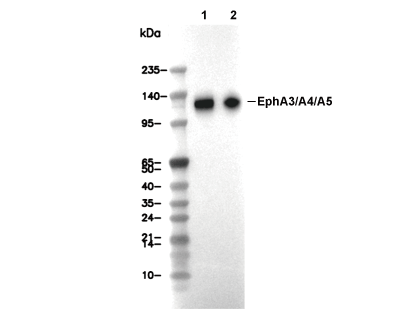 Lane 1: MOLT-4, Lane 2: NIH/3T3