
-
 Australia
-
 Austria
-
 Belgium
-
 Brazil
-
 Canada
-
 China
China
-
 Czech Republic
-
 Denmark
-
 Finland
-
 France
-
 Germany
-
 Greece
-
 Hong Kong
-
 Hungary
-
 Iceland
-
 India
India
-
 Ireland
-
 Israel
-
 Italy
Italy
-
 Japan
Japan
-
 Korea
Korea
-
 Luxembourg
-
 Malaysia
-
 Netherlands
-
 New Zealand
-
 Norway
-
 Poland
-
 Qatar
Qatar
-
 Romania
-
 Saudi Arabia
-
 Singapore
-
 Spain
Spain
-
 Sweden
-
 Switzerland
-
 Taiwan
-
 Turkey
-
 United Kingdom
-
 United States
Proteasome Inhibitors
| Cat.No. | Product Name | Information | Product Use Citations | Product Validations |
|---|---|---|---|---|
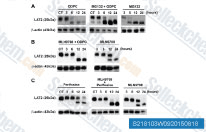
| S2181 | Ixazomib Citrate (MLN9708) Analogue | Ixazomib Citrate (MLN9708) Analogue is the analogue of Ixazomib Citrate (MLN9708) from WO2016165677A1. Ixazomib Citrate (MLN9708) immediately hydrolyzed to Ixazomib (MLN2238), the biologically active form, on exposure to aqueous solutions or plasma. Ixazomib (MLN2238) inhibits the chymotrypsin-like proteolytic (β5) site of the 20S proteasome with IC50/Ki of 3.4 nM/0.93 nM in cell-free assays, less potent to β1 and little activity to β2. Ixazomib (MLN2238) induces autophagy. Phase 3. |
|
|
| S7933 | VR23 | VR23 is a potent proteasome inhibitor with IC50 of 1 nM, 50-100 nM, and 3 μM for trypsin-like proteasomes, chymotrypsin-like proteasomes, and caspase-like proteasomes, respectively. |
|
|
| S7504 | Marizomib (Salinosporamide A) | Marizomib (Salinosporamide A) is a novel marine derived proteasome inhibitor which inhibits CT-L β5, C-L β1, and T-L β2 proteasome activities in human erythrocyte-derived 20S proteasomes with IC50 of 3.5 nM, 430 nM, 28 nM. |
|
|
| S7462 | PI-1840 | PI-1840 is a reversible and selective chymotrypsin-like (CT-L) inhibitor with IC50 of 27 nM with little effects on the other two major proteasome proteolytic activities, trypsin-like (T-L) and postglutamyl-peptide-hydrolysis-like (PGPH-L). |
|
|
| E1214 | KSQ-4279 (USP1-IN-1) | KSQ-4279 (USP1-IN-1) is an orally bioavailable selective inhibitor of the ubiquitin specific protease 1 (USP1) with anti-proliferative activity. KSQ-4279 also exhibits synergistic activity in combination with PARP inhibitors. |
|
|
| S5813 | Isoginkgetin | Isoginkgetin is a naturally derived biflavonoid with anti-tumor activity. This compound directly inhibits the chymotrypsin-like, trypsin-like, and caspase-like activities of the 20S proteasome. It also is a general inhibitor of Pre-mRNA splicing. |
|
|
| S6851 | RA-190 | RA190, a bis-benzylidine piperidon, is a potent, selective and oral effective inhibitor of proteasome ubiquitin receptor RPN13/ADRM1 with anticancer activity. RA190 triggers ER stress response, p53/p21 signaling axis and autophagy in multiple myeloma cells. | ||
| E7414 | MG-115 | MG-115 is a potent and reversible inhibitor of proteasomes with ki of 21 nM and 35 nM for the 20S and 26S proteasomes, respectively. It also induces apoptosis in Rat-1 and PC12 cells by selectively inhibiting the chymotrypsin-like activity of the proteasome. | ||
| S8279 | (±)-Shikonin | (±)-Shikonin, a potent and specific Pyruvate kinase M2 (PKM2) inhibitor, is a major component of zicao (purple gromwell, the dried root of Lithospermum erythrorhizon), a Chinese herbal medicine with various biological activities. It is also an inhibitor of TMEM16A chloride channel activity using cell-based fluorescent-quenching assay. Shikonin exerts an anti-inflammatory effect by inhibiting tumor necrosis factor-α (TNF-α) and prevents activation of nuclear factor-κB (NF-κB) pathway via proteasome inhibition. |
|
|
| S3269 | Acetylcorynoline | Acetylcorynoline, a major alkaloid component derived from Corydalis bungeana which is a traditional Chinese medical herb, shows anti-inflammatory properties. This compound may decrease egl-1 expression to suppress apoptosis pathways and increase rpn5 expression to enhance the activity of proteasomes. |

Products are for research use only. Not for human use. We do not sell to patients.
©Copyright 2013 Selleck Chemicals. All Rights Reserved.