
CAS No. 58-58-2
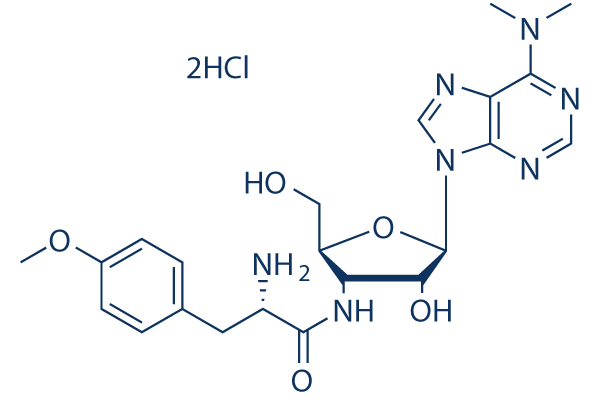
| IUPAC Name | (2S)-2-amino-N-[(2S,3S,4R,5R)-5-[6-(dimethylamino)purin-9-yl]-4-hydroxy-2-(hydroxymethyl)oxolan-3-yl]-3-(4-methoxyphenyl)propanamide;dihydrochloride | |
|---|---|---|
| CAS Number | 58-58-2 | |
| Molecular Formula |
C22H29N7O5.2HCl |
|
| Molecular Weight (MW) | 544.43 | |
| SMILES | CN(C)C1=NC=NC2=C1N=CN2C3C(C(C(O3)CO)NC(=O)C(CC4=CC=C(C=C4)OC)N)O.Cl.Cl | |
| InChIKey | MKSVFGKWZLUTTO-FZFAUISWSA-N |
Puromycin Dihydrochloride is an aminonucleoside antibiotic derived from Streptomyces alboniger that functions as a broad-spectrum inhibitor of protein synthesis. It acts as a structural analog of the 3' end of aminoacyl-tRNA, incorporating into the C-terminus of elongating nascent polypeptide chains to cause premature translation termination. This disruption of ribosomal translation prevents polypeptide elongation and inhibits cellular growth in prokaryotic and eukaryotic systems.
|
Concentration
Volume
Mass
|
|---|
| Solvent | Solubility & Note |
|---|---|
| DMSO |
100 mg/mL
(183.67 mM)
(Moisture-contaminated DMSO may reduce solubility. Use fresh, anhydrous DMSO. The recommended stock concentration is 10 mM in DMSO.) |
| Water | 100 mg/mL |
| Ethanol | Insoluble |
| Water | 100 mg/mL |
| DMSO |
14 mg/mL
(25.71 mM)
(Moisture-contaminated DMSO may reduce solubility. Use fresh, anhydrous DMSO. The recommended stock concentration is 10 mM in DMSO.) |
| Ethanol | Insoluble |
| DMSO |
100 mg/mL
(183.67 mM)
(Moisture-contaminated DMSO may reduce solubility. Use fresh, anhydrous DMSO. The recommended stock concentration is 10 mM in DMSO.) |
| Water | 100 mg/mL |
| Ethanol | Insoluble |
| DMSO |
100 mg/mL
(183.67 mM)
(Moisture-contaminated DMSO may reduce solubility. Use fresh, anhydrous DMSO. The recommended stock concentration is 10 mM in DMSO.) |
| Water | 100 mg/mL |
| Ethanol | Insoluble |
| DMSO |
100 mg/mL
(183.67 mM)
(Moisture-contaminated DMSO may reduce solubility. Use fresh, anhydrous DMSO. The recommended stock concentration is 10 mM in DMSO.) |
| Water | 100 mg/mL |
| Ethanol | Insoluble |
- Preheat media/saline to 37°C.
- Mix rapidly (pipette/vortex) upon addition.
- For complex mixes, always add the aqueous phase last.
- Re-dissolve minor precipitates with a 37°C water bath and sonication (≤30 min).

Pre-aliquoted for Longevity: Solid-state aliquots offer significantly longer shelf life compared to stock solutions, ensuring maximum stability for every use.
Looking for a specific aliquot size? Reach out to your local sales representative or contact us at orders@selleckchem.com.
- Puromycin Dihydrochloride Mechanism of Action: Ribosome Inhibition in Mammalian Cell Research
- Puromycin Dihydrochloride Working Concentration | Cell Culture | Treatment
- Puromycin Dihydrochloride Solubility in DMSO
- Puromycin Dihydrochloride Stock Solution
- Puromycin Dihydrochloride Storage
- Puromycin Dihydrochloride Stability
- Puromycin Dihydrochloride Combination Database
- Puromycin Dihydrochloride Molecular Weight
- Puromycin Dihydrochloride SMILES
- Puromycin Dihydrochloride Chemical Structure (2D and 3D)
- Puromycin Dihydrochloride IC50 for Cell-based and Cell-free Assays
- Puromycin Dihydrochloride MedChemExpress (HY-15680)? Try a better option.
- Puromycin Dihydrochloride Sigma (P7255)? Try a better option.
- Puromycin Dihydrochloride Abmole (M3637)? Try a better option.
- Puromycin Dihydrochloride STEMCELL (73342)? Try a better option.
- Puromycin Dihydrochloride Cell Signaling Technology (40939)? Try a better option.
- Puromycin Dihydrochloride SDS|MSDS