
CAS No. 1706522-79-3
Batch:
Purity:99.52
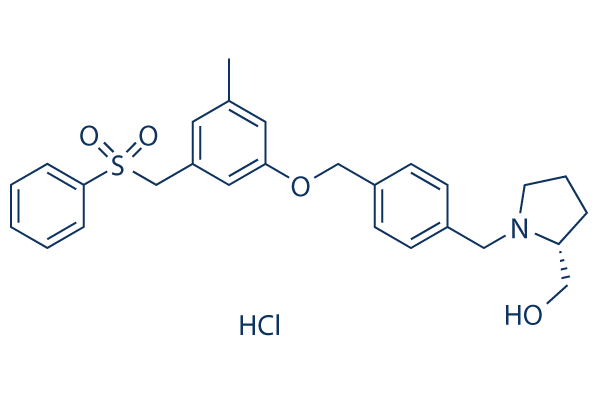
Chemical Structure
Check the
PF-543 hydrochloride
product page for in-depth specifications, including solubility, stock solutions, MOA, and working concentrations.
| IUPAC Name | [(2R)-1-[[4-[[3-(benzenesulfonylmethyl)-5-methylphenoxy]methyl]phenyl]methyl]pyrrolidin-2-yl]methanol;hydrochloride | |
|---|---|---|
| CAS Number | 1706522-79-3 | |
| Molecular Formula |
C27H32ClNO4S |
|
| Molecular Weight (MW) | 502.07 | |
| SMILES | CC1=CC(=CC(=C1)OCC2=CC=C(C=C2)CN3CCCC3CO)CS(=O)(=O)C4=CC=CC=C4.Cl | |
| InChIKey | WNKWAZFYPZMDGJ-VQIWEWKSSA-N |
PF-543 hydrochloride is a potent, sphingosine-competitive inhibitor of sphingosine kinase 1 (SphK1) with an IC50 ofand a Ki of 3.6 nM, exhibiting >100-fold selectivity over the SphK2 isoform. By selectively blocking SphK1 activity, PF-543 suppresses endogenous sphingosine-1-phosphate production, downstream signaling pathways, and cellular proliferation while inducing apoptosis, necrosis, and autophagy in various cell types. [1]
Batch:
All in vitro solubility values are batch-tested experimental data (non-literature values).
| Solvent | Solubility & Note |
|---|---|
| DMSO |
100 mg/mL
(199.17 mM)
(Moisture-contaminated DMSO may reduce solubility. Use fresh, anhydrous DMSO. The recommended stock concentration is 10 mM in DMSO.) |
| Ethanol | 100 mg/mL |
| Water | Insoluble |
| DMSO |
100 mg/mL
(199.17 mM)
(Moisture-contaminated DMSO may reduce solubility. Use fresh, anhydrous DMSO. The recommended stock concentration is 10 mM in DMSO.) |
| Ethanol | 100 mg/mL |
| Water | Insoluble |
| DMSO |
93 mg/mL
(185.23 mM)
(Moisture-contaminated DMSO may reduce solubility. Use fresh, anhydrous DMSO. The recommended stock concentration is 10 mM in DMSO.) |
| Ethanol | 93 mg/mL |
| Water | Insoluble |
| DMSO |
100 mg/mL
(199.17 mM)
(Moisture-contaminated DMSO may reduce solubility. Use fresh, anhydrous DMSO. The recommended stock concentration is 10 mM in DMSO.) |
| Ethanol | 100 mg/mL |
| Water | 12 mg/mL |
Q: Why does a DMSO stock precipitate in media/saline?
A: It is caused by unheated aqueous media (supersaturation), local solvent shock, or incorrect mixing sequence.
How to fix it?
- Preheat media/saline to 37°C.
- Mix rapidly (pipette/vortex) upon addition.
- For complex mixes, always add the aqueous phase last.
- Re-dissolve minor precipitates with a 37°C water bath and sonication (≤30 min).

Pre-aliquoted for Longevity: Solid-state aliquots offer significantly longer shelf life compared to stock solutions, ensuring maximum stability for every use.
Looking for a specific aliquot size? Reach out to your local sales representative or contact us at orders@selleckchem.com.
Note: Technical data last updated: Sep 1, 2026.