
CAS No. 51-35-4
Batch:
Purity:99.64
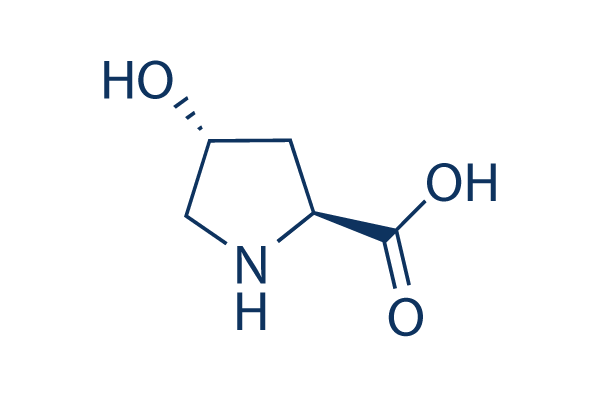
Chemical Structure
Check the
L-Hydroxyproline
product page for in-depth specifications, including solubility, stock solutions, MOA, and working concentrations.
| IUPAC Name | (2S,4R)-4-hydroxypyrrolidine-2-carboxylic acid | |
|---|---|---|
| CAS Number | 51-35-4 | |
| Molecular Formula |
C5H9NO3 |
|
| Molecular Weight (MW) | 131.13 | |
| SMILES | C1C(CNC1C(=O)O)O | |
| InChIKey | PMMYEEVYMWASQN-DMTCNVIQSA-N |
L-Hydroxyproline (trans-4-Hydroxy-L-proline) is a collagen-specific amino acid derivative that serves as a major structural constituent of collagen. Post-translational hydroxylation of proline residues stabilizes the collagen triple helix, maintaining extracellular matrix integrity. Free hydroxyproline released during matrix breakdown functions as an indicator of collagen metabolism, reflecting dynamic remodeling in tissues such as bone and liver during pathophysiological processes.
|
Concentration
Volume
Mass
|
|---|
Batch:
All in vitro solubility values are batch-tested experimental data (non-literature values).
| Solvent | Solubility & Note |
|---|---|
| Water | 26 mg/mL |
| DMSO |
Insoluble
(Moisture-contaminated DMSO may reduce solubility. Use fresh, anhydrous DMSO.) |
| Ethanol | Insoluble |
Q: Why does a DMSO stock precipitate in media/saline?
A: It is caused by unheated aqueous media (supersaturation), local solvent shock, or incorrect mixing sequence.
How to fix it?
- Preheat media/saline to 37°C.
- Mix rapidly (pipette/vortex) upon addition.
- For complex mixes, always add the aqueous phase last.
- Re-dissolve minor precipitates with a 37°C water bath and sonication (≤30 min).
Note: Technical data last updated: Sep 1, 2026.