
CAS No. 93106-59-3
Batch:
Purity:99.99
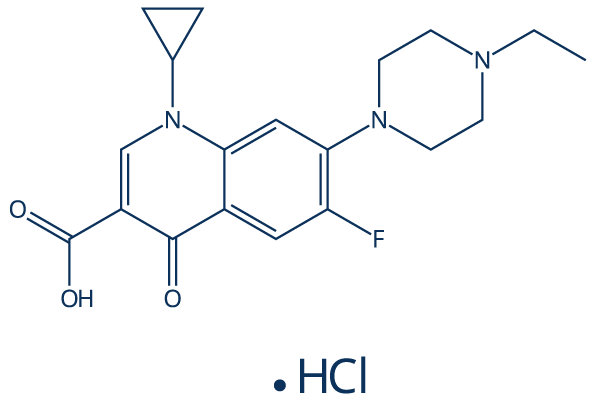
Chemical Structure
Check the
Enrofloxacin hydrochloride
product page for in-depth specifications, including solubility, stock solutions, MOA, and working concentrations.
Chemical Information
| IUPAC Name | 1-cyclopropyl-7-(4-ethylpiperazin-1-yl)-6-fluoro-4-oxoquinoline-3-carboxylic acid;hydrochloride | |
|---|---|---|
| CAS Number | 93106-59-3 | |
| Molecular Formula |
C19H22FN3O3.ClH |
|
| Molecular Weight (MW) | 395.86 | |
| InChIKey | PZJWYUDBXNNVLZ-UHFFFAOYSA-N |
Biological Activity
Enrofloxacin hydrochloride is a fluoroquinolone antibiotic with potent antibacterial activity against Mycoplasma bovis, exhibiting a minimum inhibitory concentration (MIC90) of 0.312 μg/mL. It acts by targeting bacterial DNA gyrase and topoisomerase IV, thereby inhibiting DNA replication and transcription. This broad-spectrum antibacterial activity makes it a key agent in research models evaluating bovine respiratory and systemic diseases, including pneumonia, mastitis, and arthritis. [1]
How to Prepare Stock Solution?
|
Concentration
Volume
Mass
|
|---|
Solubility
Batch:
All in vitro solubility values are batch-tested experimental data (non-literature values).
| Solvent | Solubility & Note |
|---|---|
| Water | 4 mg/mL |
| DMSO |
Insoluble
(Moisture-contaminated DMSO may reduce solubility. Use fresh, anhydrous DMSO.) |
| Ethanol | Insoluble |
Q: Why does a DMSO stock precipitate in media/saline?
A: It is caused by unheated aqueous media (supersaturation), local solvent shock, or incorrect mixing sequence.
How to fix it?
- Preheat media/saline to 37°C.
- Mix rapidly (pipette/vortex) upon addition.
- For complex mixes, always add the aqueous phase last.
- Re-dissolve minor precipitates with a 37°C water bath and sonication (≤30 min).
Reference
Jump to
Note: Technical data last updated: Sep 1, 2026.