
SMILES:
C1CCN(CC1)CCOC2=CC=CC(=C2)C3=NNC4=C3C=C(C=C4)C5=NC=NN5.Cl
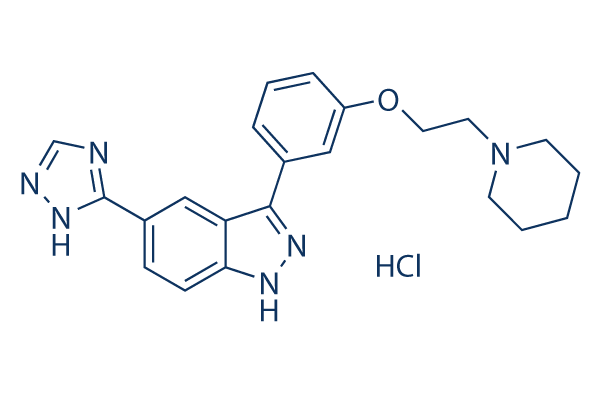
Chemical Structure
Check the
CC-401 Hydrochloride
product page for in-depth specifications, including solubility, stock solutions, MOA, and working concentrations.
| IUPAC Name | 3-[3-(2-piperidin-1-ylethoxy)phenyl]-5-(1H-1,2,4-triazol-5-yl)-1H-indazole;hydrochloride | |
|---|---|---|
| CAS Number | 1438391-30-0 | |
| Molecular Formula |
C22H25ClN6O |
|
| Molecular Weight (MW) | 424.93 | |
| SMILES | C1CCN(CC1)CCOC2=CC=CC(=C2)C3=NNC4=C3C=C(C=C4)C5=NC=NN5.Cl | |
| InChIKey | OIBVXKYKWOUGAO-UHFFFAOYSA-N |
|
Concentration
Volume
Mass
|
|---|
Batch:
All in vitro solubility values are batch-tested experimental data (non-literature values).
| Solvent | Solubility & Note |
|---|---|
| DMSO |
85 mg/mL
(200.03 mM)
(Moisture-contaminated DMSO may reduce solubility. Use fresh, anhydrous DMSO. The recommended stock concentration is 10 mM in DMSO.) |
| Water | 85 mg/mL |
| Ethanol | 2 mg/mL |
Q: Why does a DMSO stock precipitate in media/saline?
A: It is caused by unheated aqueous media (supersaturation), local solvent shock, or incorrect mixing sequence.
How to fix it?
- Preheat media/saline to 37°C.
- Mix rapidly (pipette/vortex) upon addition.
- For complex mixes, always add the aqueous phase last.
- Re-dissolve minor precipitates with a 37°C water bath and sonication (≤30 min).
Note: Technical data last updated: Sep 1, 2026.