
CAS No. 154947-66-7
Batch:
Purity:99.94
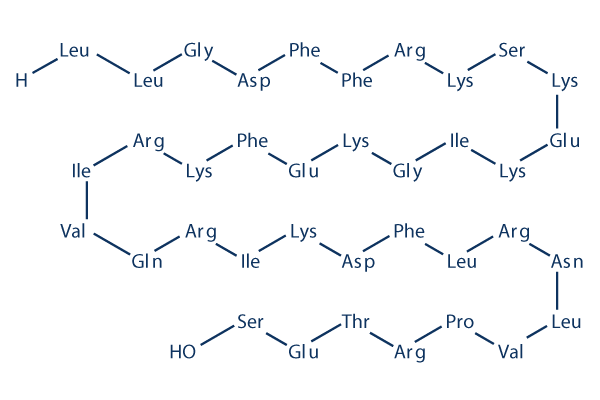
Chemical Structure
Check the
LL37 (Human cathelicidin)
product page for in-depth specifications, including solubility, stock solutions, MOA, and working concentrations.
| IUPAC Name | (4S)-5-[[(2S)-6-amino-1-[[(2S,3S)-1-[[2-[[(2S)-6-amino-1-[[(2S)-1-[[(2S)-1-[[(2S)-6-amino-1-[[(2S)-1-[[(2S,3S)-1-[[(2S)-1-[[(2S)-5-amino-1-[[(2S)-1-[[(2S,3S)-1-[[(2S)-6-amino-1-[[(2S)-1-[[(2S)-1-[[(2S)-1-[[(2S)-1-[[(2S)-4-amino-1-[[(2S)-1-[[(2S)-1-[(2S)-2-[[(2S)-5-carbamimidamido-1-[[(2S,3R)-1-[[(2S)-4-carboxy-1-[[(1S)-1-carboxy-2-hydroxyethyl]amino]-1-oxobutan-2-yl]amino]-3-hydroxy-1-oxobutan-2-yl]amino]-1-oxopentan-2-yl]carbamoyl]pyrrolidin-1-yl]-3-methyl-1-oxobutan-2-yl]amino]-4-methyl-1-oxopentan-2-yl]amino]-1,4-dioxobutan-2-yl]amino]-5-carbamimidamido-1-oxopentan-2-yl]amino]-4-methyl-1-oxopentan-2-yl]amino]-1-oxo-3-phenylpropan-2-yl]amino]-3-carboxy-1-oxopropan-2-yl]amino]-1-oxohexan-2-yl]amino]-3-methyl-1-oxopentan-2-yl]amino]-5-carbamimidamido-1-oxopentan-2-yl]amino]-1,5-dioxopentan-2-yl]amino]-3-methyl-1-oxobutan-2-yl]amino]-3-methyl-1-oxopentan-2-yl]amino]-5-carbamimidamido-1-oxopentan-2-yl]amino]-1-oxohexan-2-yl]amino]-1-oxo-3-phenylpropan-2-yl]amino]-4-carboxy-1-oxobutan-2-yl]amino]-1-oxohexan-2-yl]amino]-2-oxoethyl]amino]-3-methyl-1-oxopentan-2-yl]amino]-1-oxohexan-2-yl]amino]-4-[[(2S)-6-amino-2-[[(2S)-2-[[(2S)-6-amino-2-[[(2S)-2-[[(2S)-2-[[(2S)-2-[[(2S)-2-[[2-[[(2S)-2-[[(2S)-2-amino-4-methylpentanoyl]amino]-4-methylpentanoyl]amino]acetyl]amino]-3-carboxypropanoyl]amino]-3-phenylpropanoyl]amino]-3-phenylpropanoyl]amino]-5-carbamimidamidopentanoyl]amino]hexanoyl]amino]-3-hydroxypropanoyl]amino]hexanoyl]amino]-5-oxopentanoic acid | |
|---|---|---|
| CAS Number | 154947-66-7 | |
| Molecular Formula |
C205H340N60O53 |
|
| Molecular Weight (MW) | 4493.26 | |
| InChIKey | POIUWJQBRNEFGX-XAMSXPGMSA-N |
LL37 is an amphipathic, cathelicidin-derived antimicrobial peptide that acts as a functional ligand for formyl peptide receptor-like 1 (FPRL1/FPR2). Engagement of FPRL1 by LL37 stimulates intracellular calcium mobilization and activates downstream signaling cascades. This pathway mediates the chemotaxis of human peripheral blood neutrophils and monocytes, thereby modulating innate immune responses and cell migration. [1]
Batch:
All in vitro solubility values are batch-tested experimental data (non-literature values).
| Solvent | Solubility & Note |
|---|---|
| Water | 100 mg/mL |
| Water | 50 mg/mL |
Q: Why does a DMSO stock precipitate in media/saline?
A: It is caused by unheated aqueous media (supersaturation), local solvent shock, or incorrect mixing sequence.
How to fix it?
- Preheat media/saline to 37°C.
- Mix rapidly (pipette/vortex) upon addition.
- For complex mixes, always add the aqueous phase last.
- Re-dissolve minor precipitates with a 37°C water bath and sonication (≤30 min).
- LL37 (Human cathelicidin) Clinical Trials
- LL37 (Human cathelicidin) Solubility in DMSO
- LL37 (Human cathelicidin) Stock Solution
- LL37 (Human cathelicidin) Storage
- LL37 (Human cathelicidin) Stability
- LL37 (Human cathelicidin) Molecular Weight
- LL37 (Human cathelicidin) Chemical Structure (2D and 3D)
- LL37 (Human cathelicidin) SDS|MSDS
Note: Technical data last updated: Sep 1, 2026.