
|
How to Cite 1. For In-Text Citation (Materials & Methods): 2. For Key Resources Table: |
||
|
Toll Free: (877) 796-6397 -- USA and Canada only -- |
Fax: +1-832-582-8590 Orders: +1-832-582-8158 |
Tech Support: +1-832-582-8158 Ext:3 Please provide your Order Number in the email. We strive to reply to |
Technical Data
| Formula | C14H21N3O.2HCl |
||||||
| Molecular Weight | 320.26 | CAS No. | 129830-38-2 | ||||
| Solubility (25°C)* | In vitro | DMSO | 64 mg/mL (199.83 mM) | ||||
| Water | 64 mg/mL (199.83 mM) | ||||||
| Ethanol | Insoluble | ||||||
| In vivo (Add solvents to the product individually and in order) |
|
||||||
|
* <1 mg/ml means slightly soluble or insoluble. * Please note that Selleck tests the solubility of all compounds in-house, and the actual solubility may differ slightly from published values. This is normal and is due to slight batch-to-batch variations. * Room temperature shipping (Stability testing shows this product can be shipped without any cooling measures.) |
|||||||
Preparing Stock Solutions
Biological Activity
| Description | Y-27632 2HCl is a selective ROCK1 and ROCK2 inhibitor with a Ki of 140 nM and 300nM in a cell-free assay, exhibits >200-fold selectivity over other kinases, including PKC, cAMP-dependent protein kinase, MLCK and PAK. | ||||
|---|---|---|---|---|---|
| Targets |
|
||||
| In vitro | Y-27632 2HCl inhibits ROCK-II while displaying little activity against PKC, cAMP-dependent protein kinase and myosin light-chain kinase (MLCK) with Ki of 26 μM, 25 μM and > 250 μM, respectively, as well as PKA activated by another Rho-family GTPase member, Cdc42. This compound inhibits smooth-muscle contraction induces by various agonists including phenylephrine, histamine, acetylcholine, serotonin, endothelin, and thromboxane with IC50 of 0.3-1 μM, by selectively inhibiting Ca2+ sensitization. It suppresses Rho-induced, p160ROCK-mediated formation of stress fibres in cultured cells. This chemical treatment blocks both Rho-mediated activation of actomyosin and LPA-stimulated invasive activity of MM1 cells in a concentration-dependent manner. This compound treatment is not only sufficient to initiate formation of exuberant axonal processes but also facilitates axonal maturation during the very early stages of axonogenesis, while largely sparing axon elongation. In human embryonic stem (hES) cells, this chemical treatment at 10 μM markedly diminishes dissociation-induced apoptosis even in serum-free suspension (SFEB) culture, increases cloning efficiency (from ~1% to ~27%), facilitates subcloning after gene transfer, and enables SFEB-cultured hES cells to survive and differentiate into Bf1+ cortical and basal telencephalic progenitors. |
||||
| In vivo | Oral administration of Y-27632 2HCl at 30 mg/kg significantly decreases the blood pressure in a dose-dependent manner in spontaneous hypertensive rats, renal hypertensive rats, as well as deoxycorticosterone acetate (DOCA)-salt hypertensive rats. When this compound is continuously administered at a rate of 0.55 μL per hour by implanted pumps for 11 days tumor cell invasion (MM1 cells expressing Val14-RhoA in rats) is significantly delayed. By inhibiting ROCK, this chemical treatment attenuates hypoxia-induced angiogenesis and vascular remodeling in the pulmonary circulation. Pretreatment with this compound has a protective effect against tumor formation in albino mice with Ehrlich ascites carcinoma. |
Protocol (from reference)
| Kinase Assay: |
|
|---|---|
| Cell Assay: |
|
| Animal Study: |
|
References
|
Customer Product Validation
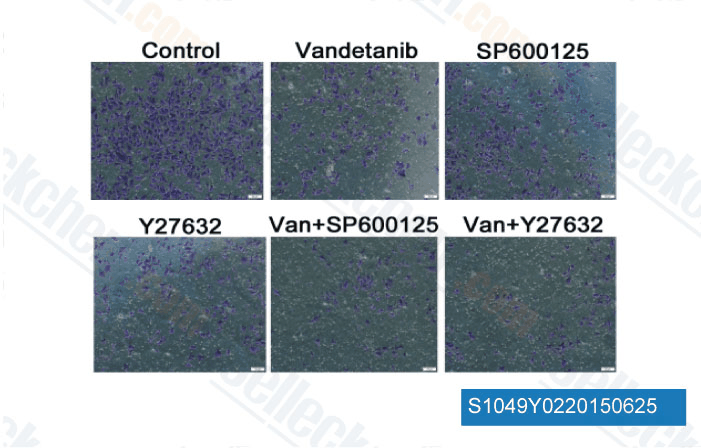
-
Data from [ Mol Neurobiol , 2015 , 10.1007/s12035-014-9084-z ]
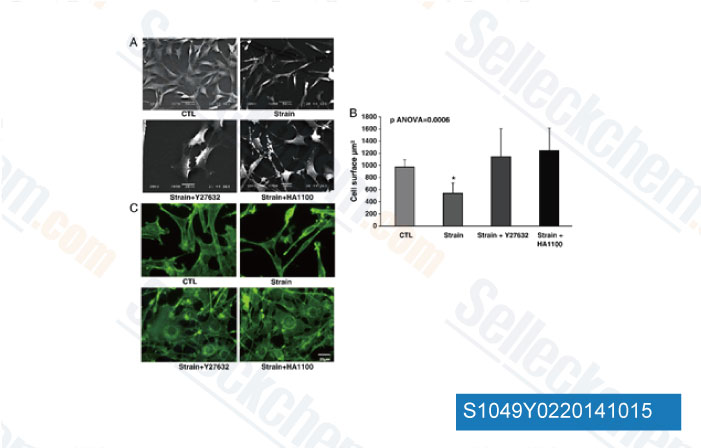
-
Data from [ J Mol Cell Cardiol , 2014 , 67, 49-59 ]
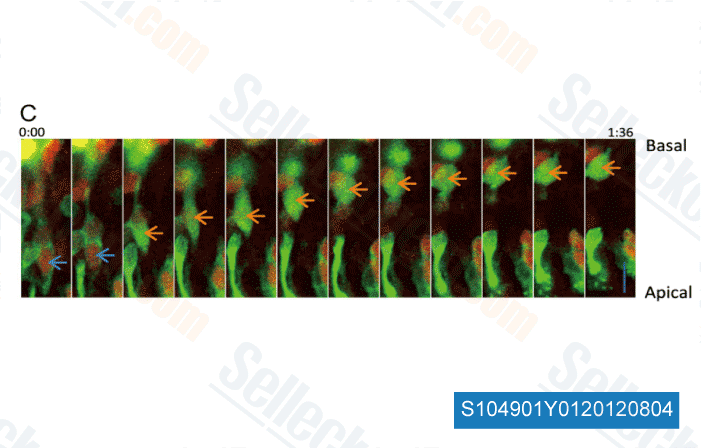
-
Data from [ Dev Biol , 2012 , 370, 33-41 ]
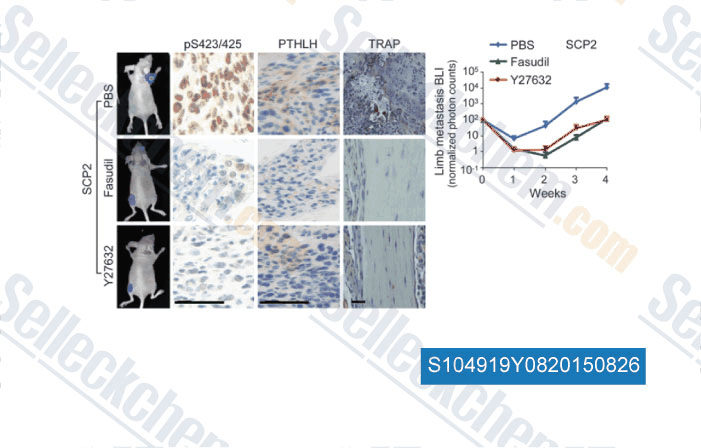
-
Data from [ , , J Clin Invest, 2014, 124(4): 1646-59 ]
Selleck's Y-27632 Dihydrochloride Has Been Cited by 1502 Publications
| A single small molecule-based human embryo model reveals V-ATPase requirement in mammalian blastocyst cavitation [ Cell Res, 2026, 36(7):475-498] | PubMed: 41936702 |
| Human pluripotent stem cell-derived atrioventricular node-like pacemaker cells exhibit biological conduction bridge properties [ Cell Stem Cell, 2026, 33(4):571-588.e13] | PubMed: 41875893 |
| Mosaic gastruloids reveal a temporal restriction for developmental cell competition [ Nat Cell Biol, 2026, 10.1038/s41556-026-01923-x] | PubMed: 41922518 |
| Epitranscriptomic regulation of mRNA stability in pivotal transcription factors modulates the second cell fate decision [ Nat Commun, 2026, 17(1):5800] | PubMed: 42045194 |
| A dual-pronged host-directed therapeutic targeting cyclophilin A and pathogenic interferon response abrogates virus-triggered pregnancy pathologies [ Nat Commun, 2026, 17(1)6990] | PubMed: 42215434 |
| Disrupting pegRNA intramolecular complementarity via PBS and spacer sequence alterations can enhance prime editing efficiency [ Nucleic Acids Res, 2026, 54(7)gkag292] | PubMed: 42011779 |
| Patient-derived kidney organoids recapitulate ADPKD and facilitate the identification of Rho pathway inhibitors as candidate therapeutics [ Cell Rep Med, 2026, 7(4):102720] | PubMed: 41946363 |
| Endogenous retroviral elements LTR8B and MER65 rewire PSG9 regulation to control trophoblast syncytialization and pre-eclampsia risk [ Genome Biol, 2026, 27(1)73] | PubMed: 41796334 |
| RBM15 drives bladder cancer progression through YTHDF2-dependent m6A-mediated regulation of ZO2 [ J Exp Clin Cancer Res, 2026, 10.1186/s13046-026-03684-9] | PubMed: 41913267 |
| Modified hTERT treatment ameliorates pressure overload-induced heart failure [ EBioMedicine, 2026, 126:106203] | PubMed: 41806656 |
RETURN POLICY
Selleck Chemical’s Unconditional Return Policy ensures a smooth online shopping experience for our customers. If you are in any way unsatisfied with your purchase, you may return any item(s) within 7 days of receiving it. In the event of product quality issues, either protocol related or product related problems, you may return any item(s) within 365 days from the original purchase date. Please follow the instructions below when returning products.
SHIPPING AND STORAGE
Selleck products are transported at room temperature. If you receive the product at room temperature, please rest assured, the Selleck Quality Inspection Department has conducted experiments to verify that the normal temperature placement of one month will not affect the biological activity of powder products. After collecting, please store the product according to the requirements described in the datasheet. Most Selleck products are stable under the recommended conditions.
NOT FOR HUMAN, VETERINARY DIAGNOSTIC OR THERAPEUTIC USE.
- Y-27632 Dihydrochloride Mechanism of Action: ROCK Inhibition in Pluripotent Stem Cell Research
- Y-27632 Dihydrochloride Clinical Trials
- Y-27632 Dihydrochloride Working Concentration | Cell Culture | Treatment
- Y-27632 Dihydrochloride Solubility in DMSO
- Y-27632 Dihydrochloride Stock Solution
- Y-27632 Dihydrochloride Storage
- Y-27632 Dihydrochloride Stability
- Y-27632 Dihydrochloride VS KD025 (Belumosudil) | Netarsudil (AR-13324) 2HCl
- Y-27632 Dihydrochloride Molecular Weight
- Y-27632 Dihydrochloride SMILES
- Y-27632 Dihydrochloride CAS Number
- Y-27632 Dihydrochloride Chemical Structure (2D and 3D)
- Y-27632 Dihydrochloride IC50 for Cell-based and Cell-free Assays
- Y-27632 Dihydrochloride Sigma (Y0503)? Try a better option.
- Y-27632 Dihydrochloride MedChemExpress (HY-10583)? Try a better option.
- Y-27632 Dihydrochloride Tocris (1254)? Try a better option.
- Y-27632 Dihydrochloride STEM CELL (72307)? Try a better option.
- Y-27632 Dihydrochloride Cayman (10005583)? Try a better option.
- Y-27632 Dihydrochloride SDS|MSDS