
-
 Australia
-
 Austria
-
 Belgium
-
 Brazil
-
 Canada
-
 China
China
-
 Czech Republic
-
 Denmark
-
 Finland
-
 France
-
 Germany
-
 Greece
-
 Hong Kong
-
 Hungary
-
 Iceland
-
 India
India
-
 Ireland
-
 Israel
-
 Italy
Italy
-
 Japan
Japan
-
 Korea
Korea
-
 Luxembourg
-
 Malaysia
-
 Netherlands
-
 New Zealand
-
 Norway
-
 Poland
-
 Qatar
Qatar
-
 Romania
-
 Saudi Arabia
-
 Singapore
-
 Spain
Spain
-
 Sweden
-
 Switzerland
-
 Taiwan
-
 Turkey
-
 United Kingdom
-
 United States
research use only
UNC5B Antibody [H5N21]
Cat.No.: F3976
Application:
Reactivity:
-
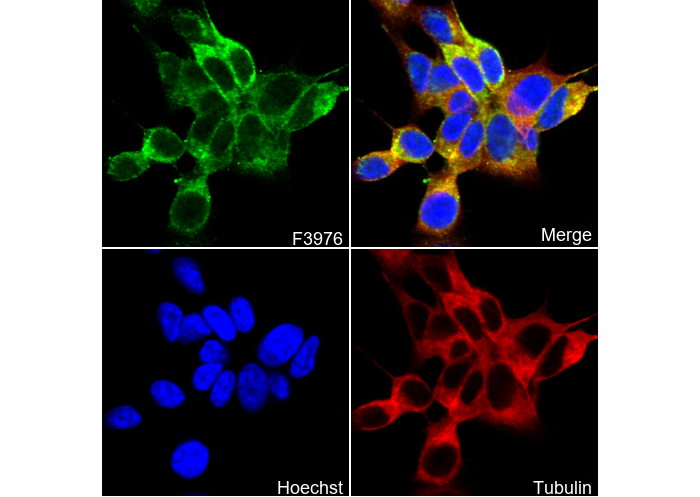 Immunofluorescent analysis of SH-SY5Y cells using F3976 (green, 1:200), Hoechst (blue) and tubulin (Red).
Usage Information
| Dilution |
|---|
|
| Application |
|---|
| IF |
| Reactivity |
|---|
| Human |
| Source |
|---|
| Mouse Monoclonal Antibody |
| Storage Buffer |
|---|
| PBS, pH 7.2+50% Glycerol+0.05% BSA+0.01% NaN3 |
| Storage (from the date of receipt) |
|---|
| -20°C (avoid freeze-thaw cycles), 2 years |
| Positive Control | SHSY5Y cells |
|---|---|
| Negative Control |
Experimental Methods
| IF |
|---|
Experimental Protocol:
Sample Preparation
1. Adherent Cells: Place a clean, sterile coverslip in a culture dish. Once the cells grow to near confluence as a monolayer, remove the coverslip for further use.
2. Suspension Cells: Seed the cells onto a clean, sterile slide coated with poly-L-lysine.
3. Frozen Sections: Allow the slide to thaw at room temperature. Wash it with pure water or PBS for 2 times, 3 minutes each time.
4. Paraffin Sections: Deparaffinization and rehydration. Wash the slide with pure water or PBS for 3 times, 3 minutes each time. Then perform antigen retrieval.
Fixation
1. Fix the cell coverslips/spots or tissue sections at room temperature using a fixative such as 4% paraformaldehyde (4% PFA) for 10-15 minutes.
2. Wash the sample with PBS for 3 times, 3 minutes each time.
Permeabilization
1.Add a detergent such as 0.1–0.3% Triton X-100 to the sample and incubate at room temperature for 10–20 minutes.
(Note: This step is only required for intracellular antigens. For antigens expressed on the cell membrane, this step is unnecessary.)
Wash the sample with PBS for 3 times, 3 minutes each time.
Blocking
Add blocking solution and incubate at room temperature for at least 1 hour. (Common blocking solutions include: serum from the same source as the secondary antibody, BSA, or goat serum.)
Note: Ensure the sample remains moist during and after the blocking step to prevent drying, which can lead to high background.
Immunofluorescence Staining (Day 1)
1. Remove the blocking solution and add the diluted primary antibody.
2. Incubate the sample in a humidified chamber at 4°C overnight.
Immunofluorescence Staining (Day 2)
1. Remove the primary antibody and wash with PBST for 3 times, 5 minutes each time.
2. Add the diluted fluorescent secondary antibody and incubate in the dark at 4°C for 1–2 hours.
3. Remove the secondary antibody and wash with PBST for 3 times, 5 minutes each time.
4. Add diluted DAPI and incubate at room temperature in the dark for 5–10 minutes.
5. Wash with PBST for 3 times, 5 minutes each time.
Mounting
1. Mount the sample with an anti-fade mounting medium.
2. Allow the slide to dry at room temperature overnight in the dark.
3. Store the slide in a slide storage box at 4°C, protected from light.
|
Biological Description
| Specificity |
|---|
| UNC5B Antibody [H5N21] detects endogenous levels of total UNC5B protein. |
| Subcellular Location |
|---|
| Cell membrane, Membrane |
| Uniprot ID |
|---|
| Q8IZJ1 |
| Clone |
|---|
| H5N21 |
| Synonym(s) |
|---|
| P53RDL1; UNC5H2; UNQ1883/PRO4326; UNC5B; Netrin receptor UNC5B; Protein unc-5 homolog 2; Protein unc-5 homolog B; p53-regulated receptor for death and life protein 1; P53rdl1 |
| Background |
|---|
| UNC5B, a dependence receptor of the UNC5 family involved in netrin-1-mediated repulsion during axon guidance and vascular development, is characterized by two extracellular Ig-like domains (Ig1–2) and two thrombospondin type 1 repeats (TSP1) that mediate netrin-1 binding, a process further enhanced by heparan sulfates. It possesses a single transmembrane helix and a cytoplasmic region containing ZU5, UPA, and death domains (DD), where caspase-3 cleaves at DLVD↓N (Asp931) to release the pro-apoptotic intracellular domain (ICD), with residues such as Phe601 in UPA stabilizing the autoinhibited, closed conformation. In the absence of netrin-1, UNC5B homodimers adopt an open cytosolic state in which the DD recruits DAPK1 following its dephosphorylation at Ser308, activating the kinase and stimulating p53/Bax/caspase-9-dependent apoptosis; simultaneously, UNC5B-DCC heterodimers expose DCC’s P1 domain, leading to repulsive signaling via Rac1/Cdc42 inhibition and PAK/LIMK/cofilin-mediated collapse of F-actin protrusions, thereby pruning excessive axons or vascular tip cell filopodia. Upon netrin-1 binding, closed ZU5-UPA interactions are stabilized, blocking DAPK1 access and shifting signaling to pro-angiogenic PI3K/Akt survival pathways alongside continued repulsive cytoskeletal modulation. Predominantly expressed in endothelial and neuronal tissues, UNC5B-mediated pruning is essential for central and peripheral nervous system circuit refinement and vascular patterning, while the splice isoform UNC5B-Δ8 (generated by NOVA2-mediated exon 8 skipping) promotes constitutive, netrin-1-insensitive apoptosis to ensure tip cell competition. Epigenetic silencing or oncogenic mutations of UNC5B, frequent in colorectal cancer, disrupt the balance between repulsion and survival, fueling tumor angiogenesis, metastasis, and poor prognosis. |
| References |
|---|
|
Tech Support
Tel: +1-832-582-8158 Ext:3
If you have any other enquiries, please leave a message.

Products are for research use only. Not for human use. We do not sell to patients.
©Copyright 2013 Selleck Chemicals. All Rights Reserved.