
-
 Australia
-
 Austria
-
 Belgium
-
 Brazil
-
 Canada
-
 China
China
-
 Czech Republic
-
 Denmark
-
 Finland
-
 France
-
 Germany
-
 Greece
-
 Hong Kong
-
 Hungary
-
 Iceland
-
 India
India
-
 Ireland
-
 Israel
-
 Italy
Italy
-
 Japan
Japan
-
 Korea
Korea
-
 Luxembourg
-
 Malaysia
-
 Netherlands
-
 New Zealand
-
 Norway
-
 Poland
-
 Qatar
Qatar
-
 Romania
-
 Saudi Arabia
-
 Singapore
-
 Spain
Spain
-
 Sweden
-
 Switzerland
-
 Taiwan
-
 Turkey
-
 United Kingdom
-
 United States
research use only
SNX3 Antibody [J24C14]
Cat.No.: F8332
Application:
Reactivity:
-
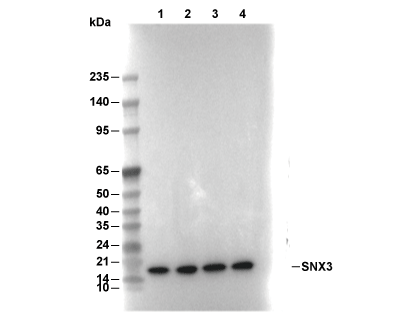 Lane 1: HeLa, Lane 2: NIH/3T3, Lane 3: Neuro-2a, Lane 4: THP-1
Usage Information
| Dilution |
|---|
|
| Application |
|---|
| WB, IF, FCM |
| Reactivity |
|---|
| Human, Mouse |
| Source |
|---|
| Rabbit Monoclonal Antibody |
| Storage Buffer |
|---|
| PBS, pH 7.2+50% Glycerol+0.05% BSA+0.01% NaN3 |
| Storage (from the date of receipt) |
|---|
| -20°C (avoid freeze-thaw cycles), 2 years |
| Predicted MW |
|---|
| 18 kDa |
Biological Description
| Specificity |
|---|
| SNX3 Antibody [J24C14] detects endogenous levels of total SNX3 protein. |
| Clone |
|---|
| J24C14 |
| Synonym(s) |
|---|
| Sorting nexin-3, Protein SDP3, SNX3 |
| Background |
|---|
| Sorting nexin‑3 (SNX3) is a member of the sorting nexin family that localizes to early endosomes and functions as a phosphoinositide‑binding adaptor that couples phosphatidylinositol 3‑phosphate–rich membranes to cargo‑selective machinery governing endosomal sorting and retrograde transport. The protein is built around a single PX domain that mediates high‑affinity binding to phosphatidylinositol 3‑phosphate and anchors SNX3 to early endosomal microdomains without the BAR‑type membrane‑bending elements that characterize other nexins, which places SNX3 in a distinct structural subclass specialized for recognition of specific lipid and protein environments rather than broad tubule formation. Association of SNX3 with early endosomes regulates progression of cargo through the endocytic pathway, as PX‑domain‑dependent binding to phosphatidylinositol 3‑phosphate controls its recruitment and allows SNX3 to influence the balance between sorting toward lysosomal degradation and recycling routes by modulating traffic between early, recycling, and late compartments. A central role emerges in a retromer pathway in which SNX3 interacts directly with the VPS26–VPS29–VPS35 cargo‑selective trimer to form a SNX3–retromer complex that recognizes the Wnt cargo receptor Wntless and sorts it into a dedicated retrograde route from endosomes to the trans‑Golgi network. This SNX3‑dependent pathway operates independently of classical SNX‑BAR retromer nexins and defines an alternative retrieval system that preserves Wntless in the secretory cycle, thereby supporting efficient Wnt loading in the Golgi and sustained secretion of Wnt ligands required for developmental patterning and tissue homeostasis. The positioning of SNX3 at early endosomes also allows it to contribute to multivesicular body dynamics and to the organization of tubular endosomal networks, where it participates in the generation or stabilization of membrane subdomains that serve as platforms for cargo selection and vesicle fission events feeding recycling and retrograde streams. In phagocytic immune cells, recruitment of SNX3 to phagosomes aligns its lipid‑binding specificity with control of phosphatidylinositol 3‑phosphate‑dependent effectors, providing a mechanism for negative regulation of phagocytic uptake and for shaping the composition and maturation state of phagosomal membranes during antigen handling. |
| References |
|---|
|
Tech Support
Tel: +1-832-582-8158 Ext:3
If you have any other enquiries, please leave a message.

Products are for research use only. Not for human use. We do not sell to patients.
©Copyright 2013 Selleck Chemicals. All Rights Reserved.