
-
 Australia
-
 Austria
-
 Belgium
-
 Brazil
-
 Canada
-
 China
China
-
 Czech Republic
-
 Denmark
-
 Finland
-
 France
-
 Germany
-
 Greece
-
 Hong Kong
-
 Hungary
-
 Iceland
-
 India
India
-
 Ireland
-
 Israel
-
 Italy
Italy
-
 Japan
Japan
-
 Korea
Korea
-
 Luxembourg
-
 Malaysia
-
 Netherlands
-
 New Zealand
-
 Norway
-
 Poland
-
 Qatar
Qatar
-
 Romania
-
 Saudi Arabia
-
 Singapore
-
 Spain
Spain
-
 Sweden
-
 Switzerland
-
 Taiwan
-
 Turkey
-
 United Kingdom
-
 United States
research use only
SATB2 Antibody [C16D1]
Cat.No.: F9672
Application:
Reactivity:
-
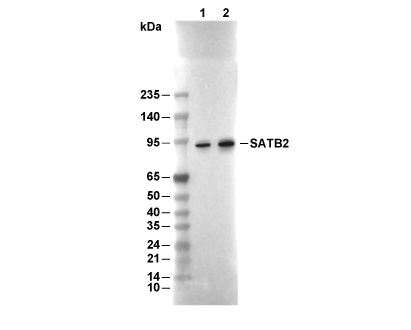 Lane 1: DLD-1, Lane 2: THP-1
Usage Information
| Dilution |
|---|
|
| Application |
|---|
| WB, IP, IHC |
| Reactivity |
|---|
| Human |
| Source |
|---|
| Rabbit Monoclonal Antibody |
| Storage Buffer |
|---|
| PBS, pH 7.2+50% Glycerol+0.05% BSA+0.01% NaN3 |
| Storage (from the date of receipt) |
|---|
| -20°C (avoid freeze-thaw cycles), 2 years |
| Predicted MW |
|---|
| 83 kDa |
| Positive Control | Human colon carcinoma; DLD-1 cells; THP-1 cells |
|---|---|
| Negative Control | Human breast carcinoma; Human lung carcinoma; KARPAS-299 cells; SH-SY5Y cells |
Biological Description
| Specificity |
|---|
| SATB2 Antibody [C16D1] detects endogenous levels of total SATB2 protein. |
| Clone |
|---|
| C16D1 |
| Synonym(s) |
|---|
| DNA-binding protein SATB2; FLJ21474; FLJ32076; GLSS; KIAA1034; MGC119474; MGC119477; SATB family member 2; SATB homeobox 2; SATB2; Special AT-rich sequence-binding protein 2 |
| Background |
|---|
| SATB2 (special AT‑rich sequence‑binding protein 2) is a MAR‑binding nuclear protein of the SATB family that functions as a higher‑order chromatin organizer and transcriptional regulator, integrating long‑range chromatin architecture with gene expression programs governing craniofacial and skeletal development, neocortical projection neuron identity, hematopoietic differentiation, and tumorigenesis. The protein contains two CUT domains and a homeodomain embedded in a low‑complexity N‑terminal region that tether SATB2 to AT‑rich matrix attachment region elements and recruit chromatin modifiers and transcriptional co‑regulators, allowing SATB2 to assemble regulatory hubs that loop distant genomic elements into functional domains and either activate or repress target gene clusters depending on associated cofactors. In osteoblast‑lineage cells of branchial arches and developing bone, SATB2 promotes osteogenic differentiation and craniofacial patterning by repressing posterior Hoxa2 expression and cooperating with osteogenic transcription factors Runx2 and ATF4 to induce bone matrix genes, and its dosage critically influences craniofacial morphogenesis and bone regeneration potential, establishing SATB2 as an osteoinductive factor with translational relevance for bone defect repair. In the developing cerebral cortex, SATB2 is expressed in callosal and subsets of subcerebral projection neurons, where it binds MARs and regulatory regions near Ctip2/Bcl11b and other corticofugal determinants to repress subcortical identity programs and promote callosal projection neuron fate, thereby directing axon targeting across the corpus callosum rather than down corticospinal tracts; conditional deletion reveals additional roles in deep‑layer subcerebral projection neurons, where early transient SATB2 expression is required for corticospinal tract formation, demonstrating layer‑ and time‑dependent control of projection neuron subclass specification and axon pathfinding. Genome‑wide mapping of SATB2 targets in developing cortex identifies more than a thousand downstream effector genes organized into temporally distinct clusters, including axon guidance receptors and ligands such as Plxnd1, Ntng1, Efnb2, Ephb1, Plxna2, and Epha3, as well as synapse‑related genes and the transcription factor Mef2c, placing SATB2 at the apex of regulatory networks that coordinate axonogenesis, synaptogenesis, and synaptic plasticity and linking SATB2 dosage to cognitive and psychiatric phenotypes through enrichment of SATB2‑regulated genes among neurodevelopmental disorder loci. In the adult cortex and hippocampus, SATB2 persists in pyramidal neurons across layers, where it switches interaction partners from predominantly repressive complexes in development to chromatin‑structuring and transcription‑modulating networks in maturity, and SATB2‑interacting gene sets are highly constrained in humans, with rare disruptive variants causing severe cognitive disorders and common variants contributing to general cognitive ability, emphasizing the importance of SATB2‑centered chromatin hubs in human cognition. |
| References |
|---|
|
Tech Support
Tel: +1-832-582-8158 Ext:3
If you have any other enquiries, please leave a message.

Products are for research use only. Not for human use. We do not sell to patients.
©Copyright 2013 Selleck Chemicals. All Rights Reserved.