
-
 Australia
-
 Austria
-
 Belgium
-
 Brazil
-
 Canada
-
 China
China
-
 Czech Republic
-
 Denmark
-
 Finland
-
 France
-
 Germany
-
 Greece
-
 Hong Kong
-
 Hungary
-
 Iceland
-
 India
India
-
 Ireland
-
 Israel
-
 Italy
Italy
-
 Japan
Japan
-
 Korea
Korea
-
 Luxembourg
-
 Malaysia
-
 Netherlands
-
 New Zealand
-
 Norway
-
 Poland
-
 Qatar
Qatar
-
 Romania
-
 Saudi Arabia
-
 Singapore
-
 Spain
Spain
-
 Sweden
-
 Switzerland
-
 Taiwan
-
 Turkey
-
 United Kingdom
-
 United States
research use only
Pyrin Antibody (Rabbit mAb) [L17B15]
CatNo: F2811
Application:
Reactivity:
-
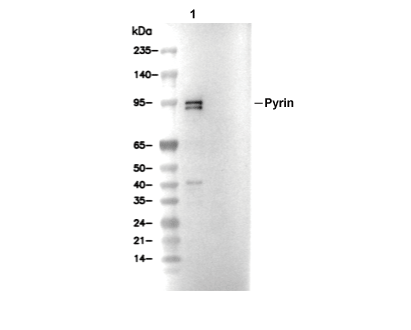 Lane 1: Bone marrow derived-macrophage of WT C57/B6 mice
Experiment Essentials
WB
Exposure time of at least 120s is recommended.
Exposure time of at least 120s is recommended.
Usage Information
| Dilution |
|---|
|
| Application |
|---|
| WB, IP |
| Reactivity |
|---|
| Mouse |
| Source |
|---|
| Rabbit Monoclonal Antibody |
| Storage Buffer |
|---|
| PBS, pH 7.2+50% Glycerol+0.05% BSA+0.01% NaN3 |
| Storage (from the date of receipt) |
|---|
| -20°C (avoid freeze-thaw cycles), 2 years |
| Predicted MW Observed MW |
|---|
| 86 kDa 110 kDa |
| *Why do the predicted and actual molecular weights differ? The following reasons may explain differences between the predicted and actual protein molecular weight. Post-translational modifications(e.g., phosphorylation, glycosylation); Splice variants and isoforms; Relative charge; Multimerization. |
| Positive Control | Bone marrow derived-macrophage of wild type C57/B6 mice (LPS, stimulated); Bone marrow derived-macrophage of wild type C57/B6 mice (TNFα, stimulated); DC2.4 cells |
|---|---|
| Negative Control |
Experimental Methods
| WB |
|---|
Experimental Protocol:
Sample preparation
1. Tissue: Lyse the tissue sample by adding an appropriate volume of ice-cold RIPA/NP-40 Lysis Buffer (containing Protease Inhibitor Cocktail),and homogenize the tissue at a low temperature or lyse it by sonication on ice, then incubate on ice for 30 minutes. 2. Adherent cell: Aspirate the culture medium and wash the cells with ice-cold PBS twice. Lyse the cells by adding an appropriate volume of RIPA/NP-40 Lysis Buffer (containing Protease Inhibitor Cocktail) , sonicate to lyse the cells, and incubate on ice for 30 minutes. 3. Suspension cell: Transfer the culture medium to a pre-cooled centrifuge tube. Centrifuge and aspirate the supernatant. Wash the cells with ice-cold PBS twice. Lyse the cells by adding an appropriate volume of RIPA/NP-40 Lysis Buffer (containing Protease Inhibitor Cocktail) , sonicate to lyse the cells, and incubate on ice for 30 minutes. 4. Place the lysate into a pre-cooled microcentrifuge tube. Centrifuge at 4°C for 15 min. Collect the supernatant;
5. Remove a small volume of lysate to determine the protein concentration;
6. Combine the lysate with protein loading buffer. Boil 20 µL sample under 95-100°C for 5 min. Centrifuge for 5 min after cool down on ice.
Electrophoretic separation
1. According to the concentration of extracted protein, load appropriate amount of protein sample and marker onto SDS-PAGE gels for electrophoresis. Recommended separating gel (lower gel) concentration: 10%. Reference Table for Selecting SDS-PAGE Separation Gel Concentrations 2. Power up 80V for 30 minutes. Then the power supply is adjusted (110 V~150 V), the Marker is observed, and the electrophoresis can be stopped when the indicator band of the predyed protein Marker where the protein is located is properly separated. (Note that the current should not be too large when electrophoresis, too large current (more than 150 mA) will cause the temperature to rise, affecting the result of running glue. If high currents cannot be avoided, an ice bath can be used to cool the bath.)
Transfer membrane
1. Take out the converter, soak the clip and consumables in the pre-cooled converter;
2. Activate PVDF membrane with methanol for 1 min and rinse with transfer buffer;
3. Install it in the order of "black edge of clip - sponge - filter paper - filter paper - glue -PVDF membrane - filter paper - filter paper - sponge - white edge of clip"; 4. The protein was electrotransferred to PVDF membrane. ( 0.45 µm PVDF membrane is recommended ) Reference Table for Selecting PVDF Membrane Pore Size Specifications Recommended conditions for wet transfer: 200 mA, 120 min. ( Note that the transfer conditions can be adjusted according to the protein size. For high-molecular-weight proteins, a higher current and longer transfer time are recommended. However, ensure that the transfer tank remains at a low temperature to prevent gel melting.)
Block
1. After electrotransfer, wash the film with TBST at room temperature for 5 minutes;
2. Incubate the film in the blocking solution for 1 hour at room temperature;
3. Wash the film with TBST for 3 times, 5 minutes each time.
Antibody incubation
1. Use primary antibody dilution buffer to prepare the primary antibody working liquid (recommended dilution ratio for primary antibody 1:1000), gently shake and incubate with the film at 4°C overnight; 2. Wash the film with TBST 3 times, 5 minutes each time;
3. Add the secondary antibody to the blocking solution and incubate with the film gently at room temperature for 1 hour;
4. After incubation, wash the film with TBST 3 times for 5 minutes each time.
Antibody staining
1. Add the prepared ECL luminescent substrate (or select other color developing substrate according to the second antibody) and mix evenly;
2. Incubate with the film for 1 minute, remove excess substrate (keep the film moist), wrap with plastic film, and expose in the imaging system. (Exposure time of at least 120s is recommended) |
Biological Description
| Specificity |
|---|
| Pyrin Antibody (Rabbit mAb) [L17B15] detects endogenous levels of total Pyrin protein. |
| Subcellular Location |
|---|
| Cell projection, Cytoplasm, Cytoplasmic vesicle, Cytoskeleton, Microtubule, Nucleus |
| Uniprot ID |
|---|
| O15553 |
| Clone |
|---|
| L17B15 |
| Synonym(s) |
|---|
| MEF, TRIM20, MEFV, Pyrin, Marenostrin |
| Background |
|---|
| Pyrin is an innate immune sensor encoded by the MEFV gene that belongs to the TRIM family and functions as a cytosolic pattern‑recognition receptor assembling an inflammasome in response to defined disturbances in cytoskeletal and Rho GTPase–dependent homeostasis rather than by directly binding microbial ligands. The protein contains an N‑terminal pyrin domain that mediates homotypic interactions with the adaptor ASC, a central B‑box and coiled‑coil region that support higher‑order assembly and association with cytoskeletal and regulatory partners, and a C‑terminal B30.2/SPRY domain implicated in sensing upstream regulatory changes and in conferring allele‑specific effects on activation threshold. Under resting conditions, RhoA GTPases and their downstream kinases PKN1 and PKN2 phosphorylate pyrin at specific serine residues, creating docking sites for 14‑3‑3 proteins that maintain pyrin in an inactive state, so that intact RhoA signaling keeps the pyrin inflammasome off despite the presence of MEFV. Bacterial toxins and effectors that inactivate RhoA or otherwise disrupt its signaling relieve this repression by preventing pyrin phosphorylation and 14‑3‑3 binding, which permits pyrin oligomerization, ASC recruitment via pyrin–PYD to ASC–PYD interactions, and subsequent recruitment and proximity‑induced activation of pro‑caspase‑1. Activated caspase‑1 cleaves pro–IL‑1β and pro–IL‑18 into their mature forms and processes gasdermin D to drive pyroptotic cell death, thereby coupling detection of pathogen‑induced RhoA inactivation to rapid release of key pro‑inflammatory cytokines and lytic elimination of the infected cell. Pyrin is expressed at high levels in neutrophils, monocytes, and macrophages and contributes to host defense against pathogens that target Rho GTPases, with pyrin‑dependent inflammasome activation lowering bacterial loads and shaping inflammatory responses in lung, gut, and systemic infection models. Missense and truncating mutations in MEFV, particularly within the B30.2 domain, lower the activation threshold or disrupt negative regulation of pyrin, resulting in constitutive or exaggerated inflammasome assembly, increased caspase‑1 activity, and excessive IL‑1β/IL‑18 production that underlie familial Mediterranean fever and other pyrin‑associated autoinflammatory diseases. |
| References |
|---|
|
Tech Support
Tel: +1-832-582-8158 Ext:3
If you have any other enquiries, please leave a message.

Products are for research use only. Not for human use. We do not sell to patients.
©Copyright 2013 Selleck Chemicals. All Rights Reserved.