
-
 Argentina
-
 Australia
-
 Austria
-
 Belgium
-
 Brazil
-
 Canada
-
 China
China
-
 Czech Republic
-
 Denmark
-
 Finland
-
 France
-
 Germany
-
 Greece
-
 Hong Kong
-
 Hungary
-
 Iceland
-
 India
India
-
 Ireland
-
 Israel
-
 Italy
Italy
-
 Japan
Japan
-
 Korea
Korea
-
 Luxembourg
-
 Malaysia
-
 Netherlands
-
 New Zealand
-
 Norway
-
 Poland
-
 Portugal
-
 Qatar
Qatar
-
 Romania
-
 Saudi Arabia
-
 Singapore
-
 Spain
Spain
-
 Sweden
-
 Switzerland
-
 Taiwan
-
 Turkey
-
 United Kingdom
-
 United States
research use only
PSMB6 Antibody (Rabbit mAb) [G20N21]
CatNo: F7058
Application:
Reactivity:
-
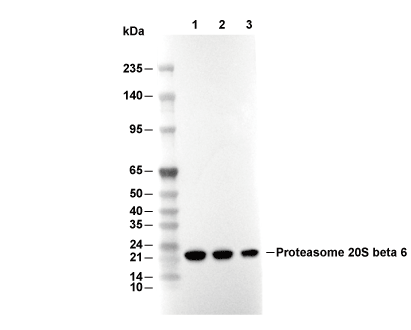 Lane 1: NCI-H460, Lane 2: Caco 2, Lane 3: HeLa
Experiment Essentials
WB
Recommended wet transfer conditions: 200 mA, 60 min.
Recommended wet transfer conditions: 200 mA, 60 min.
Usage Information
| Dilution |
|---|
|
| Application |
|---|
| WB, IF |
| Reactivity |
|---|
| Human |
| Source |
|---|
| Rabbit Monoclonal Antibody |
| Storage Buffer |
|---|
| PBS, pH 7.2+50% Glycerol+0.05% BSA+0.01% NaN3 |
| Storage (from the date of receipt) |
|---|
| -20°C (avoid freeze-thaw cycles), 2 years |
| Predicted MW |
|---|
| 25 kDa |
| Positive Control | HeLa cells; Human fetal liver cells; NCI-H460 cells; Caco 2 cells |
|---|---|
| Negative Control |
Experimental Methods
| WB |
|---|
Experimental Protocol:
Sample preparation
1. Tissue: Lyse the tissue sample by adding an appropriate volume of ice-cold RIPA/NP-40 Lysis Buffer (containing Protease Inhibitor Cocktail),and homogenize the tissue at a low temperature or lyse it by sonication on ice, then incubate on ice for 30 minutes. 2. Adherent cell: Aspirate the culture medium and wash the cells with ice-cold PBS twice. Lyse the cells by adding an appropriate volume of RIPA/NP-40 Lysis Buffer (containing Protease Inhibitor Cocktail) , sonicate to lyse the cells, and incubate on ice for 30 minutes. 3. Suspension cell: Transfer the culture medium to a pre-cooled centrifuge tube. Centrifuge and aspirate the supernatant. Wash the cells with ice-cold PBS twice. Lyse the cells by adding an appropriate volume of RIPA/NP-40 Lysis Buffer (containing Protease Inhibitor Cocktail) , sonicate to lyse the cells, and incubate on ice for 30 minutes. 4. Place the lysate into a pre-cooled microcentrifuge tube. Centrifuge at 4°C for 15 min. Collect the supernatant;
5. Remove a small volume of lysate to determine the protein concentration;
6. Add protein loading buffer to the 20 μL sample, and keep it on ice for immediate use; or determine the optimal denaturation conditions by boiling the sample at a temperature gradient (e.g., 37°C, 50°C, 70°C, 90°C, and 100°C). Cool the sample on ice and centrifuge for 5 min.
Electrophoretic separation
1. According to the concentration of extracted protein, load appropriate amount of protein sample and marker onto SDS-PAGE gels for electrophoresis. Recommended separating gel (lower gel) concentration: 10%. Reference Table for Selecting SDS-PAGE Separation Gel Concentrations 2. Power up 80V for 30 minutes. Then the power supply is adjusted (110 V~150 V), the Marker is observed, and the electrophoresis can be stopped when the indicator band of the predyed protein Marker where the protein is located is properly separated. (Note that the current should not be too large when electrophoresis, too large current (more than 150 mA) will cause the temperature to rise, affecting the result of running glue. If high currents cannot be avoided, an ice bath can be used to cool the bath.)
Transfer membrane
1. Take out the converter, soak the clip and consumables in the pre-cooled converter;
2. Activate PVDF membrane with methanol for 1 min and rinse with transfer buffer;
3. Install it in the order of "black edge of clip - sponge - filter paper - filter paper - glue -PVDF membrane - filter paper - filter paper - sponge - white edge of clip"; 4. The protein was electrotransferred to PVDF membrane. ( 0.45 µm PVDF membrane is recommended ) Reference Table for Selecting PVDF Membrane Pore Size Specifications Recommended conditions for wet transfer: 200 mA, 60 min. ( Note that the transfer conditions can be adjusted according to the protein size. For high-molecular-weight proteins, a higher current and longer transfer time are recommended. However, ensure that the transfer tank remains at a low temperature to prevent gel melting.)
Block
1. After electrotransfer, wash the film with TBST at room temperature for 5 minutes;
2. Incubate the film in the blocking solution for 1 hour at room temperature;
3. Wash the film with TBST for 3 times, 5 minutes each time.
Antibody incubation
1. Use primary antibody dilution buffer to prepare the primary antibody working liquid (recommended dilution ratio for primary antibody 1:1000), gently shake and incubate with the film at 4°C overnight; 2. Wash the film with TBST 3 times, 5 minutes each time;
3. Add the secondary antibody to the blocking solution and incubate with the film gently at room temperature for 1 hour;
4. After incubation, wash the film with TBST 3 times for 5 minutes each time.
Antibody staining
1. Add the prepared ECL luminescent substrate (or select other color developing substrate according to the second antibody) and mix evenly;
2. Incubate with the film for 1 minute, remove excess substrate (keep the film moist), wrap with plastic film, and expose in the imaging system. |
| IF |
|---|
Experimental Protocol:
Sample Preparation
1. Adherent Cells: Place a clean, sterile coverslip in a culture dish. Once the cells grow to near confluence as a monolayer, remove the coverslip for further use.
2. Suspension Cells: Seed the cells onto a clean, sterile slide coated with poly-L-lysine.
3. Frozen Sections: Allow the slide to thaw at room temperature. Wash it with pure water or PBS for 2 times, 3 minutes each time.
4. Paraffin Sections: Deparaffinization and rehydration. Wash the slide with pure water or PBS for 3 times, 3 minutes each time. Then perform antigen retrieval.
Fixation
1. Fix the cell coverslips/spots or tissue sections at room temperature using a fixative such as 4% paraformaldehyde (4% PFA) for 10-15 minutes.
2. Wash the sample with PBS for 3 times, 3 minutes each time.
Blocking
Add blocking solution and incubate at room temperature for at least 1 hour. (Common blocking solutions include: serum from the same source as the secondary antibody, BSA, or goat serum.)
Note: Ensure the sample remains moist during and after the blocking step to prevent drying, which can lead to high background.
Immunofluorescence Staining (Day 1)
1. Remove the blocking solution and add the diluted primary antibody.
2. Incubate the sample in a humidified chamber at 4°C overnight.
Immunofluorescence Staining (Day 2)
1. Remove the primary antibody and wash with PBST for 3 times, 5 minutes each time.
2. Add the diluted fluorescent secondary antibody and incubate in the dark at 4°C for 1–2 hours.
3. Remove the secondary antibody and wash with PBST for 3 times, 5 minutes each time.
4. Add diluted DAPI and incubate at room temperature in the dark for 5–10 minutes.
5. Wash with PBST for 3 times, 5 minutes each time.
Mounting
1. Mount the sample with an anti-fade mounting medium.
2. Allow the slide to dry at room temperature overnight in the dark.
3. Store the slide in a slide storage box at 4°C, protected from light.
|
Biological Description
| Specificity |
|---|
| PSMB6 Antibody (Rabbit mAb) [G20N21] detects endogenous levels of total PSMB6 protein. |
| Subcellular Location |
|---|
| Cell membrane, Membrane |
| Uniprot ID |
|---|
| P28072 |
| Clone |
|---|
| G20N21 |
| Synonym(s) |
|---|
| DELTA | LMPY | Macropain delta chain | MGC5169 | Multicatalytic endopeptidase complex delta chain | proteasome (prosome | macropain) subunit | beta type | 6 | proteasome 20S subunit beta 6 | proteasome catalytic subunit 1 | Proteasome delta chain | proteasome subunit beta 6 | Proteasome subunit beta type-6 | proteasome subunit beta1 | proteasome subunit delta | Proteasome subunit Y | PSB6 | PSMB6 | PSY large multifunctional protease Y | Y |
| Background |
|---|
| Proteasome 20S β6 (PSMB6) is a constitutive β-type subunit of the 20S core proteasome that contributes to the major ATP/ubiquitin-dependent proteolytic machinery responsible for degradation of most intracellular proteins and maintenance of protein homeostasis. Within the four-ring 20S core, PSMB6 resides in the β-ring and provides caspase-like or postacidic peptidylglutamyl-hydrolyzing activity, cleaving peptide bonds after acidic residues and shaping the overall spectrum of proteasome-generated peptides. Association of the 20S core containing PSMB6 with two 19S regulatory particles forms the 26S proteasome, which recognizes ubiquitinated substrates, unfolds them and translocates them into the catalytic chamber, where PSMB6 and other β subunits cooperate to remove misfolded or damaged proteins and proteins whose functions are no longer needed, thereby supporting processes such as cell-cycle progression, transcriptional regulation, and stress responses. Alternative association of the PSMB6-containing 20S core with PA28 or PA200 regulatory complexes enables ubiquitin-independent proteolysis, with 20S–PA28 complexes contributing to the generation of a subset of MHC class I–presented antigenic peptides and 20S–PA200 complexes supporting spermatogenesis, highlighting roles for PSMB6-containing cores in both general proteostasis and antigen-processing routes. In immune cells, interferon-γ and other proinflammatory cytokines induce expression of immunoproteasome catalytic subunits PSMB9, PSMB10 and PSMB8, which replace the constitutive β1, β2 and β5 subunits including PSMB6 in the 20S core to form immunoproteasomes; this remodeling reduces caspase-like activity and enhances chymotrypsin- and trypsin-like activities, creating C-terminal cleavage patterns that favor loading of peptides onto MHC class I molecules. At the functional level, PSMB6 acts as part of the standard proteasome in pathways such as COP1 autodegradation and CDK-mediated phosphorylation and removal of Cdc6, integrating proteasomal turnover with regulation of E3 ligases and replication licensing factors. Experimental inhibition or knockdown of PSMB6 in deltamethrin-resistant mosquito cells increases susceptibility to insecticide and decreases cell viability under treatment, demonstrating that PSMB6-containing proteasomes support stress adaptation and xenobiotic resistance in this model and that proteasome inhibitors such as bortezomib or MG‑132 can synergize with deltamethrin by targeting PSMB6-dependent proteolysis. Proteasome 20S β6 acts as a caspase-like catalytic subunit embedded in the constitutive 20S core that participates in ATP/ubiquitin-dependent and -independent proteolysis, is replaced by inducible β1i in immunoproteasomes during inflammatory responses, and contributes to pathways ranging from protein quality control and replication factor turnover to xenobiotic resistance and antigen peptide generation. |
| References |
|---|
|
Tech Support
Tel: +1-832-582-8158 Ext:3
If you have any other enquiries, please leave a message.

Products are for research use only. Not for human use. We do not sell to patients.
©Copyright 2013 Selleck Chemicals. All Rights Reserved.