
-
 Argentina
-
 Australia
-
 Austria
-
 Belgium
-
 Brazil
-
 Canada
-
 China
China
-
 Czech Republic
-
 Denmark
-
 Finland
-
 France
-
 Germany
-
 Greece
-
 Hong Kong
-
 Hungary
-
 Iceland
-
 India
India
-
 Ireland
-
 Israel
-
 Italy
Italy
-
 Japan
Japan
-
 Korea
Korea
-
 Luxembourg
-
 Malaysia
-
 Netherlands
-
 New Zealand
-
 Norway
-
 Poland
-
 Portugal
-
 Qatar
Qatar
-
 Romania
-
 Saudi Arabia
-
 Singapore
-
 Spain
Spain
-
 Sweden
-
 Switzerland
-
 Taiwan
-
 Turkey
-
 United Kingdom
-
 United States
research use only
PKC β Antibody (Rabbit mAb) [C22A12]
CatNo: F6483
Application:
Reactivity:
-
 Lane 1: K562, Lane 2: Jurkat, Lane 3: Mouse brain
 -
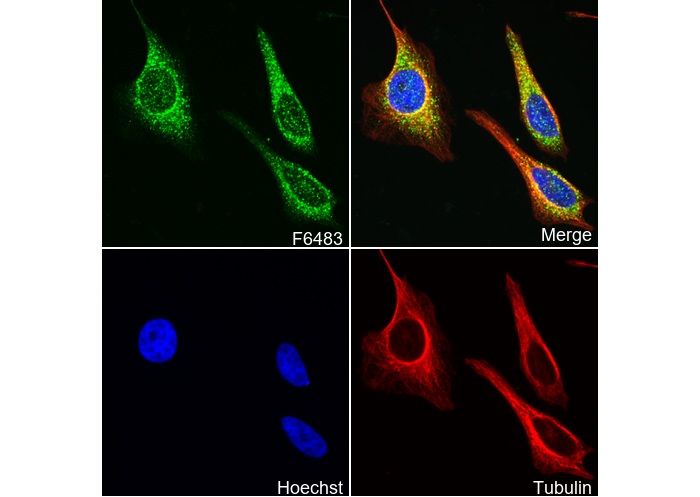 Immunofluorescent analysis of Hela cells using F6483 (green, 1:100), Hoechst (blue) and tubulin (Red).
Usage Information
| Dilution |
|---|
|
| Application |
|---|
| IHC, IF, FCM |
| Reactivity |
|---|
| Human, Mouse, Rat |
| Source |
|---|
| Rabbit Monoclonal Antibody |
| Storage Buffer |
|---|
| PBS, pH 7.2+50% Glycerol+0.05% BSA+0.01% NaN3 |
| Storage (from the date of receipt) |
|---|
| -20°C (avoid freeze-thaw cycles), 2 years |
| Predicted MW |
|---|
| 77 kDa |
| Positive Control | Rat spleen tissue; Mouse kidney tissue; Human colon cancer tissue; K562 cells; HeLa cells |
|---|---|
| Negative Control |
Experimental Methods
| IF |
|---|
Experimental Protocol:
Sample Preparation
1. Adherent Cells: Place a clean, sterile coverslip in a culture dish. Once the cells grow to near confluence as a monolayer, remove the coverslip for further use.
2. Suspension Cells: Seed the cells onto a clean, sterile slide coated with poly-L-lysine.
3. Frozen Sections: Allow the slide to thaw at room temperature. Wash it with pure water or PBS for 2 times, 3 minutes each time.
4. Paraffin Sections: Deparaffinization and rehydration. Wash the slide with pure water or PBS for 3 times, 3 minutes each time. Then perform antigen retrieval.
Fixation
1. Fix the cell coverslips/spots or tissue sections at room temperature using a fixative such as 4% paraformaldehyde (4% PFA) for 10-15 minutes.
2. Wash the sample with PBS for 3 times, 3 minutes each time.
Permeabilization
1.Add a detergent such as 0.1–0.3% Triton X-100 to the sample and incubate at room temperature for 10–20 minutes.
(Note: This step is only required for intracellular antigens. For antigens expressed on the cell membrane, this step is unnecessary.)
Wash the sample with PBS for 3 times, 3 minutes each time.
Blocking
Add blocking solution and incubate at room temperature for at least 1 hour. (Common blocking solutions include: serum from the same source as the secondary antibody, BSA, or goat serum.)
Note: Ensure the sample remains moist during and after the blocking step to prevent drying, which can lead to high background.
Immunofluorescence Staining (Day 1)
1. Remove the blocking solution and add the diluted primary antibody.
2. Incubate the sample in a humidified chamber at 4°C overnight.
Immunofluorescence Staining (Day 2)
1. Remove the primary antibody and wash with PBST for 3 times, 5 minutes each time.
2. Add the diluted fluorescent secondary antibody and incubate in the dark at 4°C for 1–2 hours.
3. Remove the secondary antibody and wash with PBST for 3 times, 5 minutes each time.
4. Add diluted DAPI and incubate at room temperature in the dark for 5–10 minutes.
5. Wash with PBST for 3 times, 5 minutes each time.
Mounting
1. Mount the sample with an anti-fade mounting medium.
2. Allow the slide to dry at room temperature overnight in the dark.
3. Store the slide in a slide storage box at 4°C, protected from light.
|
| IHC |
|---|
Experimental Protocol:
Deparaffinization/Rehydration
1. Deparaffinize/hydrate sections:
2. Incubate sections in three washes of xylene for 5 min each.
3. Incubate sections in two washes of 100% ethanol for 10 min each.
4. Incubate sections in two washes of 95% ethanol for 10 min each.
5. Wash sections two times in dH2O for 5 min each.
6.Antigen retrieval: For Citrate: Heat slides in a microwave submersed in 1X citrate unmasking solution until boiling is initiated; continue with 10 min at a sub-boiling temperature (95°-98°C). Cool slides on bench top for 30 min.
Staining
1. Wash sections in dH2O three times for 5 min each.
2. Incubate sections in 3% hydrogen peroxide for 10 min.
3. Wash sections in dH2O two times for 5 min each.
4. Wash sections in wash buffer for 5 min.
5. Block each section with 100–400 µl of blocking solution for 1 hr at room temperature.
6. Remove blocking solution and add 100–400 µl primary antibody diluent in to each section. Incubate overnight at 4°C.
7. Remove antibody solution and wash sections with wash buffer three times for 5 min each.
8. Cover section with 1–3 drops HRPas needed. Incubate in a humidified chamber for 30 min at room temperature.
9. Wash sections three times with wash buffer for 5 min each.
10. Add DAB Chromogen Concentrate to DAB Diluent and mix well before use.
11. Apply 100–400 µl DAB to each section and monitor closely. 1–10 min generally provides an acceptable staining intensity.
12. Immerse slides in dH2O.
13. If desired, counterstain sections with hematoxylin.
14. Wash sections in dH2O two times for 5 min each.
15. Dehydrate sections: Incubate sections in 95% ethanol two times for 10 sec each; Repeat in 100% ethanol, incubating sections two times for 10 sec each; Repeat in xylene, incubating sections two times for 10 sec each.
16. Mount sections with coverslips and mounting medium.
|
Biological Description
| Specificity |
|---|
| PKC β Antibody (Rabbit mAb) [C22A12] detects endogenous levels of total PKC β protein. |
| Uniprot ID |
|---|
| P05771 |
| Clone |
|---|
| C22A12 |
| Synonym(s) |
|---|
| KPCB | MGC41878 | PKC beta II | PKC beta2 | PKC-B | PKC-beta | PKC-beta II | PKC-beta2 | PKCB | PKCbeta | PKCI(2) | PRKCB | PRKCB1 | PRKCB2 | protein kinase C beta | protein kinase C beta 1 | Protein kinase C beta type | protein kinase C | beta | protein kinase C | beta 1 polypeptide |
| Background |
|---|
| PKC β is a conventional protein kinase C isoform within the serine/threonine kinase family that responds to diacylglycerol and calcium and participates in signaling cascades controlling cell growth, survival, differentiation, cytoskeletal dynamics, and secretory responses. The enzyme contains an N‑terminal regulatory region with C1 domains that bind diacylglycerol and phorbol esters and a C2 domain that senses calcium and anionic phospholipids, plus a C‑terminal catalytic domain that phosphorylates substrates on serine and threonine residues once the autoinhibitory pseudosubstrate segment is released at membranes enriched in acidic phospholipids. Activation of PKC β1 follows receptor‑triggered phospholipase C–dependent generation of diacylglycerol and calcium mobilization, leading to its translocation from the cytosol to the plasma membrane and other membrane compartments, where it phosphorylates target proteins involved in cytoskeletal remodeling, ion transport, gene expression, and metabolism. PKC β1 participates in growth factor signaling; epidermal growth factor activation of PKC β1 promotes reorganization of the F‑actin cytoskeleton, maintenance of barrier cytoarchitecture, and normalization of intracellular calcium by enhancing calcium efflux, linking this isoform to cytoskeletal protection and calcium homeostasis during oxidative or inflammatory stress. PKC β1 also contributes to the regulation of transporters and channels at specialized barriers, including the blood–brain barrier, where pharmacologic activation of PKC β1 modulates P‑glycoprotein activity and alters drug efflux capacity, connecting this kinase to control of central nervous system drug delivery. Within broader signaling networks, PKC β isoforms interface with MAPK/ERK and PI3K/Akt pathways by phosphorylating or regulating upstream and intermediate components, thereby influencing transcription factor activation, cell cycle progression, and survival signaling in immune and non‑immune cells. Elevated PKC β activity associates with vascular dysfunction in metabolic disease, with diacylglycerol‑driven PKC β activation in hyperglycemic conditions contributing to changes in endothelial permeability, extracellular matrix production, and expression of vasoactive mediators that underlie microvascular complications. In lymphoid malignancies, PKC‑β expression is frequently increased, and high PKC‑β levels in diffuse large B‑cell lymphoma correlate with adverse outcome and align with survival pathways that support B‑cell growth and resistance to apoptosis, which has driven interest in PKC β–directed therapeutic strategies. |
| References |
|---|
|
Tech Support
Tel: +1-832-582-8158 Ext:3
If you have any other enquiries, please leave a message.

Products are for research use only. Not for human use. We do not sell to patients.
©Copyright 2013 Selleck Chemicals. All Rights Reserved.