
-
 Argentina
-
 Australia
-
 Austria
-
 Belgium
-
 Brazil
-
 Canada
-
 China
China
-
 Czech Republic
-
 Denmark
-
 Finland
-
 France
-
 Germany
-
 Greece
-
 Hong Kong
-
 Hungary
-
 Iceland
-
 India
India
-
 Ireland
-
 Israel
-
 Italy
Italy
-
 Japan
Japan
-
 Korea
Korea
-
 Luxembourg
-
 Malaysia
-
 Netherlands
-
 New Zealand
-
 Norway
-
 Poland
-
 Portugal
-
 Qatar
Qatar
-
 Romania
-
 Saudi Arabia
-
 Singapore
-
 Spain
Spain
-
 Sweden
-
 Switzerland
-
 Taiwan
-
 Turkey
-
 United Kingdom
-
 United States
research use only
Phospho-Mnk1 (Thr197/202) Antibody (Rabbit mAb) [A20A1]
CatNo: F9487
-
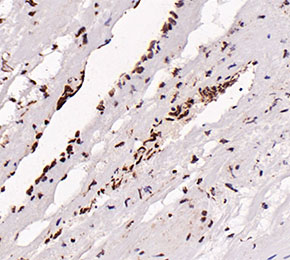 Immunohistochemical analysis of formalin fixed paraffin embedded human prostate cancer tissue with F9487 at 1:1000 dilution.
Usage Information
| Dilution |
|---|
|
| Application |
|---|
| IHC, IF |
| Reactivity |
|---|
| Human |
| Source |
|---|
| Rabbit Monoclonal Antibody |
| Storage Buffer |
|---|
| PBS, pH 7.2+50% Glycerol+0.05% BSA+0.01% NaN3 |
| Storage (from the date of receipt) |
|---|
| -20°C (avoid freeze-thaw cycles), 2 years |
| Predicted MW |
|---|
| 51 kDa |
| Positive Control | Human thyroid carcinoma; Human prostate carcinoma; HeLa cells |
|---|---|
| Negative Control | Human thyroid tissue; Human prostate tissue |
Experimental Methods
| IF |
|---|
Experimental Protocol:
Sample Preparation
1. Adherent Cells: Place a clean, sterile coverslip in a culture dish. Once the cells grow to near confluence as a monolayer, remove the coverslip for further use.
2. Suspension Cells: Seed the cells onto a clean, sterile slide coated with poly-L-lysine.
3. Frozen Sections: Allow the slide to thaw at room temperature. Wash it with pure water or PBS for 2 times, 3 minutes each time.
4. Paraffin Sections: Deparaffinization and rehydration. Wash the slide with pure water or PBS for 3 times, 3 minutes each time. Then perform antigen retrieval.
Fixation
1. Fix the cell coverslips/spots or tissue sections at room temperature using a fixative such as 4% paraformaldehyde (4% PFA) for 10-15 minutes.
2. Wash the sample with PBS for 3 times, 3 minutes each time.
Permeabilization
1.Add a detergent such as 0.1–0.3% Triton X-100 to the sample and incubate at room temperature for 10–20 minutes.
(Note: This step is only required for intracellular antigens. For antigens expressed on the cell membrane, this step is unnecessary.)
Wash the sample with PBS for 3 times, 3 minutes each time.
Blocking
Add blocking solution and incubate at room temperature for at least 1 hour. (Common blocking solutions include: serum from the same source as the secondary antibody, BSA, or goat serum.)
Note: Ensure the sample remains moist during and after the blocking step to prevent drying, which can lead to high background.
Immunofluorescence Staining (Day 1)
1. Remove the blocking solution and add the diluted primary antibody.
2. Incubate the sample in a humidified chamber at 4°C overnight.
Immunofluorescence Staining (Day 2)
1. Remove the primary antibody and wash with PBST for 3 times, 5 minutes each time.
2. Add the diluted fluorescent secondary antibody and incubate in the dark at 4°C for 1–2 hours.
3. Remove the secondary antibody and wash with PBST for 3 times, 5 minutes each time.
4. Add diluted DAPI and incubate at room temperature in the dark for 5–10 minutes.
5. Wash with PBST for 3 times, 5 minutes each time.
Mounting
1. Mount the sample with an anti-fade mounting medium.
2. Allow the slide to dry at room temperature overnight in the dark.
3. Store the slide in a slide storage box at 4°C, protected from light.
|
| IHC |
|---|
Experimental Protocol:
Deparaffinization/Rehydration
1. Deparaffinize/hydrate sections:
2. Incubate sections in three washes of xylene for 5 min each.
3. Incubate sections in two washes of 100% ethanol for 10 min each.
4. Incubate sections in two washes of 95% ethanol for 10 min each.
5. Wash sections two times in dH2O for 5 min each.
6.Antigen retrieval: For Citrate: Heat slides in a microwave submersed in 1X citrate unmasking solution until boiling is initiated; continue with 10 min at a sub-boiling temperature (95°-98°C). Cool slides on bench top for 30 min.
Staining
1. Wash sections in dH2O three times for 5 min each.
2. Incubate sections in 3% hydrogen peroxide for 10 min.
3. Wash sections in dH2O two times for 5 min each.
4. Wash sections in wash buffer for 5 min.
5. Block each section with 100–400 µl of blocking solution for 1 hr at room temperature.
6. Remove blocking solution and add 100–400 µl primary antibody diluent in to each section. Incubate overnight at 4°C.
7. Remove antibody solution and wash sections with wash buffer three times for 5 min each.
8. Cover section with 1–3 drops HRPas needed. Incubate in a humidified chamber for 30 min at room temperature.
9. Wash sections three times with wash buffer for 5 min each.
10. Add DAB Chromogen Concentrate to DAB Diluent and mix well before use.
11. Apply 100–400 µl DAB to each section and monitor closely. 1–10 min generally provides an acceptable staining intensity.
12. Immerse slides in dH2O.
13. If desired, counterstain sections with hematoxylin.
14. Wash sections in dH2O two times for 5 min each.
15. Dehydrate sections: Incubate sections in 95% ethanol two times for 10 sec each; Repeat in 100% ethanol, incubating sections two times for 10 sec each; Repeat in xylene, incubating sections two times for 10 sec each.
16. Mount sections with coverslips and mounting medium.
|
Biological Description
| Specificity |
|---|
Phospho-Mnk1 (Thr197/202) Antibody (Rabbit mAb) [A20A1] detects endogenous levels of total Mnk1 protein only when it is phosphorylated at Thr197 and Thr202. |
| Subcellular Location |
|---|
| Cytoplasm, Nucleus |
| Uniprot ID |
|---|
| Q9BUB5 |
| Clone |
|---|
| A20A1 |
| Synonym(s) |
|---|
| MAP kinase interacting serine/threonine kinase 1; MAP kinase signal-integrating kinase 1; MAPK signal-integrating kinase 1; MAPK-interacting protein kinase-like kinase 1b; unnamed protein product; MNK1 |
| Background |
|---|
MNK1 (MAP kinase-interacting kinase 1) belongs to the MAP kinase-interacting kinase family alongside MNK2, both classified as MAPK-activated serine/threonine kinases that function downstream of the ERK and p38 signaling cascades. Activation of MNK1 occurs through dual phosphorylation on Thr197 and Thr202 within its activation loop, a modification catalyzed directly by ERK and p38 MAPK in response to mitogenic and stress-related extracellular stimuli. Phosphorylated MNK1 associates with the eIF4F translation initiation complex through binding to the scaffolding protein eIF4G, positioning the kinase in physical proximity to its substrate eIF4E for subsequent phosphorylation on Ser209. This eIF4E modification alters cap-binding affinity and nuclear export behavior, linking upstream MAPK signaling to control over the translational efficiency of specific mRNA subsets rather than global protein synthesis. MNK1 activation is inducible and responds acutely to mitogen and cytokine stimulation, while the related isoform MNK2 maintains a higher basal, constitutive level of kinase activity independent of strong upstream stimulation, giving the two isoforms distinct temporal roles in sustaining eIF4E phosphorylation across different signaling contexts. Expression of constitutively active MNK1 mutants reduces cap-dependent translation relative to cap-independent translation in reporter assays, indicating that MNK1 signaling exerts a negative regulatory influence on canonical translation initiation despite promoting eIF4E phosphorylation. Tissue-specific analysis shows that Mnk1 accounts for the inducible component of eIF4E phosphorylation following MAPK pathway activation, while Mnk2 sustains phosphorylation under unstimulated conditions, together maintaining Ser209 phosphorylation across diverse tissue types. Because eIF4E phosphorylation downstream of MNK1 selectively promotes translation of transcripts linked to cell survival and proliferation, this axis is implicated in tumorigenesis and is actively pursued as a therapeutic target through selective MNK inhibitors aimed at limiting oncogenic translational reprogramming without disrupting core protein synthesis. |
| References |
|---|
|
Tech Support
Tel: +1-832-582-8158 Ext:3
If you have any other enquiries, please leave a message.

Products are for research use only. Not for human use. We do not sell to patients.
©Copyright 2013 Selleck Chemicals. All Rights Reserved.