
-
 Australia
-
 Austria
-
 Belgium
-
 Brazil
-
 Canada
-
 China
China
-
 Czech Republic
-
 Denmark
-
 Finland
-
 France
-
 Germany
-
 Greece
-
 Hong Kong
-
 Hungary
-
 Iceland
-
 India
India
-
 Ireland
-
 Israel
-
 Italy
Italy
-
 Japan
Japan
-
 Korea
Korea
-
 Luxembourg
-
 Malaysia
-
 Netherlands
-
 New Zealand
-
 Norway
-
 Poland
-
 Qatar
Qatar
-
 Romania
-
 Saudi Arabia
-
 Singapore
-
 Spain
Spain
-
 Sweden
-
 Switzerland
-
 Taiwan
-
 Turkey
-
 United Kingdom
-
 United States
research use only
Pancreatic Polypeptide Antibody (Rabbit mAb) [L20N2]
CatNo: F5352
Application:
Reactivity:
-
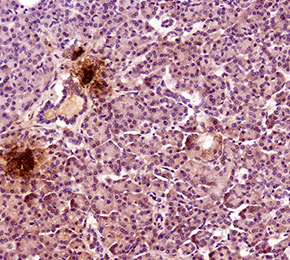 Immunohistochemical analysis of formalin fixed paraffin embedded human pancreatic tissue with F5352 at 1:2000 dilution.
 -
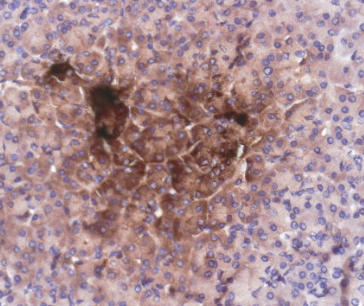 Immunohistochemical analysis of formalin fixed paraffin embedded human pancreatic tissue with F5352 at 1:2000 dilution.
Usage Information
| Dilution |
|---|
|
| Application |
|---|
| IHC |
| Reactivity |
|---|
| Mouse, Rat, Human |
| Source |
|---|
| Rabbit Monoclonal Antibody |
| Storage Buffer |
|---|
| PBS, pH 7.2+50% Glycerol+0.05% BSA+0.01% NaN3 |
| Storage (from the date of receipt) |
|---|
| -20°C (avoid freeze-thaw cycles), 2 years |
| Predicted MW |
|---|
| 10 kDa |
| Positive Control | Rat pancreas tissue; Mouse pancreas tissue; Human pancreas tissue |
|---|---|
| Negative Control |
Experimental Methods
| IHC |
|---|
Experimental Protocol:
Deparaffinization/Rehydration
1. Deparaffinize/hydrate sections:
2. Incubate sections in three washes of xylene for 5 min each.
3. Incubate sections in two washes of 100% ethanol for 10 min each.
4. Incubate sections in two washes of 95% ethanol for 10 min each.
5. Wash sections two times in dH2O for 5 min each.
6.Antigen retrieval: For Citrate: Heat slides in a microwave submersed in 1X citrate unmasking solution until boiling is initiated; continue with 10 min at a sub-boiling temperature (95°-98°C). Cool slides on bench top for 30 min.
Staining
1. Wash sections in dH2O three times for 5 min each.
2. Incubate sections in 3% hydrogen peroxide for 10 min.
3. Wash sections in dH2O two times for 5 min each.
4. Wash sections in wash buffer for 5 min.
5. Block each section with 100–400 µl of blocking solution for 1 hr at room temperature.
6. Remove blocking solution and add 100–400 µl primary antibody diluent in to each section. Incubate overnight at 4°C.
7. Remove antibody solution and wash sections with wash buffer three times for 5 min each.
8. Cover section with 1–3 drops HRPas needed. Incubate in a humidified chamber for 30 min at room temperature.
9. Wash sections three times with wash buffer for 5 min each.
10. Add DAB Chromogen Concentrate to DAB Diluent and mix well before use.
11. Apply 100–400 µl DAB to each section and monitor closely. 1–10 min generally provides an acceptable staining intensity.
12. Immerse slides in dH2O.
13. If desired, counterstain sections with hematoxylin.
14. Wash sections in dH2O two times for 5 min each.
15. Dehydrate sections: Incubate sections in 95% ethanol two times for 10 sec each; Repeat in 100% ethanol, incubating sections two times for 10 sec each; Repeat in xylene, incubating sections two times for 10 sec each.
16. Mount sections with coverslips and mounting medium.
|
Biological Description
| Specificity |
|---|
| Pancreatic Polypeptide Antibody (Rabbit mAb) [L20N2] detects endogenous levels of total Pancreatic Polypeptide protein. |
| Subcellular Location |
|---|
| Secreted |
| Uniprot ID |
|---|
| P01298 |
| Clone |
|---|
| L20N2 |
| Synonym(s) |
|---|
| PNP | PPY | Pancreatic polypeptide prohormone | PH | Pancreatic polypeptide Y | PNP | PPY | Pancreatic polypeptide | Pancreatic polypeptide Y | Pancreatic prohormone | prepro-PP (prepropancreatic polypeptide) |
| Background |
|---|
| Pancreatic polypeptide (PP) is a 36–amino acid member of the neuropeptide Y (NPY) family that is synthesized and stored in PP (F) cells of the endocrine pancreas, predominantly in the ventral head region, and released into the circulation in response to nutrient stimulation and vagal cholinergic input as a systemic regulator of digestive function and energy homeostasis. The peptide adopts the characteristic PP‑fold, a compact polyproline II helix followed by an α‑helix, which presents key side chains for high‑affinity binding to Y4 receptors and lower‑affinity engagement of Y5 and, in some species, Y6 receptors, enabling selective activation of G protein–coupled receptor signaling in the brainstem, hypothalamus, and pancreatic islets. Secretion follows a biphasic pattern after a meal, with an early vagally mediated component and a later intestinal phase driven by cholecystokinin and other gut hormones; cholinergic vagal stimulation is the dominant driver of PP release and acts as an obligatory conduit for many other secretagogues, making PP a sensitive readout of vagal tone and autonomic regulation of the endocrine pancreas. Circulating PP feeds back on the exocrine pancreas, where it inhibits secretion of fluid, bicarbonate, and digestive enzymes and counteracts cholecystokinin‑induced pancreatic secretion, and on the biliary tract and stomach, where it reduces gallbladder contraction and alters gastric emptying, thereby coordinating postprandial digestive efficiency and limiting excessive pancreatic output. At the level of central energy balance, PP acting via Y4 receptors on vagal afferents and hypothalamic nuclei, including the arcuate, ventromedial, and lateral hypothalamus, suppresses food intake, decreases orexin expression in the lateral hypothalamic “feeding center,” and increases brain‑derived neurotrophic factor expression in the ventromedial “satiety center,” resulting in a net anorexigenic effect that reduces body weight and adiposity in animal models with exogenous PP administration or PP overexpression. PP also signals directly to pancreatic islets, where Y4/Y1‑family receptors on α cells mediate an inhibitory effect on glucagon secretion, linking postprandial PP rises to modulation of hepatic glucose output and contributing to fine‑tuning of glucose homeostasis alongside insulin and somatostatin. Low PP responses are associated with vagal dysfunction and chronic pancreatitis, and markedly elevated PP levels with PP‑secreting neuroendocrine tumors, while pharmacological or supraphysiological PP infusion in humans alters satiety, gastric accommodation, and food tolerance, underscoring its potential as a tool to probe gut–brain signaling and as a candidate target for anti‑obesity and metabolic therapies. |
| References |
|---|
|
Tech Support
Tel: +1-832-582-8158 Ext:3
If you have any other enquiries, please leave a message.

Products are for research use only. Not for human use. We do not sell to patients.
©Copyright 2013 Selleck Chemicals. All Rights Reserved.