
-
 Australia
-
 Austria
-
 Belgium
-
 Brazil
-
 Canada
-
 China
China
-
 Czech Republic
-
 Denmark
-
 Finland
-
 France
-
 Germany
-
 Greece
-
 Hong Kong
-
 Hungary
-
 Iceland
-
 India
India
-
 Ireland
-
 Israel
-
 Italy
Italy
-
 Japan
Japan
-
 Korea
Korea
-
 Luxembourg
-
 Malaysia
-
 Netherlands
-
 New Zealand
-
 Norway
-
 Poland
-
 Qatar
Qatar
-
 Romania
-
 Saudi Arabia
-
 Singapore
-
 Spain
Spain
-
 Sweden
-
 Switzerland
-
 Taiwan
-
 Turkey
-
 United Kingdom
-
 United States
research use only
MEKK3 Antibody [G24J6]
Cat.No.: F5043
Application:
Reactivity:
-
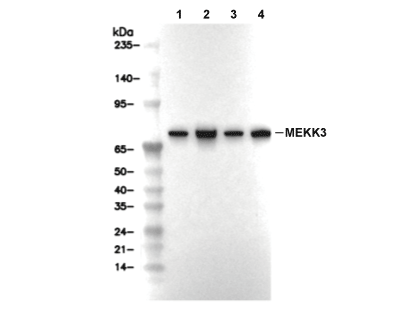 Lane 1: HEL, Lane 2: Jurkat, Lane 3: K562, Lane 4: NIH/3T3
Usage Information
| Dilution |
|---|
|
| Application |
|---|
| WB, IP |
| Reactivity |
|---|
| Human, Mouse, Rat, Monkey |
| Source |
|---|
| Rabbit Monoclonal Antibody |
| Storage Buffer |
|---|
| PBS, pH 7.2+50% Glycerol+0.05% BSA+0.01% NaN3 |
| Storage (from the date of receipt) |
|---|
| -20°C (avoid freeze-thaw cycles), 2 years |
| Predicted MW |
|---|
| 71 kDa |
Biological Description
| Specificity |
|---|
| MEKK3 Antibody [G24J6] detects endogenous levels of total MEKK3 protein. |
| Clone |
|---|
| G24J6 |
| Synonym(s) |
|---|
| M3K3; MAP/ERK kinase kinase 3; MAP3K3; MAPK/ERK kinase kinase 3; MAPKKK3; MEK kinase 3; MEKK 3; MEKK3; Mitogen-activated protein kinase kinase kinase 3 |
| Background |
|---|
| MEKK3 (MAP3K3) is a serine/threonine MAP kinase kinase kinase that integrates inflammatory, mechanical, and growth factor inputs to activate multiple downstream kinase cascades and transcriptional programs, with particularly prominent roles in ERK5/BMK1 signaling, NF‑κB activation, and vascular and immune homeostasis. The protein contains an N‑terminal PB1 domain that mediates heterotypic PB1–PB1 interactions with MEK5 and adaptor proteins such as p62, a central catalytic kinase domain with an activation loop harboring regulatory serine/threonine residues, and a C‑terminal regulatory tail that participates in protein–protein interactions and subcellular targeting, creating a scaffold that supports assembly of MEKK3–MEK5–ERK5 modules and NF‑κB upstream complexes. MEKK3 directly phosphorylates and activates MEK5, which in turn activates ERK5/BMK1 in response to growth factors and stress, establishing the canonical MEKK3–MEK5–ERK5 axis that controls endothelial cell survival, shear stress responses, and mitochondrial quality control; this pathway is required for basal mitochondrial degradation in the absence of exogenous damage and contributes to maintenance of mitochondrial homeostasis. In parallel, MEKK3 functions as an upstream activator of NF‑κB in response to TNFα, IL‑1, LPS, lysophosphatidic acid, and other stimuli by phosphorylating and activating IKK complexes, leading to IκB degradation, nuclear translocation of RelA/p50, and induction of pro‑survival and pro‑inflammatory genes, and genetic or pharmacologic interference with MEKK3 reduces NF‑κB activity and sensitizes cancer cells to apoptosis. MEKK3 also contributes to activation of JNK and p38 MAPKs under certain stress conditions, positioning it as a nodal MAP3K that can feed into SAPK, ERK1/2, p38, and ERK5 branches depending on cellular context and adaptor usage, and it participates in crosstalk with Akt, which phosphorylates MEKK3 and promotes association with 14‑3‑3 proteins to modulate its activity in vascular smooth muscle and other cell types. Structural and functional analyses show that MEKK3 interacts directly with the cerebral cavernous malformation protein CCM2 through a defined interface, forming a signaling complex that is essential for embryonic angiogenesis and blood–brain barrier integrity and whose disruption leads to increased RhoA/ROCK activity, vascular malformations, and cerebral cavernous angiomas, highlighting MEKK3 as a critical mediator of endothelial responses to hemodynamic forces and CCM signaling. MEKK3 and its close relative MEKK2 also regulate the Hippo pathway by controlling upstream inputs to MST1/2 and LATS1/2 and thereby influencing YAP/TAZ activity, revealing an additional layer where MEKK3‑dependent MAPK signaling intersects with organ size control and oncogenic transcriptional coactivators. Dysregulated MEKK3 expression and activation have been reported in several cancers, including ovarian and renal clear cell carcinoma, where high MEKK3 levels correlate with elevated IKK/NF‑κB activity, increased expression of anti‑apoptotic genes, and drug resistance, and paclitaxel‑induced stress signals require functional MEKK3 to activate JNK/p38 pathways and influence chemotherapeutic responses. |
| References |
|---|
|
Tech Support
Tel: +1-832-582-8158 Ext:3
If you have any other enquiries, please leave a message.

Products are for research use only. Not for human use. We do not sell to patients.
©Copyright 2013 Selleck Chemicals. All Rights Reserved.