
-
 Australia
-
 Austria
-
 Belgium
-
 Brazil
-
 Canada
-
 China
China
-
 Czech Republic
-
 Denmark
-
 Finland
-
 France
-
 Germany
-
 Greece
-
 Hong Kong
-
 Hungary
-
 Iceland
-
 India
India
-
 Ireland
-
 Israel
-
 Italy
Italy
-
 Japan
Japan
-
 Korea
Korea
-
 Luxembourg
-
 Malaysia
-
 Netherlands
-
 New Zealand
-
 Norway
-
 Poland
-
 Qatar
Qatar
-
 Romania
-
 Saudi Arabia
-
 Singapore
-
 Spain
Spain
-
 Sweden
-
 Switzerland
-
 Taiwan
-
 Turkey
-
 United Kingdom
-
 United States
research use only
KAT9/Elp3 Antibody (Rabbit mAb) [D16L5]
CatNo: F9562
Application:
Reactivity:
-
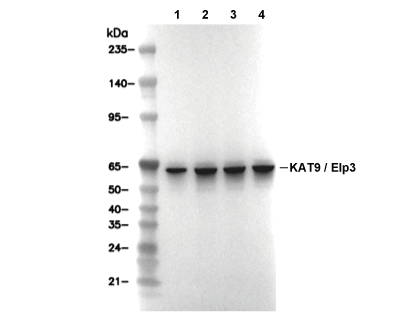 Lane 1: Hela, Lane 2: K562, Lane 3: Jurkat, Lane 4: Mouse brain
Usage Information
| Dilution |
|---|
|
| Application |
|---|
| WB, IP, IF |
| Reactivity |
|---|
| Mouse, Rat, Human |
| Source |
|---|
| Rabbit Monoclonal Antibody |
| Storage Buffer |
|---|
| PBS, pH 7.2+50% Glycerol+0.05% BSA+0.01% NaN3 |
| Storage (from the date of receipt) |
|---|
| -20°C (avoid freeze-thaw cycles), 2 years |
| Predicted MW Observed MW |
|---|
| 62 kDa 62 kDa |
| *Why do the predicted and actual molecular weights differ? The following reasons may explain differences between the predicted and actual protein molecular weight. Post-translational modifications(e.g., phosphorylation, glycosylation); Splice variants and isoforms; Relative charge; Multimerization. |
| Positive Control | Human fetal brain tissue; Human fetal heart tissue; Human fetal kidney tissue; Mouse brain tissue; Mouse heart tissue; Mouse kidney tissue; Mouse spleen tissue; Rat brain tissue; Rat heart tissue; Rat kidney tissue; Rat spleen tissue; HeLa cells; K562 cells; Jurkat cells; 293 cells; HepG2 cells; MCF7 cells; C6 cells; RAW 264.7 cells; PC-12 cells; NIH/3T3 cells |
|---|---|
| Negative Control |
Experimental Methods
| WB |
|---|
Experimental Protocol:
Sample preparation
1. Tissue: Lyse the tissue sample by adding an appropriate volume of ice-cold RIPA/NP-40 Lysis Buffer (containing Protease Inhibitor Cocktail),and homogenize the tissue at a low temperature or lyse it by sonication on ice, then incubate on ice for 30 minutes. 2. Adherent cell: Aspirate the culture medium and wash the cells with ice-cold PBS twice. Lyse the cells by adding an appropriate volume of RIPA/NP-40 Lysis Buffer (containing Protease Inhibitor Cocktail) , sonicate to lyse the cells, and incubate on ice for 30 minutes. 3. Suspension cell: Transfer the culture medium to a pre-cooled centrifuge tube. Centrifuge and aspirate the supernatant. Wash the cells with ice-cold PBS twice. Lyse the cells by adding an appropriate volume of RIPA/NP-40 Lysis Buffer (containing Protease Inhibitor Cocktail) , sonicate to lyse the cells, and incubate on ice for 30 minutes. 4. Place the lysate into a pre-cooled microcentrifuge tube. Centrifuge at 4°C for 15 min. Collect the supernatant;
5. Remove a small volume of lysate to determine the protein concentration;
6. Combine the lysate with protein loading buffer. Boil 20 µL sample under 95-100°C for 5 min. Centrifuge for 5 min after cool down on ice.
Electrophoretic separation
1. According to the concentration of extracted protein, load appropriate amount of protein sample and marker onto SDS-PAGE gels for electrophoresis. Recommended separating gel (lower gel) concentration: 10%. Reference Table for Selecting SDS-PAGE Separation Gel Concentrations 2. Power up 80V for 30 minutes. Then the power supply is adjusted (110 V~150 V), the Marker is observed, and the electrophoresis can be stopped when the indicator band of the predyed protein Marker where the protein is located is properly separated. (Note that the current should not be too large when electrophoresis, too large current (more than 150 mA) will cause the temperature to rise, affecting the result of running glue. If high currents cannot be avoided, an ice bath can be used to cool the bath.)
Transfer membrane
1. Take out the converter, soak the clip and consumables in the pre-cooled converter;
2. Activate PVDF membrane with methanol for 1 min and rinse with transfer buffer;
3. Install it in the order of "black edge of clip - sponge - filter paper - filter paper - glue -PVDF membrane - filter paper - filter paper - sponge - white edge of clip"; 4. The protein was electrotransferred to PVDF membrane. ( 0.45 µm PVDF membrane is recommended ) Reference Table for Selecting PVDF Membrane Pore Size Specifications Recommended conditions for wet transfer: 200 mA, 120 min. ( Note that the transfer conditions can be adjusted according to the protein size. For high-molecular-weight proteins, a higher current and longer transfer time are recommended. However, ensure that the transfer tank remains at a low temperature to prevent gel melting.)
Block
1. After electrotransfer, wash the film with TBST at room temperature for 5 minutes;
2. Incubate the film in the blocking solution for 1 hour at room temperature;
3. Wash the film with TBST for 3 times, 5 minutes each time.
Antibody incubation
1. Use primary antibody dilution buffer to prepare the primary antibody working liquid (recommended dilution ratio for primary antibody 1:2000), gently shake and incubate with the film at 4°C overnight; 2. Wash the film with TBST 3 times, 5 minutes each time;
3. Add the secondary antibody to the blocking solution and incubate with the film gently at room temperature for 1 hour;
4. After incubation, wash the film with TBST 3 times for 5 minutes each time.
Antibody staining
1. Add the prepared ECL luminescent substrate (or select other color developing substrate according to the second antibody) and mix evenly;
2. Incubate with the film for 1 minute, remove excess substrate (keep the film moist), wrap with plastic film, and expose in the imaging system. |
| IF |
|---|
Experimental Protocol:
Sample Preparation
1. Adherent Cells: Place a clean, sterile coverslip in a culture dish. Once the cells grow to near confluence as a monolayer, remove the coverslip for further use.
2. Suspension Cells: Seed the cells onto a clean, sterile slide coated with poly-L-lysine.
3. Frozen Sections: Allow the slide to thaw at room temperature. Wash it with pure water or PBS for 2 times, 3 minutes each time.
4. Paraffin Sections: Deparaffinization and rehydration. Wash the slide with pure water or PBS for 3 times, 3 minutes each time. Then perform antigen retrieval.
Fixation
1. Fix the cell coverslips/spots or tissue sections at room temperature using a fixative such as 4% paraformaldehyde (4% PFA) for 10-15 minutes.
2. Wash the sample with PBS for 3 times, 3 minutes each time.
Permeabilization
1.Add a detergent such as 0.1–0.3% Triton X-100 to the sample and incubate at room temperature for 10–20 minutes.
(Note: This step is only required for intracellular antigens. For antigens expressed on the cell membrane, this step is unnecessary.)
Wash the sample with PBS for 3 times, 3 minutes each time.
Blocking
Add blocking solution and incubate at room temperature for at least 1 hour. (Common blocking solutions include: serum from the same source as the secondary antibody, BSA, or goat serum.)
Note: Ensure the sample remains moist during and after the blocking step to prevent drying, which can lead to high background.
Immunofluorescence Staining (Day 1)
1. Remove the blocking solution and add the diluted primary antibody.
2. Incubate the sample in a humidified chamber at 4°C overnight.
Immunofluorescence Staining (Day 2)
1. Remove the primary antibody and wash with PBST for 3 times, 5 minutes each time.
2. Add the diluted fluorescent secondary antibody and incubate in the dark at 4°C for 1–2 hours.
3. Remove the secondary antibody and wash with PBST for 3 times, 5 minutes each time.
4. Add diluted DAPI and incubate at room temperature in the dark for 5–10 minutes.
5. Wash with PBST for 3 times, 5 minutes each time.
Mounting
1. Mount the sample with an anti-fade mounting medium.
2. Allow the slide to dry at room temperature overnight in the dark.
3. Store the slide in a slide storage box at 4°C, protected from light.
|
Biological Description
| Specificity |
|---|
| KAT9/Elp3 Antibody (Rabbit mAb) [D16L5] detects endogenous levels of total KAT9/Elp3 protein. |
| Subcellular Location |
|---|
| Cytoplasm, Nucleus |
| Uniprot ID |
|---|
| Q9H9T3 |
| Clone |
|---|
| D16L5 |
| Synonym(s) |
|---|
| Elongator complex protein 3, hELP3, tRNA uridine(34) acetyltransferase, ELP3 |
| Background |
|---|
| Elongator complex protein 3 (Elp3/KAT9) is the catalytic acetyltransferase subunit of the six‑component Elongator complex and functions at the intersection of chromatin regulation, tRNA modification and stress-responsive genome maintenance. The protein contains a GNAT‑family acetyltransferase domain and forms part of an intact Elongator assembly together with other subunits that is required for its activities; mutations in Elp3 or other Elongator components that compromise complex formation lead to comparable phenotypes, indicating that Elp3 acts within a multi-subunit unit rather than as an isolated enzyme. As a histone acetyltransferase associated with RNA polymerase II, Elp3 acetylates histones H3 and likely H4 and contributes to transcriptional elongation, transcriptional silencing and chromatin remodeling, and in yeast Elongator interacts directly with proliferating cell nuclear antigen (PCNA), linking acetylation and elongation functions to DNA replication– and repair–coupled nucleosome assembly. Cells lacking Elp3 display partial loss of silencing of reporter genes at telomeric and silent mating-type loci, increased sensitivity to the DNA replication inhibitor hydroxyurea and the damaging agent methyl methanesulfonate, and defects in S-phase progression under replication stress, situating Elp3 in pathways that maintain genome stability during transcription and DNA synthesis. Epistasis analyses show that elp3 deletion exacerbates the sensitivity of mutants lacking histone chaperones Asf1 or CAF‑1 or the H3K56 acetyltransferase Rtt109, and allele-specific genetic interactions with POL30 (PCNA) together with in vivo and in vitro binding of PCNA to Elongator indicate that Elp3 functions in a PCNA-linked pathway that couples chromatin assembly, transcriptional silencing and replication stress responses. Beyond chromatin, Elp3 is implicated in post-transcriptional tRNA modification across eukaryotes, and Elongator has been associated with α‑tubulin acetylation and neuronal migration, placing Elp3 in a broader family context of acetyltransferases that act on histones, tubulin and RNA-related substrates to coordinate transcription and translation with cytoskeletal dynamics. In tumor biology, Elp3 is induced by Wnt signaling and is required for colon cancer initiation and regeneration through regulation of Sox9 translation; Elp3 affects tRNA modification that supports efficient translation of Sox9, and genetic or experimental reduction of Elp3 activity impairs Wnt‑dependent tumor initiation and regenerative capacity in intestinal epithelium. Elp3 also stabilizes the oncogenic transcription factor c‑Myc in colorectal and hepatocellular carcinoma by binding c‑Myc and competing with the E3 ligase FBXW7β, thereby reducing FBXW7β-mediated ubiquitination and proteasomal degradation of c‑Myc, and Elp3 knockdown diminishes glycolysis, glutaminolysis, cell proliferation and xenograft growth, effects that can be rescued by c‑Myc reconstitution. |
| References |
|---|
|
Tech Support
Tel: +1-832-582-8158 Ext:3
If you have any other enquiries, please leave a message.

Products are for research use only. Not for human use. We do not sell to patients.
©Copyright 2013 Selleck Chemicals. All Rights Reserved.