
-
 Australia
-
 Austria
-
 Belgium
-
 Brazil
-
 Canada
-
 China
China
-
 Czech Republic
-
 Denmark
-
 Finland
-
 France
-
 Germany
-
 Greece
-
 Hong Kong
-
 Hungary
-
 Iceland
-
 India
India
-
 Ireland
-
 Israel
-
 Italy
Italy
-
 Japan
Japan
-
 Korea
Korea
-
 Luxembourg
-
 Malaysia
-
 Netherlands
-
 New Zealand
-
 Norway
-
 Poland
-
 Qatar
Qatar
-
 Romania
-
 Saudi Arabia
-
 Singapore
-
 Spain
Spain
-
 Sweden
-
 Switzerland
-
 Taiwan
-
 Turkey
-
 United Kingdom
-
 United States
research use only
eEF1A Antibody [P21C20]
Cat.No.: F5596
Application:
Reactivity:
-
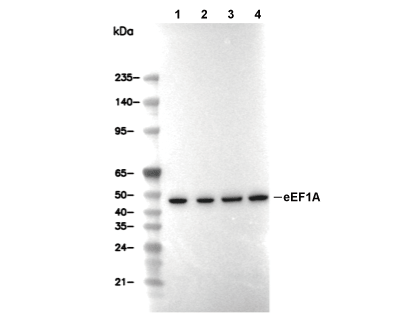 Lane 1: MCF7, Lane 2: 293, Lane 3: PANC-1, Lane 4: C2C12
Usage Information
| Dilution |
|---|
|
| Application |
|---|
| WB |
| Reactivity |
|---|
| Human, Mouse, Rat, Monkey |
| Source |
|---|
| Rabbit Monoclonal Antibody |
| Storage Buffer |
|---|
| PBS, pH 7.2+50% Glycerol+0.05% BSA+0.01% NaN3 |
| Storage (from the date of receipt) |
|---|
| -20°C (avoid freeze-thaw cycles), 2 years |
| Predicted MW |
|---|
| 50 kDa |
| Positive Control | MCF‑7 cells; 293 cells; PANC‑1 cells; RD cells; C2C12 cells; KNRK cells |
|---|---|
| Negative Control |
Experimental Methods
| WB |
|---|
Experimental Protocol:
Sample preparation
1. Tissue: Lyse the tissue sample by adding an appropriate volume of ice-cold RIPA/NP-40 Lysis Buffer (containing Protease Inhibitor Cocktail),and homogenize the tissue at a low temperature. 2. Adherent cell: Aspirate the culture medium and wash the cells with ice-cold PBS twice. Lyse the cells by adding an appropriate volume of RIPA/NP-40 Lysis Buffer (containing Protease Inhibitor Cocktail) and put the sample on ice for 5 min. 3. Suspension cell: Transfer the culture medium to a pre-cooled centrifuge tube. Centrifuge and aspirate the supernatant. Wash the cells with ice-cold PBS twice. Lyse the cells by adding an appropriate volume of RIPA/NP-40 Lysis Buffer (containing Protease Inhibitor Cocktail) and put the sample on ice for 5 min. 4. Place the lysate into a pre-cooled microcentrifuge tube. Centrifuge at 4°C for 15 min. Collect the supernatant;
5. Remove a small volume of lysate to determine the protein concentration;
6. Combine the lysate with protein loading buffer. Boil 20 µL sample under 95-100°C for 5 min. Centrifuge for 5 min after cool down on ice.
Electrophoretic separation
1. According to the concentration of extracted protein, load appropriate amount of protein sample and marker onto SDS-PAGE gels for electrophoresis. Recommended separating gel (lower gel) concentration: 10%. Reference Table for Selecting SDS-PAGE Separation Gel Concentrations 2. Power up 80V for 30 minutes. Then the power supply is adjusted (110 V~150 V), the Marker is observed, and the electrophoresis can be stopped when the indicator band of the predyed protein Marker where the protein is located is properly separated. (Note that the current should not be too large when electrophoresis, too large current (more than 150 mA) will cause the temperature to rise, affecting the result of running glue. If high currents cannot be avoided, an ice bath can be used to cool the bath.)
Transfer membrane
1. Take out the converter, soak the clip and consumables in the pre-cooled converter;
2. Activate PVDF membrane with methanol for 1 min and rinse with transfer buffer;
3. Install it in the order of "black edge of clip - sponge - filter paper - filter paper - glue -PVDF membrane - filter paper - filter paper - sponge - white edge of clip"; 4. The protein was electrotransferred to PVDF membrane. ( 0.45 µm PVDF membrane is recommended ) Reference Table for Selecting PVDF Membrane Pore Size Specifications Recommended conditions for wet transfer: 200 mA, 120 min. ( Note that the transfer conditions can be adjusted according to the protein size. For high-molecular-weight proteins, a higher current and longer transfer time are recommended. However, ensure that the transfer tank remains at a low temperature to prevent gel melting.)
Block
1. After electrotransfer, wash the film with TBST at room temperature for 5 minutes;
2. Incubate the film in the blocking solution for 1 hour at room temperature;
3. Wash the film with TBST for 3 times, 5 minutes each time.
Antibody incubation
1. Use 5% skim milk powder to prepare the primary antibody working liquid (recommended dilution ratio for primary antibody 1:1000), gently shake and incubate with the film at 4°C overnight; 2. Wash the film with TBST 3 times, 5 minutes each time;
3. Add the secondary antibody to the blocking solution and incubate with the film gently at room temperature for 1 hour;
4. After incubation, wash the film with TBST 3 times for 5 minutes each time.
Antibody staining
1. Add the prepared ECL luminescent substrate (or select other color developing substrate according to the second antibody) and mix evenly;
2. Incubate with the film for 1 minute, remove excess substrate (keep the film moist), wrap with plastic film, and expose in the imaging system. |
Biological Description
| Specificity |
|---|
| eEF1A Antibody [P21C20] detects endogenous levels of total eEF1A protein. |
| Subcellular Location |
|---|
| Cell membrane, Cytoplasm, Membrane, Nucleus |
| Uniprot ID |
|---|
| P68104 |
| Clone |
|---|
| P21C20 |
| Synonym(s) |
|---|
| Elongation factor 1-alpha 1; EF-1-alpha-1; Elongation factor 1 A-1; eEF1A-1; Eukaryotic elongation factor 1 A-1; EEF1A1; EF1A; LENG7 |
| Background |
|---|
| eEF1A serves as the GTPase subunit of the eukaryotic translation elongation factor 1 complex, delivering aminoacyl-tRNAs to the ribosomal A-site during protein synthesis across eukaryotes. It adopts a compact GTP-binding fold with three structural domains that undergo conformational shifts between GTP- and GDP-bound states to cycle between open and closed configurations. In its GTP-bound form, eEF1A forms a ternary complex with aminoacyl-tRNA and eEF1B guanine nucleotide exchange factor, promoting accurate codon-anticodon matching at the ribosome A-site followed by GTP hydrolysis triggered by the ribosome's sarcin-ricin loop and SRL GTPase-activating center. Post-hydrolysis, GDP-bound eEF1A dissociates, enabling eEF1B-mediated nucleotide exchange to reset the cycle while proofreading ensures fidelity through kinetic discrimination of cognate versus near-cognate tRNAs. Beyond elongation, eEF1A bundles actin filaments and stabilizes microtubules, interacting with F-actin, tubulin, and synaptic proteins to modulate cytoskeletal dynamics at growth cones and postsynaptic densities. Phosphorylation by Raf kinases at sites like Ser21 and Thr88 alters eEF1A stability, half-life, and apoptosis sensitivity in cancer cells, while heat shock activates eEF1A to recruit HSF1 to HSP70 promoters via non-coding HSR1 RNA, associate with RNA polymerase II during transcription elongation, stabilize HSP70 mRNA through 3'UTR binding, facilitate its nuclear export, and direct it to polysomes for stress granule-free translation. eEF1A isoforms exhibit tissue-specific expression with eEF1A1 ubiquitous and eEF1A2 enriched in brain and muscle, supporting proteostasis, signal transduction, and proteasomal delivery of misfolded proteins via interactions with HSC70 and Bag-6. Dysregulated eEF1A activity contributes to neurodegeneration and oncogenesis through altered translation fidelity and stress responses. |
| References |
|---|
|
Tech Support
Tel: +1-832-582-8158 Ext:3
If you have any other enquiries, please leave a message.

Products are for research use only. Not for human use. We do not sell to patients.
©Copyright 2013 Selleck Chemicals. All Rights Reserved.