
-
 Argentina
-
 Australia
-
 Austria
-
 Belgium
-
 Brazil
-
 Canada
-
 China
China
-
 Czech Republic
-
 Denmark
-
 Finland
-
 France
-
 Germany
-
 Greece
-
 Hong Kong
-
 Hungary
-
 Iceland
-
 India
India
-
 Ireland
-
 Israel
-
 Italy
Italy
-
 Japan
Japan
-
 Korea
Korea
-
 Luxembourg
-
 Malaysia
-
 Netherlands
-
 New Zealand
-
 Norway
-
 Poland
-
 Portugal
-
 Qatar
Qatar
-
 Romania
-
 Saudi Arabia
-
 Singapore
-
 Spain
Spain
-
 Sweden
-
 Switzerland
-
 Taiwan
-
 Turkey
-
 United Kingdom
-
 United States
research use only
DLL4 Antibody (Hamster mAb) [N12K10]
CatNo: F5840
-
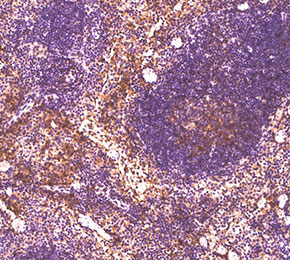 Immunohistochemical analysis of formalin fixed paraffin embedded mouse spleen tissue with F5840 at 1:100 dilution.
Usage Information
| Dilution |
|---|
|
| Application |
|---|
| IHC, FCM |
| Reactivity |
|---|
| Mouse |
| Source |
|---|
| Hamster Monoclonal Antibody |
| Storage Buffer |
|---|
| PBS, pH 7.2+50% Glycerol+0.05% BSA+0.01% NaN3 |
| Storage (from the date of receipt) |
|---|
| -20°C (avoid freeze-thaw cycles), 2 years |
| Predicted MW |
|---|
| 75 kDa |
Experimental Methods
| IHC |
|---|
Experimental Protocol:
Deparaffinization/Rehydration
1. Deparaffinize/hydrate sections:
2. Incubate sections in three washes of xylene for 5 min each.
3. Incubate sections in two washes of 100% ethanol for 10 min each.
4. Incubate sections in two washes of 95% ethanol for 10 min each.
5. Wash sections two times in dH2O for 5 min each.
6.Antigen retrieval: For Citrate: Heat slides in a microwave submersed in 1X citrate unmasking solution until boiling is initiated; continue with 10 min at a sub-boiling temperature (95°-98°C). Cool slides on bench top for 30 min.
Staining
1. Wash sections in dH2O three times for 5 min each.
2. Incubate sections in 3% hydrogen peroxide for 10 min.
3. Wash sections in dH2O two times for 5 min each.
4. Wash sections in wash buffer for 5 min.
5. Block each section with 100–400 µl of blocking solution for 1 hr at room temperature.
6. Remove blocking solution and add 100–400 µl primary antibody diluent in to each section. Incubate overnight at 4°C.
7. Remove antibody solution and wash sections with wash buffer three times for 5 min each.
8. Cover section with 1–3 drops HRPas needed. Incubate in a humidified chamber for 30 min at room temperature.
9. Wash sections three times with wash buffer for 5 min each.
10. Add DAB Chromogen Concentrate to DAB Diluent and mix well before use.
11. Apply 100–400 µl DAB to each section and monitor closely. 1–10 min generally provides an acceptable staining intensity.
12. Immerse slides in dH2O.
13. If desired, counterstain sections with hematoxylin.
14. Wash sections in dH2O two times for 5 min each.
15. Dehydrate sections: Incubate sections in 95% ethanol two times for 10 sec each; Repeat in 100% ethanol, incubating sections two times for 10 sec each; Repeat in xylene, incubating sections two times for 10 sec each.
16. Mount sections with coverslips and mounting medium.
|
Biological Description
| Specificity |
|---|
DLL4 Antibody (Hamster mAb) [N12K10] detects endogenous levels of total δ-Like Protein 4 protein. |
| Subcellular Location |
|---|
| Cell membrane, Membrane |
| Uniprot ID |
|---|
| Q9JI71 |
| Clone |
|---|
| N12K10 |
| Synonym(s) |
|---|
| AOS6 | delta 4 | delta ligand 4 | delta like canonical Notch ligand 4 | delta-like 4 (Drosophila) | delta-like 4 homolog | delta-like 4 protein | Delta-like protein 4 | Delta4 | DLL4 | Drosophila Delta homolog 4 | hdelta2 | MGC126344 | notch ligand delta-2 | notch ligand DLL4 |
| Background |
|---|
Delta‑like protein 4 (DLL4) is an endothelial‑enriched Notch ligand of the Delta/Serrate/Lag family that presents an extracellular DSL motif and tandem EGF‑like repeats to engage Notch receptors on adjacent cells, where ligand‑induced receptor cleavage generates the Notch intracellular domain and drives transcriptional programs that sculpt vascular patterning. DLL4 expression is largely restricted to arterial and actively sprouting endothelium, with highest levels in tip and stalk cells of angiogenic vessels, and is strongly induced by pro‑angiogenic cues such as VEGF and hypoxia‑regulated HIF‑1α, placing DLL4/Notch signaling downstream of VEGF receptor activation in the hierarchy of angiogenic control. At the sprouting front, DLL4 expressed on emerging tip cells activates Notch in neighboring stalk cells, down‑regulates VEGF receptor expression, limits excessive tip‑cell formation, and enforces a hierarchical branching pattern that yields a functional, perfused vascular network; genetic or pharmacologic blockade of DLL4/Notch signaling disrupts this lateral inhibition, increases endothelial proliferation and branching, and produces dense but poorly perfused, non‑productive vasculature. DLL4 is up‑regulated in the vasculature of many solid cancers, including colorectal, breast, renal, pancreatic, and glioblastoma models, and that forced DLL4 expression in tumor or stromal compartments reduces vessel density but enlarges lumen size and improves vascular function, lowering hypoxia and apoptosis and supporting tumor growth, whereas soluble DLL4 decoys or anti‑DLL4 antibodies increase vessel number yet impair perfusion and suppress tumor expansion, including in settings that are resistant to anti‑VEGF therapy. Across preclinical models, high DLL4 levels in tumor endothelium correlate with more mature vasculature and shorter patient survival, while DLL4 blockade consistently drives hyper‑sprouting and functional collapse of the tumor vasculature, identifying DLL4/Notch as a central negative regulator of angiogenic output that modulates and intersects with VEGF signaling rather than simply mirroring it. |
| References |
|---|
|
Tech Support
Tel: +1-832-582-8158 Ext:3
If you have any other enquiries, please leave a message.

Products are for research use only. Not for human use. We do not sell to patients.
©Copyright 2013 Selleck Chemicals. All Rights Reserved.