
-
 Australia
-
 Austria
-
 Belgium
-
 Brazil
-
 Canada
-
 China
China
-
 Czech Republic
-
 Denmark
-
 Finland
-
 France
-
 Germany
-
 Greece
-
 Hong Kong
-
 Hungary
-
 Iceland
-
 India
India
-
 Ireland
-
 Israel
-
 Italy
Italy
-
 Japan
Japan
-
 Korea
Korea
-
 Luxembourg
-
 Malaysia
-
 Netherlands
-
 New Zealand
-
 Norway
-
 Poland
-
 Qatar
Qatar
-
 Romania
-
 Saudi Arabia
-
 Singapore
-
 Spain
Spain
-
 Sweden
-
 Switzerland
-
 Taiwan
-
 Turkey
-
 United Kingdom
-
 United States
research use only
Choline Acetyltransferase Antibody (Rabbit mAb) [N24K12]
CatNo: F5491
-
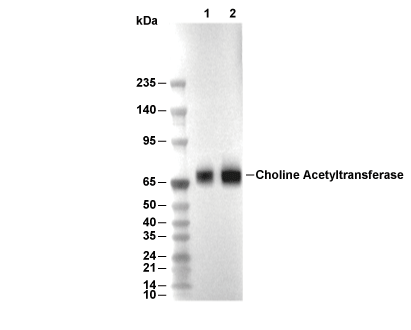 Lane 1: Mouse brain, Lane 2: Rat brain
Usage Information
| Dilution |
|---|
|
| Application |
|---|
| WB, IHC |
| Reactivity |
|---|
| Mouse, Rat, Rabbit, Guinea pig |
| Source |
|---|
| Rabbit Monoclonal Antibody |
| Storage Buffer |
|---|
| PBS, pH 7.2+50% Glycerol+0.05% BSA+0.01% NaN3 |
| Storage (from the date of receipt) |
|---|
| -20°C (avoid freeze-thaw cycles), 2 years |
| Predicted MW Observed MW |
|---|
| 83 kDa 72 kDa |
| *Why do the predicted and actual molecular weights differ? The following reasons may explain differences between the predicted and actual protein molecular weight. Post-translational modifications(e.g., phosphorylation, glycosylation); Splice variants and isoforms; Relative charge; Multimerization. |
| Positive Control | Rat brain; Mouse cerebral cortex tissue; Mouse brain tissue; Guinea Pig brain; Guinea Pig cerebral cortex; Guinea Pig cerebellum |
|---|---|
| Negative Control |
Experimental Methods
| WB |
|---|
Experimental Protocol:
Sample preparation
1. Tissue: Lyse the tissue sample by adding an appropriate volume of ice-cold RIPA/NP-40 Lysis Buffer (containing Protease Inhibitor Cocktail),and homogenize the tissue at a low temperature or lyse it by sonication on ice, then incubate on ice for 30 minutes. 2. Adherent cell: Aspirate the culture medium and wash the cells with ice-cold PBS twice. Lyse the cells by adding an appropriate volume of RIPA/NP-40 Lysis Buffer (containing Protease Inhibitor Cocktail) , sonicate to lyse the cells, and incubate on ice for 30 minutes. 3. Suspension cell: Transfer the culture medium to a pre-cooled centrifuge tube. Centrifuge and aspirate the supernatant. Wash the cells with ice-cold PBS twice. Lyse the cells by adding an appropriate volume of RIPA/NP-40 Lysis Buffer (containing Protease Inhibitor Cocktail) , sonicate to lyse the cells, and incubate on ice for 30 minutes. 4. Place the lysate into a pre-cooled microcentrifuge tube. Centrifuge at 4°C for 15 min. Collect the supernatant;
5. Remove a small volume of lysate to determine the protein concentration;
6. Combine the lysate with protein loading buffer. Boil 20 µL sample under 95-100°C for 5 min. Centrifuge for 5 min after cool down on ice.
Electrophoretic separation
1. According to the concentration of extracted protein, load appropriate amount of protein sample and marker onto SDS-PAGE gels for electrophoresis. Recommended separating gel (lower gel) concentration: 10%. Reference Table for Selecting SDS-PAGE Separation Gel Concentrations 2. Power up 80V for 30 minutes. Then the power supply is adjusted (110 V~150 V), the Marker is observed, and the electrophoresis can be stopped when the indicator band of the predyed protein Marker where the protein is located is properly separated. (Note that the current should not be too large when electrophoresis, too large current (more than 150 mA) will cause the temperature to rise, affecting the result of running glue. If high currents cannot be avoided, an ice bath can be used to cool the bath.)
Transfer membrane
1. Take out the converter, soak the clip and consumables in the pre-cooled converter;
2. Activate PVDF membrane with methanol for 1 min and rinse with transfer buffer;
3. Install it in the order of "black edge of clip - sponge - filter paper - filter paper - glue -PVDF membrane - filter paper - filter paper - sponge - white edge of clip"; 4. The protein was electrotransferred to PVDF membrane. ( 0.45 µm PVDF membrane is recommended ) Reference Table for Selecting PVDF Membrane Pore Size Specifications Recommended conditions for wet transfer: 200 mA, 120 min. ( Note that the transfer conditions can be adjusted according to the protein size. For high-molecular-weight proteins, a higher current and longer transfer time are recommended. However, ensure that the transfer tank remains at a low temperature to prevent gel melting.)
Block
1. After electrotransfer, wash the film with TBST at room temperature for 5 minutes;
2. Incubate the film in the blocking solution for 1 hour at room temperature;
3. Wash the film with TBST for 3 times, 5 minutes each time.
Antibody incubation
1. Use primary antibody dilution buffer to prepare the primary antibody working liquid (recommended dilution ratio for primary antibody 1:5000), gently shake and incubate with the film at 4°C overnight; 2. Wash the film with TBST 3 times, 5 minutes each time;
3. Add the secondary antibody to the blocking solution and incubate with the film gently at room temperature for 1 hour;
4. After incubation, wash the film with TBST 3 times for 5 minutes each time.
Antibody staining
1. Add the prepared ECL luminescent substrate (or select other color developing substrate according to the second antibody) and mix evenly;
2. Incubate with the film for 1 minute, remove excess substrate (keep the film moist), wrap with plastic film, and expose in the imaging system. |
| IHC |
|---|
Experimental Protocol:
Deparaffinization/Rehydration
1. Deparaffinize/hydrate sections:
2. Incubate sections in three washes of xylene for 5 min each.
3. Incubate sections in two washes of 100% ethanol for 10 min each.
4. Incubate sections in two washes of 95% ethanol for 10 min each.
5. Wash sections two times in dH2O for 5 min each.
6.Antigen retrieval: For Citrate: Heat slides in a microwave submersed in 1X citrate unmasking solution until boiling is initiated; continue with 10 min at a sub-boiling temperature (95°-98°C). Cool slides on bench top for 30 min.
Staining
1. Wash sections in dH2O three times for 5 min each.
2. Incubate sections in 3% hydrogen peroxide for 10 min.
3. Wash sections in dH2O two times for 5 min each.
4. Wash sections in wash buffer for 5 min.
5. Block each section with 100–400 µl of blocking solution for 1 hr at room temperature.
6. Remove blocking solution and add 100–400 µl primary antibody diluent in to each section. Incubate overnight at 4°C.
7. Remove antibody solution and wash sections with wash buffer three times for 5 min each.
8. Cover section with 1–3 drops HRPas needed. Incubate in a humidified chamber for 30 min at room temperature.
9. Wash sections three times with wash buffer for 5 min each.
10. Add DAB Chromogen Concentrate to DAB Diluent and mix well before use.
11. Apply 100–400 µl DAB to each section and monitor closely. 1–10 min generally provides an acceptable staining intensity.
12. Immerse slides in dH2O.
13. If desired, counterstain sections with hematoxylin.
14. Wash sections in dH2O two times for 5 min each.
15. Dehydrate sections: Incubate sections in 95% ethanol two times for 10 sec each; Repeat in 100% ethanol, incubating sections two times for 10 sec each; Repeat in xylene, incubating sections two times for 10 sec each.
16. Mount sections with coverslips and mounting medium.
|
Biological Description
| Specificity |
|---|
Choline Acetyltransferase Antibody (Rabbit mAb) [N24K12] detects endogenous levels of total Choline Acetyltransferase protein. |
| Uniprot ID |
|---|
| P28329 |
| Clone |
|---|
| N24K12 |
| Synonym(s) |
|---|
| Choline O-acetyltransferase, CHOACTase, ChAT, Choline acetylase, Chat |
| Background |
|---|
Choline acetyltransferase (ChAT; EC 2.3.1.6) is the biosynthetic enzyme for the neurotransmitter acetylcholine and serves as the most specific biochemical marker of cholinergic neurons in the central and peripheral nervous systems, where it is synthesized in the perikaryon and transported to nerve terminals in both soluble and non‑ionic membrane‑associated forms to support continuous transmitter production at synapses. ChAT is a single‑chain globular protein that belongs to the choline/carnitine acyltransferase family and is organized into two domains forming an interfacial active‑site tunnel; structural analysis combined with mechanistic studies shows that conserved residues such as His334, Tyr95, Pro108 and Ser550 coordinate catalysis by acting as a general base, stabilizing the unprotonated histidine, and supporting oxyanion stabilization during tetrahedral intermediate formation, enabling the reversible transfer of an acetyl group from acetyl‑CoA to choline with high specificity. The ChAT gene has a distinctive genomic architecture in which its first intron encodes the vesicular acetylcholine transporter (VAChT), and multiple mRNA species (R‑, N‑ and M‑type) produced by alternative promoters and splicing yield different transcript forms that in humans can generate both large and small ChAT proteins, while rodents produce a single protein form; these arrangements allow coordinated transcriptional regulation of ChAT and VAChT so that cytosolic acetylcholine synthesis and vesicular loading remain tightly matched in cholinergic neurons. Immunohistochemical and in situ hybridization mapping identifies ChAT‑positive neurons in basal forebrain regions such as the medial septal nucleus, diagonal band of Broca and nucleus basalis of Meynert, in striatal structures including caudate nucleus, putamen and nucleus accumbens, in brainstem nuclei such as the pedunculopontine and laterodorsal tegmental nuclei and medial habenula, and in spinal anterior horn motor neurons, where their widely projecting axons create an extensive cholinergic network that participates in learning, memory, arousal, sleep and movement. At the mechanistic level, ChAT catalysis proceeds via deprotonation of choline by His334, nucleophilic attack on the acetyl‑CoA carbonyl to form a tetrahedral oxyanion intermediate stabilized by Ser550, collapse of this intermediate with release of CoA and formation of acetylcholine, and choline acetyltransferase operates as a reversible acyltransferase whose kinetic properties, including substrate affinities for choline and acetyl‑CoA, determine acetylcholine synthesis rates under physiological and pathological conditions. Mutations in CHAT that alter active‑site residues, substrate binding pockets or domain interfaces reduce catalytic efficiency or destabilize the enzyme and cause congenital myasthenic syndromes with episodic apnea and fatigable weakness, highlighting that intact ChAT structure and function are essential for neuromuscular transmission and that mutation distribution across the 3D structure explains disease severity and response to cholinergic therapies. In neurodegenerative disease, ChAT activity is significantly reduced in multiple cortical and hippocampal regions in Alzheimer’s disease, especially in early‑onset cases, and enzyme activity correlates with dementia severity and neurofibrillary tangle burden rather than plaque counts, supporting the cholinergic hypothesis that basal forebrain cholinergic dysfunction contributes to cognitive decline and providing a quantitative marker of cholinergic pathway integrity in human tissue and animal models. ChAT abnormalities have also been reported in amyotrophic lateral sclerosis, schizophrenia and sudden infant death syndrome, where disturbed cholinergic innervation is thought to influence clinical manifestations, and recent work on primate‑specific large ChAT isoforms indicates that increased expression of an 82‑kDa variant can attenuate progression of amyloid pathology and cholinergic dysfunction in Alzheimer‑like mouse models, suggesting that ChAT isoform composition and regulation may have therapeutic relevance. |
| References |
|---|
|
Tech Support
Tel: +1-832-582-8158 Ext:3
If you have any other enquiries, please leave a message.

Products are for research use only. Not for human use. We do not sell to patients.
©Copyright 2013 Selleck Chemicals. All Rights Reserved.