
-
 Australia
-
 Austria
-
 Belgium
-
 Brazil
-
 Canada
-
 China
China
-
 Czech Republic
-
 Denmark
-
 Finland
-
 France
-
 Germany
-
 Greece
-
 Hong Kong
-
 Hungary
-
 Iceland
-
 India
India
-
 Ireland
-
 Israel
-
 Italy
Italy
-
 Japan
Japan
-
 Korea
Korea
-
 Luxembourg
-
 Malaysia
-
 Netherlands
-
 New Zealand
-
 Norway
-
 Poland
-
 Qatar
Qatar
-
 Romania
-
 Saudi Arabia
-
 Singapore
-
 Spain
Spain
-
 Sweden
-
 Switzerland
-
 Taiwan
-
 Turkey
-
 United Kingdom
-
 United States
research use only
ANK-3 Antibody (Mouse mAb) [F22J23]
CatNo: F3938
Application:
Reactivity:
-
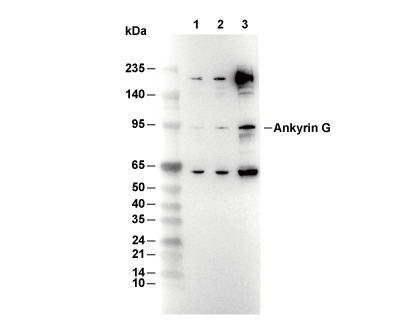 Lane 1: SH-ST5T, Lane 2: U-87MG, Lane 3: Mouse brain
Experiment Essentials
WB
Recommended SDS-PAGE separating gel concentration: 5%.
Recommended wet transfer conditions: 250 mA, 180 min.
Recommended SDS-PAGE separating gel concentration: 5%.
Recommended wet transfer conditions: 250 mA, 180 min.
Usage Information
| Dilution |
|---|
|
| Application |
|---|
| WB, IP, IF, ELISA |
| Reactivity |
|---|
| Dog, Human, Mouse, Rabbit, Rat |
| Source |
|---|
| Mouse Monoclonal Antibody |
| Storage Buffer |
|---|
| PBS, pH 7.2+50% Glycerol+0.05% BSA+0.01% NaN3 |
| Storage (from the date of receipt) |
|---|
| -20°C (avoid freeze-thaw cycles), 2 years |
| Predicted MW |
|---|
| 480 kDa |
| Positive Control | U-87 MG cells; SH-SY5Y cells |
|---|---|
| Negative Control |
Experimental Methods
| WB |
|---|
Experimental Protocol:
Sample preparation
1. Tissue: Lyse the tissue sample by adding an appropriate volume of ice-cold RIPA/NP-40 Lysis Buffer (containing Protease Inhibitor Cocktail),and homogenize the tissue at a low temperature or lyse it by sonication on ice, then incubate on ice for 30 minutes. 2. Adherent cell: Aspirate the culture medium and wash the cells with ice-cold PBS twice. Lyse the cells by adding an appropriate volume of RIPA/NP-40 Lysis Buffer (containing Protease Inhibitor Cocktail) , sonicate to lyse the cells, and incubate on ice for 30 minutes. 3. Suspension cell: Transfer the culture medium to a pre-cooled centrifuge tube. Centrifuge and aspirate the supernatant. Wash the cells with ice-cold PBS twice. Lyse the cells by adding an appropriate volume of RIPA/NP-40 Lysis Buffer (containing Protease Inhibitor Cocktail) , sonicate to lyse the cells, and incubate on ice for 30 minutes. 4. Place the lysate into a pre-cooled microcentrifuge tube. Centrifuge at 4°C for 15 min. Collect the supernatant;
5. Remove a small volume of lysate to determine the protein concentration;
6. Combine the lysate with protein loading buffer. Boil 20 µL sample under 95-100°C for 5 min. Centrifuge for 5 min after cool down on ice.
Electrophoretic separation
1. According to the concentration of extracted protein, load appropriate amount of protein sample and marker onto SDS-PAGE gels for electrophoresis. Recommended separating gel (lower gel) concentration: 5%. Reference Table for Selecting SDS-PAGE Separation Gel Concentrations 2. Power up 80V for 30 minutes. Then the power supply is adjusted (110 V~150 V), the Marker is observed, and the electrophoresis can be stopped when the indicator band of the predyed protein Marker where the protein is located is properly separated. (Note that the current should not be too large when electrophoresis, too large current (more than 150 mA) will cause the temperature to rise, affecting the result of running glue. If high currents cannot be avoided, an ice bath can be used to cool the bath.)
Transfer membrane
1. Take out the converter, soak the clip and consumables in the pre-cooled converter;
2. Activate PVDF membrane with methanol for 1 min and rinse with transfer buffer;
3. Install it in the order of "black edge of clip - sponge - filter paper - filter paper - glue -PVDF membrane - filter paper - filter paper - sponge - white edge of clip"; 4. The protein was electrotransferred to PVDF membrane. ( 0.45 µm PVDF membrane is recommended ) Reference Table for Selecting PVDF Membrane Pore Size Specifications Recommended conditions for wet transfer: 250 mA, 180 min. ( Note that the transfer conditions can be adjusted according to the protein size. For high-molecular-weight proteins, a higher current and longer transfer time are recommended. However, ensure that the transfer tank remains at a low temperature to prevent gel melting.)
Block
1. After electrotransfer, wash the film with TBST at room temperature for 5 minutes;
2. Incubate the film in the blocking solution for 1 hour at room temperature;
3. Wash the film with TBST for 3 times, 5 minutes each time.
Antibody incubation
1. Use primary antibody dilution buffer to prepare the primary antibody working liquid (recommended dilution ratio for primary antibody 1:1000), gently shake and incubate with the film at 4°C overnight; 2. Wash the film with TBST 3 times, 5 minutes each time;
3. Add the secondary antibody to the blocking solution and incubate with the film gently at room temperature for 1 hour;
4. After incubation, wash the film with TBST 3 times for 5 minutes each time.
Antibody staining
1. Add the prepared ECL luminescent substrate (or select other color developing substrate according to the second antibody) and mix evenly;
2. Incubate with the film for 1 minute, remove excess substrate (keep the film moist), wrap with plastic film, and expose in the imaging system. |
| IF |
|---|
Experimental Protocol:
Sample Preparation
1. Adherent Cells: Place a clean, sterile coverslip in a culture dish. Once the cells grow to near confluence as a monolayer, remove the coverslip for further use.
2. Suspension Cells: Seed the cells onto a clean, sterile slide coated with poly-L-lysine.
3. Frozen Sections: Allow the slide to thaw at room temperature. Wash it with pure water or PBS for 2 times, 3 minutes each time.
4. Paraffin Sections: Deparaffinization and rehydration. Wash the slide with pure water or PBS for 3 times, 3 minutes each time. Then perform antigen retrieval.
Fixation
1. Fix the cell coverslips/spots or tissue sections at room temperature using a fixative such as 4% paraformaldehyde (4% PFA) for 10-15 minutes.
2. Wash the sample with PBS for 3 times, 3 minutes each time.
Permeabilization
1.Add a detergent such as 0.1–0.3% Triton X-100 to the sample and incubate at room temperature for 10–20 minutes.
(Note: This step is only required for intracellular antigens. For antigens expressed on the cell membrane, this step is unnecessary.)
Wash the sample with PBS for 3 times, 3 minutes each time.
Blocking
Add blocking solution and incubate at room temperature for at least 1 hour. (Common blocking solutions include: serum from the same source as the secondary antibody, BSA, or goat serum.)
Note: Ensure the sample remains moist during and after the blocking step to prevent drying, which can lead to high background.
Immunofluorescence Staining (Day 1)
1. Remove the blocking solution and add the diluted primary antibody.
2. Incubate the sample in a humidified chamber at 4°C overnight.
Immunofluorescence Staining (Day 2)
1. Remove the primary antibody and wash with PBST for 3 times, 5 minutes each time.
2. Add the diluted fluorescent secondary antibody and incubate in the dark at 4°C for 1–2 hours.
3. Remove the secondary antibody and wash with PBST for 3 times, 5 minutes each time.
4. Add diluted DAPI and incubate at room temperature in the dark for 5–10 minutes.
5. Wash with PBST for 3 times, 5 minutes each time.
Mounting
1. Mount the sample with an anti-fade mounting medium.
2. Allow the slide to dry at room temperature overnight in the dark.
3. Store the slide in a slide storage box at 4°C, protected from light.
|
Biological Description
| Specificity |
|---|
| ANK-3 Antibody (Mouse mAb) [F22J23] detects endogenous levels of total ANK-3 protein. |
| Subcellular Location |
|---|
| Cell membrane, Cell projection, Cytoskeleton, Golgi apparatus, Lysosome, Synapse |
| Uniprot ID |
|---|
| Q12955 |
| Clone |
|---|
| F22J23 |
| Synonym(s) |
|---|
| Ankyrin-3 | ANK-3 | Ankyrin-G | ANK3 |
| Background |
|---|
| Ankyrin‑G, encoded by ANK-3, is a member of the ankyrin family of modular scaffold proteins that link selected integral membrane proteins to the spectrin–actin cytoskeleton, and it is highly enriched at axon initial segments and nodes of Ranvier where it organizes specialized excitable domains required for action potential initiation and propagation. The protein contains an N‑terminal membrane‑binding domain formed by multiple ankyrin repeats that recognize cytoplasmic motifs in ion channels and adhesion molecules, a central spectrin‑binding region that connects to βIV‑spectrin and the submembranous actin network, and a C‑terminal regulatory tail that is subject to phosphorylation and other modifications, creating a flexible scaffold that stabilizes large macromolecular complexes at defined axonal segments. At axon initial segments, ankyrin‑G is required for the clustering of voltage‑gated sodium channels such as Nav1.6 and Nav1.2 together with the adhesion molecules neurofascin‑186 and NrCAM; conditional loss of ankyrin‑G disperses these channels and adhesion proteins, eliminates the high-density sodium channel cluster, and abolishes normal action potential firing, demonstrating that ankyrin‑G is an essential organizer of AIS excitability rather than a passive tether. The assembly mechanisms of ankyrin‑G–dependent domains differ between AIS and nodes of Ranvier: AIS formation is intrinsically specified by the early accumulation of ankyrin‑G, which then recruits neurofascin‑186 via its intracellular tail and supports sodium channel clustering from the inside toward the membrane, whereas peripheral nervous system nodes are specified by Schwann‑cell cues that target neurofascin‑186 to nodal axolemma through its extracellular domain and subsequently recruit ankyrin‑G and sodium channels from the outside in, defining distinct inside‑out and outside‑in assembly pathways that both converge on ankyrin‑G as a central scaffold. Ankyrin‑G not only concentrates Nav channels but also directly regulates their gating; co‑expression of ankyrin‑G with Nav1.6 reduces persistent sodium current while ankyrin‑B does not, and chimera experiments show that the membrane‑binding domain of ankyrin‑G is critical for this effect, indicating that ankyrin‑G can adjust channel biophysical properties in addition to organizing their spatial distribution. At developing nodes of Ranvier, giant ankyrin‑G isoforms co‑cluster with neurofascin, NrCAM and Nav channels within discrete segments of the spectrin–actin network, delineating early nodal intermediates that mature into fully functional nodes, and this scaffolding arrangement also shapes a diffusion barrier that preserves axonal identity by restricting somatodendritic proteins from entering the axon. Ankyrin‑G is expressed as multiple tissue‑specific splice variants, including giant neuronal isoforms uniquely targeted to AIS and nodes, and shorter isoforms present at epithelial cell–cell junctions and intracellular membranes where they anchor adhesion complexes and potentially modulate polarized trafficking, expanding the relevance of ankyrin‑G beyond classical neuronal excitability into broader aspects of cell architecture. Genetic and functional data link ANK3/ankyrin‑G to neuropsychiatric conditions such as bipolar disorder and autism spectrum disorder, consistent with the central role of AIS structure and Nav channel clustering in shaping neuronal firing patterns and circuit integration, and ankyrin‑G’s established importance in excitable cell domains has also connected this scaffold to cardiac arrhythmia and sudden death when cytoskeletal signaling pathways are disrupted. |
| References |
|---|
|
Tech Support
Tel: +1-832-582-8158 Ext:3
If you have any other enquiries, please leave a message.

Products are for research use only. Not for human use. We do not sell to patients.
©Copyright 2013 Selleck Chemicals. All Rights Reserved.