
|
How to Cite 1. For In-Text Citation (Materials & Methods): 2. For Key Resources Table: |
||
|
Toll Free: (877) 796-6397 -- USA and Canada only -- |
Fax: +1-832-582-8590 Orders: +1-832-582-8158 |
Tech Support: +1-832-582-8158 Ext:3 Please provide your Order Number in the email. We strive to reply to |
Biological Description
| Specificity | UQCRFS1/RISP Antibody [P24M17] detects endogenous levels of total UQCRFS1/RISP protein. |
|---|---|
| Background | UQCRFS1, known as the Rieske iron-sulfur protein or RISP, functions as the mobile extrinsic subunit of mitochondrial complex III (cytochrome bc1 complex) within the electron transport chain, facilitating electron shuttling from ubiquinol to cytochrome c during oxidative phosphorylation. The protein harbors a [2Fe-2S] cluster coordinated by eight cysteine and histidine residues within a folded extrinsic domain tethered by a single transmembrane helix, enabling conformational swinging between Qo and Qi sites of cytochrome b to execute the Q-cycle that translocates four protons per two electrons while preventing superoxide leakage under physiological potentials. During catalysis, reduced ubiquinol at the Qo site donates the first electron to the high-potential [2Fe-2S] cluster, which relays it to cytochrome c1 via histidine ligation, while the semiquinone intermediate bifurcates the second electron to bL and bH hemes, sustaining chain continuity and protonmotive force generation coupled to ATP synthesis. BCS1L chaperone imports the mitochondrial targeting sequence-cleaved precursor from the matrix, stabilizing the holoform through LYRM7-mediated Fe-S cluster insertion before membrane integration proximal to UQCRC1/UQCRC2 core subunits. In hematopoietic stem cells, UQCRFS1 deficiency disrupts quiescence by impairing TGF-β signaling coordination through SHP-1 interactions, elevating cycling indices and exhausting long-term repopulation capacity during serial transplantation. T cell receptor stimulation recruits UQCRFS1 to lipid rafts where complex III activity amplifies NFAT and NF-κB activation via localized ROS and calcium flux, with knockout diminishing IL-2 production and proliferation. |
Usage Information
| Application | WB, IP | Dilution |
|
||||
|---|---|---|---|---|---|---|---|
| Reactivity | Human, Mouse, Rat | ||||||
| Source | Rabbit Monoclonal Antibody | MW | 23 kDa | ||||
| Storage Buffer | PBS, pH 7.2+50% Glycerol+0.05% BSA+0.01% NaN3 | Storage (from the date of receipt) |
-20°C (avoid freeze-thaw cycles), 2 years | ||||
References
|
Application Data
WB
Validated by Selleck
-
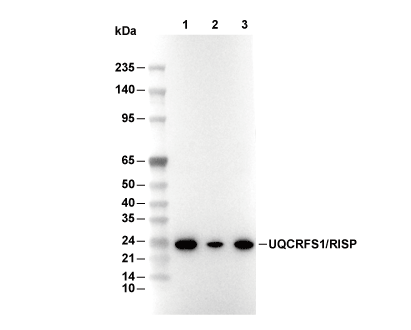 Lane 1: Neuro-2a, Lane 2: HT55, Lane 3: REC-1