
|
How to Cite 1. For In-Text Citation (Materials & Methods): 2. For Key Resources Table: |
||
|
Toll Free: (877) 796-6397 -- USA and Canada only -- |
Fax: +1-832-582-8590 Orders: +1-832-582-8158 |
Tech Support: +1-832-582-8158 Ext:3 Please provide your Order Number in the email. We strive to reply to |
Biological Description
| Specificity | PSF Antibody [M17A24] detects endogenous levels of total PSF protein. |
|---|---|
| Background | PSF (Polypyrimidine tract-binding protein-associated splicing factor) belongs to the DBHS family of nuclear proteins and functions as a multifunctional nucleic acid-binding regulator of gene expression. The protein contains two RNA recognition motifs, a DNA-binding domain, and an N-terminal proline/glutamine-rich region that mediates protein-protein interactions. PSF represses transcription of multiple oncogenic genes through direct binding to their regulatory regions via its DNA-binding domain, while RNA-binding domains form complexes with non-coding VL30 retroelement RNA to release PSF repression and reverse transcriptional silencing. PSF stimulates splicing and 3'-end cleavage of pre-mRNA in a manner dependent on RNA polymerase II C-terminal domain phosphorylation and transcriptional activator strength, with distinct RNA recognition motifs playing nonredundant roles in promoting efficient cotranscriptional processing of 5'-proximal introns. PSF coordinates with p54nrb/NonO in spliceosomal complexes and interacts with U5 snRNP stem-loop 1 to recruit tri-snRNP subunits, ensuring accurate intron removal. The protein anchors hyper-edited RNAs in paraspeckles through high-affinity binding to inosine-rich sequences, preventing their cytoplasmic export until NEAT1 dissociation or specific cleavage relieves retention. PSF binds directly to double-strand breaks via its N-terminal RGG box through the proline-rich domain and recruits RAD51D recombinase for homologous recombination repair. Increased PSF expression inhibits proliferation and colony formation while suppressing oncogenes like P450ssc and GAGE6. |
Usage Information
| Application | WB, IP, IHC, IF | Dilution |
|
||
|---|---|---|---|---|---|
| Reactivity | Human, Mouse | ||||
| Source | Mouse Monoclonal Antibody | MW | 80 kDa | ||
| Storage Buffer | PBS, pH 7.2+50% Glycerol+0.05% BSA+0.01% NaN3 | Storage (from the date of receipt) |
-20°C (avoid freeze-thaw cycles), 2 years | ||
References
|
Application Data
WB
Validated by Selleck
-
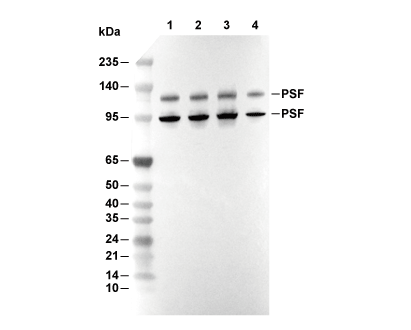 Lane 1: Hela, Lane 2: A431, Lane 3: HUVEC, Lane 4: HepG2