
|
How to Cite 1. For In-Text Citation (Materials & Methods): 2. For Key Resources Table: |
||
|
Toll Free: (877) 796-6397 -- USA and Canada only -- |
Fax: +1-832-582-8590 Orders: +1-832-582-8158 |
Tech Support: +1-832-582-8158 Ext:3 Please provide your Order Number in the email. We strive to reply to |
Technical Data
| Formula | C21H25N5O4S |
|||
| Molecular Weight | 443.52 | CAS No. | 905579-51-3 | |
| Solubility (25°C)* | In vitro | DMSO | 89 mg/mL (200.66 mM) | |
| Ethanol | 22 mg/mL (49.6 mM) | |||
| Water | Insoluble | |||
|
* <1 mg/ml means slightly soluble or insoluble. * Please note that Selleck tests the solubility of all compounds in-house, and the actual solubility may differ slightly from published values. This is normal and is due to slight batch-to-batch variations. * Room temperature shipping (Stability testing shows this product can be shipped without any cooling measures.) |
||||
Preparing Stock Solutions
Biological Activity
| Description | MLN4924 is a small molecule inhibitor of Nedd8 activating enzyme (NAE) with IC50 of 4 nM. | ||
|---|---|---|---|
| Targets |
|
||
| In vitro | Pevonedistat (MLN4924) is structurally related to adenosine 59-monophosphate (AMP)—a tight binding product of the NAE reaction. It (3 μM) selectively inhibits NAE in HCT-116 cell lysates and inhibits overall protein turnover by <9% in HCT-116 cells. This compound results in a dose-dependent decrease of Ubc12–NEDD8 thioester and NEDD8–cullin conjugates with an IC50 < 0.1 μM in HCT-116 cells, resulting in a reciprocal increase in the abundance of the known CRL substrates CDT1, p27 and NRF2, but not non-CRL substrates. It (3 μM) leads cells to accumulate in S-phase as early as 8 hours and results in a significant fraction of cells contained 4N DNA content by 24 hours in HCT-116 cells. At the same concentration, it results in rapid accumulation of pIkappaBalpha, decrease in nuclear p65 content, reduction of nuclear factor-kappaB (NF-kappaB) transcriptional activity, and G(1) arrest, ultimately resulting in apoptosis induction, events consistent with potent NF-kappaB pathway inhibition in ABC DLBCL cells. At 1 μM, it triggers DNA replication and inhibits cell proliferation by stabilizing the DNA replication factor Cdt1, a substrate of cullins 1 and 4. This concentration, which is sufficient to elevate Cdt1 for 4-5 hours, is found to be sufficient to induce DNA replication and to activate apoptosis and senescence pathways. Treatment with this compound induces the characteristics of senescence phenotypes as evidenced by enlarged and flattened cellular morphology and positive staining of senescence-associated β-Gal. MLN4924-induced senescence is associated with cellular response to DNA damage, triggered by accumulation of DNA-licensing proteins CDT1 and ORC1, as a result of inactivation of CRL/SCF E3s. It is irreversible and coupled with persistent accumulation of p21 and sustained activation of DNA damage response. | ||
| In vivo | Pevonedistat (MLN4924) (60 mg/kg) results in a dose- and time-dependent decrease of NEDD8–cullin levels as early as 30 min after administration in HCT-116 tumour-bearing mice, with maximal effect 1–2 hours post-dose. It also leads to a dose- and time-dependent increase in the steady state levels of NRF2 and CDT1 in HCT-116 tumour-bearing mice. This compound leads to DNA damage in the tumour indicated by the increased levels of phosphorylated CHK1 in HCT-116 tumour-bearing mice. When administered on a BID schedule at 30 mg/kg and 60 mg/kg, it inhibits tumour growth with T/C values of 0.36 and 0.15, respectively, in mice bearing HCT-116 xenografts. It (60 mg/kg) blocks NAE pathway biomarkers and results in complete tumor growth inhibition in mice bearing human xenograft tumors of ABC- and GCB-DLBCL. This compound (60 mg/kg) results in NF-kappaB pathway inhibition accompanied by tumor regressions in primary human tumor mice models of ABC-DLBCL. | ||
| Features | A mechanism-based inhibitor of NAE, and creates a covalent NEDD8-MLN4924 adduct catalyzed by the enzyme. |
Protocol (from reference)
| Kinase Assay:[1] |
|
|---|---|
| Cell Assay:[1] |
|
| Animal Study:[1] |
|
References
|
Customer Product Validation
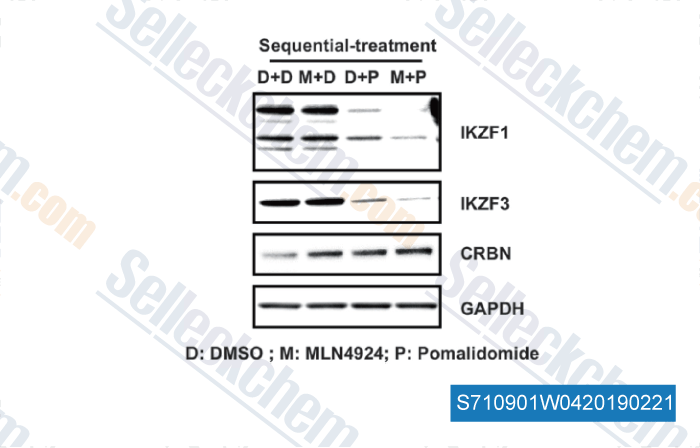
-
Data from [ , , Leukemia, 2019, 33(1):171-180 ]
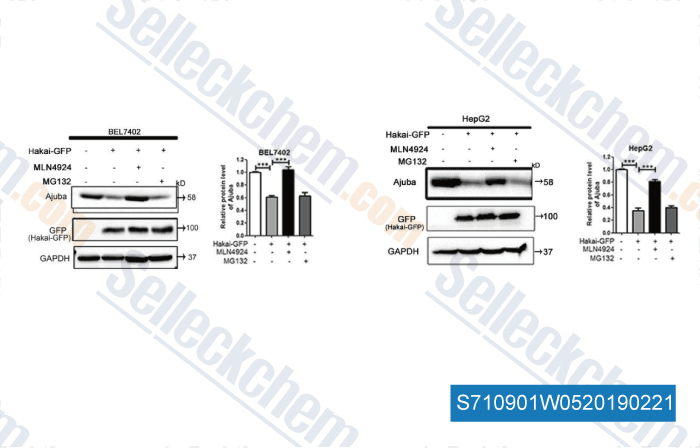
-
Data from [ , , J Exp Clin Cancer Res, 2018, 37(1):165 ]
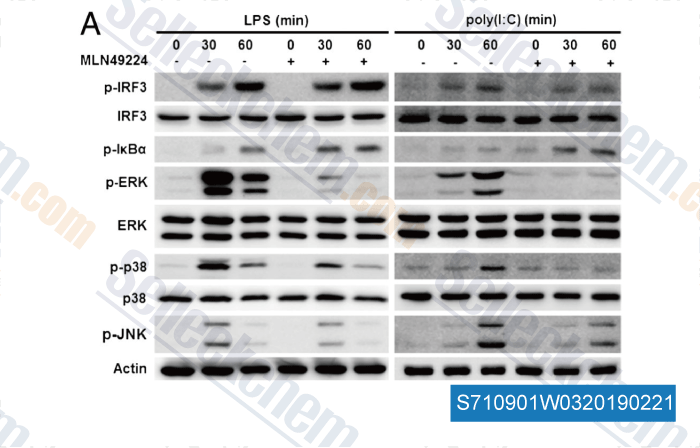
-
Data from [ , , J Immunol, 2016, 196(7):3117-23 ]
Selleck's MLN4924 (Pevonedistat) Has Been Cited by 157 Publications
| UBE2M as a bridge spanning neddylation and cell cycle regulation in colorectal adenocarcinoma [ Exp Mol Med, 2026, 58(2):501-518] | PubMed: 41680469 |
| Inhibiting TRIM21 Neddylation Rejuvenates Oocyte Quality in PCOS by Regulating Ubiquitination of CPT1A [ Research (Wash D C), 2026, 9:1223] | PubMed: 41939244 |
| Neddylation relieves cytoskeletal tension to permit primary cilia formation during mouse decidualization [ Cell Commun Signal, 2026, 24(1)198] | PubMed: 41709324 |
| Differential contribution of TFE3 isoforms to cell motility and invasion [ EMBO Rep, 2026, 27(2):471-500] | PubMed: 41361692 |
| Multigenerational cell tracking of DNA replication and heritable DNA damage [ Nature, 2025, 642(8068):785-795] | PubMed: 40399682 |
| USP7 V517F mutation as a mechanism of inhibitor resistance [ Nat Commun, 2025, 16(1):2526] | PubMed: 40087304 |
| SAMD9 senses cytosolic double-stranded nucleic acids in epithelial and mesenchymal cells to induce antiviral immunity [ Nat Commun, 2025, 16(1):3756] | PubMed: 40263291 |
| The E3 ligase RNF32 controls the IκB kinase complex and NF-κB signaling in intestinal stem cells [ Mol Cell, 2025, 85(22):4254-4267.e9] | PubMed: 41167191 |
| LC3-dependent intercellular transfer of phosphorylated STAT1/2 elicits CXCL9+ macrophages and enhances radiation-induced antitumor immunity [ J Clin Invest, 2025, 135(23)e195279] | PubMed: 41321309 |
| Disrupting AGR2/IGF1 paracrine and reciprocal signaling for pancreatic cancer therapy [ Cell Rep Med, 2025, 6(2):101927] | PubMed: 39914384 |
RETURN POLICY
Selleck Chemical’s Unconditional Return Policy ensures a smooth online shopping experience for our customers. If you are in any way unsatisfied with your purchase, you may return any item(s) within 7 days of receiving it. In the event of product quality issues, either protocol related or product related problems, you may return any item(s) within 365 days from the original purchase date. Please follow the instructions below when returning products.
SHIPPING AND STORAGE
Selleck products are transported at room temperature. If you receive the product at room temperature, please rest assured, the Selleck Quality Inspection Department has conducted experiments to verify that the normal temperature placement of one month will not affect the biological activity of powder products. After collecting, please store the product according to the requirements described in the datasheet. Most Selleck products are stable under the recommended conditions.
NOT FOR HUMAN, VETERINARY DIAGNOSTIC OR THERAPEUTIC USE.
- MLN4924 (Pevonedistat) Mechanism of Action: NAE Inhibition in Hematopoietic Cancer Cell Research
- MLN4924 (Pevonedistat) Clinical Trials
- MLN4924 (Pevonedistat) Working Concentration | Cell Culture | Treatment
- MLN4924 (Pevonedistat) Solubility in DMSO
- MLN4924 (Pevonedistat) Stock Solution
- MLN4924 (Pevonedistat) Storage
- MLN4924 (Pevonedistat) Stability
- MLN4924 (Pevonedistat) Combination Database
- MLN4924 (Pevonedistat) Molecular Weight
- MLN4924 (Pevonedistat) SMILES
- MLN4924 (Pevonedistat) CAS Number
- MLN4924 (Pevonedistat) Chemical Structure (2D and 3D)
- MLN4924 (Pevonedistat) IC50 for Cell-based and Cell-free Assays
- MLN4924 (Pevonedistat) Sigma (5.05477)? Try a better option.
- MLN4924 (Pevonedistat) MedChemExpress (HY-70062)? Try a better option.
- MLN4924 (Pevonedistat) Cell Signaling Technology (85923)? Try a better option.
- MLN4924 (Pevonedistat) STEMCELL (74184)? Try a better option.
- MLN4924 (Pevonedistat) Cayman (15217)? Try a better option.
- MLN4924 (Pevonedistat) SDS|MSDS