
|
How to Cite 1. For In-Text Citation (Materials & Methods): 2. For Key Resources Table: |
||
|
Toll Free: (877) 796-6397 -- USA and Canada only -- |
Fax: +1-832-582-8590 Orders: +1-832-582-8158 |
Tech Support: +1-832-582-8158 Ext:3 Please provide your Order Number in the email. We strive to reply to |
Technical Data
| Formula | C19H17NO3 |
||||||||||
| Molecular Weight | 307.34 | CAS No. | 154447-36-6 | ||||||||
| Solubility (25°C)* | In vitro | DMSO | 61 mg/mL (198.47 mM) | ||||||||
| Ethanol | 61 mg/mL (198.47 mM) | ||||||||||
| Water | Insoluble | ||||||||||
| In vivo (Add solvents to the product individually and in order) |
|
||||||||||
|
* <1 mg/ml means slightly soluble or insoluble. * Please note that Selleck tests the solubility of all compounds in-house, and the actual solubility may differ slightly from published values. This is normal and is due to slight batch-to-batch variations. * Room temperature shipping (Stability testing shows this product can be shipped without any cooling measures.) |
|||||||||||
Preparing Stock Solutions
Biological Activity
| Description | LY294002 (SF 1101, NSC 697286) is the first synthetic molecule known to inhibit PI3Kα/δ/β with IC50 of 0.5 μM/0.57 μM/0.97 μM, respectively; more stable in solution than Wortmannin, and also blocks autophagosome formation. It not only binds to class I PI3Ks and other PI3K-related kinases, but also to novel targets seemingly unrelated to the PI3K family. This compound also inhibits CK2 with IC50 of 98 nM. It is a non-specific DNA-PKcs inhibitor and activates autophagy and apoptosis. | ||||||||||
|---|---|---|---|---|---|---|---|---|---|---|---|
| Targets |
|
||||||||||
| In vitro | LY294002 is not exclusively selective for the PI3Ks, and could in fact act on other lipid kinases and additional apparently unrelated proteins. This compound is shown to inhibit not only mTOR and DNA-PK, but also other protein kinases, such as CK2 (casein kinase 2) and Pim-1. It inactivates Akt/PKB, consequently inhibiting cell proliferation and inducing apoptosis. This chemical demonstrates a remarkable growth-inhibitory and apoptosis-inducing effect in these colon cancer cell lines, with decreased expression of phosphorylated Akt (Ser473). It induces marked nuclear pyknosis and diminished cytoplasmic volume in the tumor cells. Thus, this compound markedly inhibits ovarian cancer cell proliferation in vitro. It induces specific G1 arrest in cell growth, leading to almost complete inhibition of melanoma cell proliferation and partial inhibition of MG-63 (osteosarcoma cell line) proliferation. The effect of this chemical on cell cycle progression may provide insights into a possible link between the PI3K activation pathway and cancer cell cycle regulation. |
||||||||||
| In vivo | LY294002 also results in suppression of tumor growth and induction of apoptosis, especially in the LoVo tumors, and therefore shows remarkable effectiveness in the mouse peritonitis carcinomatosa model. This compound significantly inhibits growth and ascites formation of ovarian carcinoma. |
Protocol (from reference)
| Kinase Assay: |
|
|---|---|
| Cell Assay: |
|
| Animal Study: |
|
References
|
Customer Product Validation
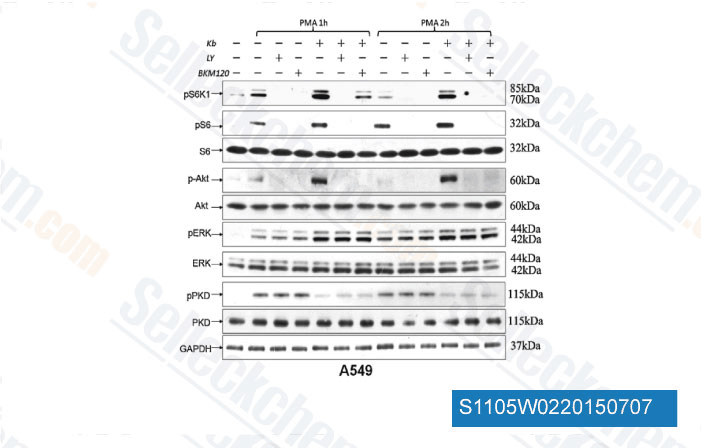
-
Data from [ Int J Biochem Cell Biol , 2015 , 60, 34-42 ]
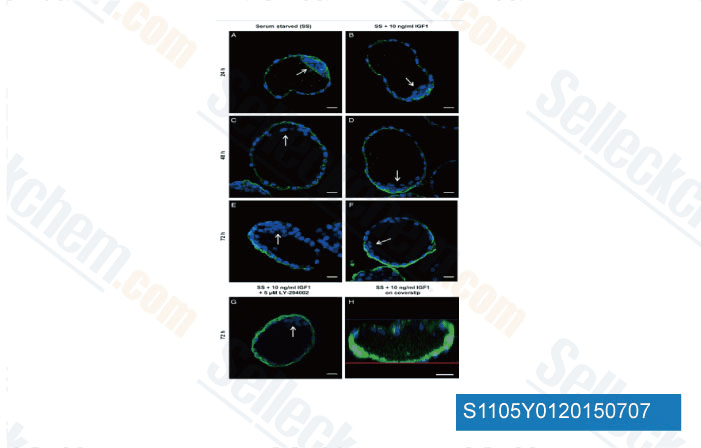
-
Data from [ Hum Reprod , 2015 , 30(2), 284-98 ]
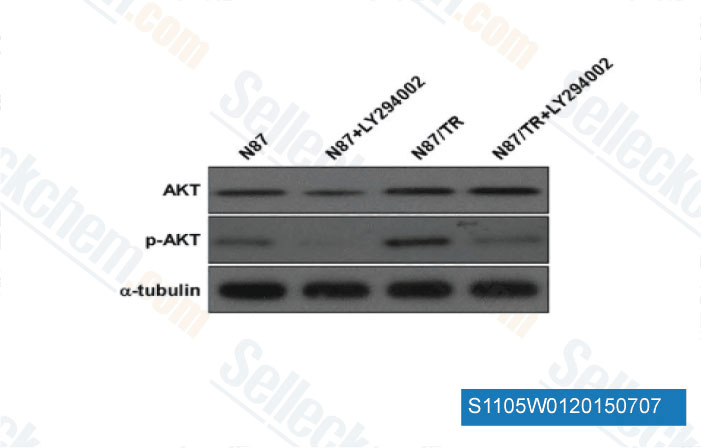
-
Data from [ Sci Rep , 2015 , 5, 11634 ]
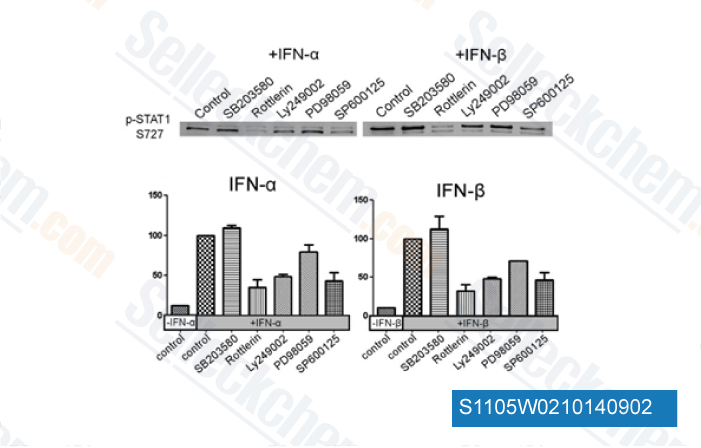
-
Data from [ Hepatology , 2014 , 59(4), 1262-72 ]
Selleck's LY294002 Has Been Cited by 1728 Publications
| Integrated Single-Cell Profiling Reveals TL1A as a Biomarker and Driver of Type 2 Inflammation via Macrophage-Dependent Immunoregulation in Asthma [ Research (Wash D C), 2026, 9:1190] | PubMed: 41970030 |
| Kdf1 Regulates Molar Cusp Morphogenesis via the PI3K/AKT/mTOR Signalling Axis [ Cell Prolif, 2026, 59(3):e70108] | PubMed: 40739677 |
| Toll signaling controls stem cell proliferation in intestinal regeneration and tumorigenesis [ EMBO Rep, 2026, 27(5):1270-1300] | PubMed: 41634381 |
| NGR1 Pretreatment Enhances the Therapeutic Efficacy of Transplanting Cardiomyocytes Derived from Human Induced Pluripotent Stem Cells for Myocardial Infarction [ Int J Mol Sci, 2026, 27(1)475] | PubMed: 41516349 |
| Omentum-Derived Mesenchymal Stem Cells Promote Antibacterial Effects and Protect Endothelial Functions via PAI-1 [ Stem Cell Rev Rep, 2026, 22(5):2491-2510.] | PubMed: 42018237 |
| SEMA4F Regulates the Malignant Phenotype of Hepatocellular Carcinoma Cells Through the PI3K-Akt Pathway [ J Hepatocell Carcinoma, 2026, 13:596827] | PubMed: 42059013 |
| Glucose‑driven TRIB3 enhances the tumorigenic potential of colon cancer via the PI3K/AKT pathway [ Mol Med Rep, 2026, 33(5)132] | PubMed: 41823543 |
| Targeting BCL-2 and PI3K signaling pathways enhances cytotoxicity of gemtuzumab ozogamicin against acute myeloid leukemia cells [ Biochem Biophys Res Commun, 2026, 817:153752] | PubMed: 41980559 |
| Elucidating the Potential Targets and Mechanisms of Bisphenol A-Induced Prostate Cancer Based on Network Toxicology and Molecular Docking Analyses [ Oncol Res, 2026, 34(5):35] | PubMed: 42065064 |
| Epigenetic Activity of Cancer Therapy Drugs Revealed by HeLa TI Cell-Based Assay [ Epigenomes, 2026, 10(1)14] | PubMed: 41892363 |
RETURN POLICY
Selleck Chemical’s Unconditional Return Policy ensures a smooth online shopping experience for our customers. If you are in any way unsatisfied with your purchase, you may return any item(s) within 7 days of receiving it. In the event of product quality issues, either protocol related or product related problems, you may return any item(s) within 365 days from the original purchase date. Please follow the instructions below when returning products.
SHIPPING AND STORAGE
Selleck products are transported at room temperature. If you receive the product at room temperature, please rest assured, the Selleck Quality Inspection Department has conducted experiments to verify that the normal temperature placement of one month will not affect the biological activity of powder products. After collecting, please store the product according to the requirements described in the datasheet. Most Selleck products are stable under the recommended conditions.
NOT FOR HUMAN, VETERINARY DIAGNOSTIC OR THERAPEUTIC USE.
Jump to:
- LY294002 Mechanism of Action: PI3K Inhibition in Tumor Cell Research
- LY294002 Working Concentration | Cell Culture | Treatment
- LY294002 Solubility in DMSO
- LY294002 Combination Database
- LY294002 Molecular Weight | Chemical Structure | Stock Solution
- LY294002 IC50 for Cell-based and Cell-free Assays
- LY294002 Sigma (440202)? Try a better option.
- LY294002 MedChemExpress (HY-10108)? Try a better option.
- LY294002 STEMCELL (72152)? Try a better option.
- LY294002 Cell Signaling Technology (9901)? Try a better option.
- LY294002 Cayman (70920)? Try a better option.
- LY294002 SDS|MSDS