
|
How to Cite 1. For In-Text Citation (Materials & Methods): 2. For Key Resources Table: |
||
|
Toll Free: (877) 796-6397 -- USA and Canada only -- |
Fax: +1-832-582-8590 Orders: +1-832-582-8158 |
Tech Support: +1-832-582-8158 Ext:3 Please provide your Order Number in the email. We strive to reply to |
Biological Description
| Specificity | eEF1A Antibody [P21C20] detects endogenous levels of total eEF1A protein. |
|---|---|
| Background | eEF1A serves as the GTPase subunit of the eukaryotic translation elongation factor 1 complex, delivering aminoacyl-tRNAs to the ribosomal A-site during protein synthesis across eukaryotes. It adopts a compact GTP-binding fold with three structural domains that undergo conformational shifts between GTP- and GDP-bound states to cycle between open and closed configurations. In its GTP-bound form, eEF1A forms a ternary complex with aminoacyl-tRNA and eEF1B guanine nucleotide exchange factor, promoting accurate codon-anticodon matching at the ribosome A-site followed by GTP hydrolysis triggered by the ribosome's sarcin-ricin loop and SRL GTPase-activating center. Post-hydrolysis, GDP-bound eEF1A dissociates, enabling eEF1B-mediated nucleotide exchange to reset the cycle while proofreading ensures fidelity through kinetic discrimination of cognate versus near-cognate tRNAs. Beyond elongation, eEF1A bundles actin filaments and stabilizes microtubules, interacting with F-actin, tubulin, and synaptic proteins to modulate cytoskeletal dynamics at growth cones and postsynaptic densities. Phosphorylation by Raf kinases at sites like Ser21 and Thr88 alters eEF1A stability, half-life, and apoptosis sensitivity in cancer cells, while heat shock activates eEF1A to recruit HSF1 to HSP70 promoters via non-coding HSR1 RNA, associate with RNA polymerase II during transcription elongation, stabilize HSP70 mRNA through 3'UTR binding, facilitate its nuclear export, and direct it to polysomes for stress granule-free translation. eEF1A isoforms exhibit tissue-specific expression with eEF1A1 ubiquitous and eEF1A2 enriched in brain and muscle, supporting proteostasis, signal transduction, and proteasomal delivery of misfolded proteins via interactions with HSC70 and Bag-6. Dysregulated eEF1A activity contributes to neurodegeneration and oncogenesis through altered translation fidelity and stress responses. |
Usage Information
| Application | WB | Dilution |
|
||
|---|---|---|---|---|---|
| Reactivity | Human, Mouse, Rat, Monkey | ||||
| Source | Rabbit Monoclonal Antibody | MW | 50 kDa | ||
| Storage Buffer | PBS, pH 7.2+50% Glycerol+0.05% BSA+0.01% NaN3 | Storage (from the date of receipt) |
-20°C (avoid freeze-thaw cycles), 2 years | ||
References
|
Application Data
WB
Validated by Selleck
-
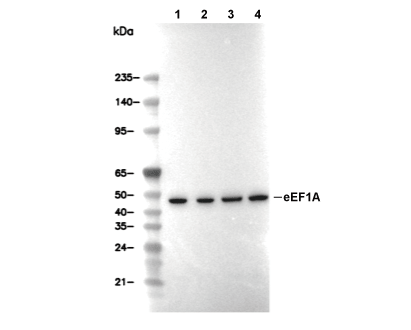 Lane 1: MCF7, Lane 2: 293, Lane 3: PANC-1, Lane 4: C2C12