
|
How to Cite 1. For In-Text Citation (Materials & Methods): 2. For Key Resources Table: |
||
|
Toll Free: (877) 796-6397 -- USA and Canada only -- |
Fax: +1-832-582-8590 Orders: +1-832-582-8158 |
Tech Support: +1-832-582-8158 Ext:3 Please provide your Order Number in the email. We strive to reply to |
Biological Description
| Specificity | c-Rel Antibody [B22C17] detects endogenous levels of total c-Rel protein. |
|---|---|
| Background | c-Rel belongs to the Rel/NF-κB family of transcription factors characterized by a Rel homology domain that mediates DNA binding, dimerization, and nuclear localization. The protein contains an N-terminal Rel homology domain encompassing DNA-binding and dimerization regions, along with C-terminal transactivation domains unique to RelA, c-Rel, and RelB members. In resting hematopoietic cells where c-Rel expression predominates, IκBα and IκBβ sequester c-Rel dimers in the cytoplasm through binding to the nuclear localization signal within the Rel homology domain. Proinflammatory stimuli trigger the IKK complex to phosphorylate IκBα at N-terminal serines, leading to its K48-linked ubiquitination and proteasomal degradation, which unmasks the c-Rel nuclear localization signal and enables nuclear translocation as p50/c-Rel or RelA/c-Rel heterodimers. These dimers bind κB sites in promoters of target genes encoding cytokines, anti-apoptotic factors, and cell cycle regulators via the Rel homology domain's DNA-binding region. Distinct domains of IκBα mediate cytoplasmic retention through N-terminal and central ankyrin repeats that mask the nuclear localization signal, while central ankyrin and C-terminal acidic residues suffice for nuclear inhibition by competing for DNA-binding sites or corepressors. c-Rel forms stable p65/c-Rel heterodimers with IκBβ in unstimulated states, where hyperphosphorylated IκBβ acts as an inhibitor until stimulus-induced slow phosphorylation triggers its partial degradation, selectively releasing p65/c-Rel for TNFα promoter activation. Nuclear IκBα colocalizes with constitutively nuclear c-Rel variants to suppress transactivation. In T cell differentiation, c-Rel induces RORγt and IL-21 expression critical for Th17 and Tfh lineages, while supporting Foxp3 in regulatory T cells. Elevated c-Rel activity drives lymphoid malignancies and chronic inflammation through persistent target gene expression. |
Usage Information
| Application | WB | Dilution |
|
||
|---|---|---|---|---|---|
| Reactivity | Human, Mouse, Rat | ||||
| Source | Rabbit Monoclonal Antibody | MW | 68-78 kDa | ||
| Storage Buffer | PBS, pH 7.2+50% Glycerol+0.05% BSA+0.01% NaN3 | Storage (from the date of receipt) |
-20°C (avoid freeze-thaw cycles), 2 years | ||
References
|
Application Data
WB
Validated by Selleck
-
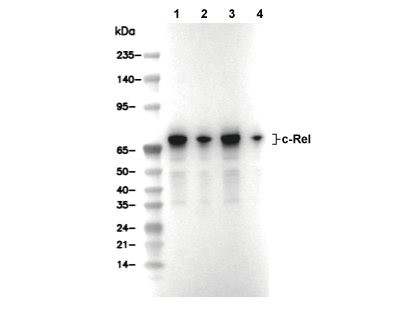 Lane 1: Raji, Lane 2: U973, Lane 3: A20, Lane 4: Neuro-2a