
|
How to Cite 1. For In-Text Citation (Materials & Methods): 2. For Key Resources Table: |
||
|
Toll Free: (877) 796-6397 -- USA and Canada only -- |
Fax: +1-832-582-8590 Orders: +1-832-582-8158 |
Tech Support: +1-832-582-8158 Ext:3 Please provide your Order Number in the email. We strive to reply to |
Technical Data
| Formula | C20H18ClF2N5O3 |
||||||
| Molecular Weight | 449.84 | CAS No. | 1492952-76-7 | ||||
| Solubility (25°C)* | In vitro | DMSO | 90 mg/mL (200.07 mM) | ||||
| Ethanol | 30 mg/mL (66.69 mM) | ||||||
| Water | Insoluble | ||||||
| In vivo (Add solvents to the product individually and in order) |
|
||||||
|
* <1 mg/ml means slightly soluble or insoluble. * Please note that Selleck tests the solubility of all compounds in-house, and the actual solubility may differ slightly from published values. This is normal and is due to slight batch-to-batch variations. * Room temperature shipping (Stability testing shows this product can be shipped without any cooling measures.) |
|||||||
Preparing Stock Solutions
Biological Activity
| Description | Asciminib (ABL001) is a potent and selective allosteric ABL1 inhibitor with dissociation constant (Kd) of 0.5-0.8 nM and selectivity to the myristoyl pocket of ABL1. | ||
|---|---|---|---|
| Targets |
|
||
| In vitro | Asciminib (ABL001) is a potent, selective BCR-ABL inhibitor that maintains activity across most mutations, including T315I, with a distinct, allosteric mechanism of action. It binds at a regulatory site typically occupied by a myristoyl group in wild-type ABL and inhibits ABL kinase activity through a mechanism distinct from catalytic site inhibitors. This compound binds to a pocket on the BCR-ABL kinase domain that is normally occupied by the myristoylated N-terminus of ABL1. Upon fusion with BCR, this myristoylated N-terminus that serves to autoregulate ABL1 activity is lost. ABL001 functionally mimics the role of the myristoylated N-terminus by occupying its vacant binding site and restores the negative regulation of the kinase activity. It selectively inhibits the growth of chronic myelogenous leukemia (CML) and Ph+ ALL cells with potencies ranging from 1-10 nM range while BCR-ABL-negative cell lines remained unaffected at concentrations 1000-fold higher. NMR and biophysical studies confirm that it binds potently (dissociation constant (Kd) = 0.5-0.8 nM) and selectively to the myristoyl pocket of ABL1 and induces the inactive C-terminal helix conformation. This compound lacks activity against more than 60 kinases, including SRC and is similarly inactive against G-protein-coupled receptors, ion channels, nuclear receptors and transporters. Thus, it has high selectivity. |
||
| In vivo | In the KCL-22 mouse xenograft model, Asciminib (ABL001) displays potent anti-tumor activity with complete tumor regression observed and a clear dose-dependent correlation with pSTAT5 inhibition. It has moderate oral absorption, volume of distribution and half-life across all species. This compound as a single agent induces clinical anti-tumour activity and is well tolerated to date in a heavily pre-treated subgroup of patients with chronic myelogenous leukemia. As for the pharmacokinetics, pharmacodynamics and efficacy, the CL (clearance) are 12, 16 and 6 mL/min/kg in mice, rats and dogs after a single iv dose of 1mg/kg, 2mg/kg and 1mg/kg, respectively. In mouse and dog, the T1/2term are 1.1 and 3.7 h after a single i.v. dose at 1 mg/kg. In Rat, the T1/2term is 2.7 h after a single i.v. dose at 2 mg/kg. The oral bioavailability in mouse and rat are 35% and 27% respectively when dosed at 30 mg/kg p.o. While in dogs the oral BA is 111% (15 mg/kg, p.o). |
Protocol (from reference)
| Cell Assay: |
|
|---|---|
| Animal Study: |
|
References
|
Customer Product Validation
-
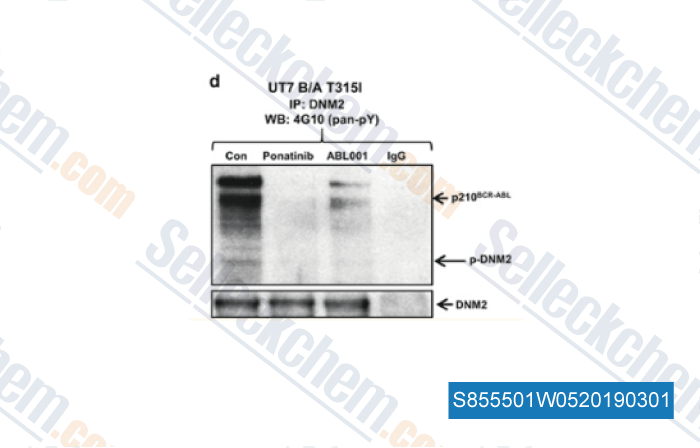
Data from [ , , Leukemia, 2017, 31(11):2376-2387 ]
Selleck's ABL001 (Asciminib) Has Been Cited by 18 Publications
| Asciminib resistance of a new BCR::ABL1 p.I293_K294insSSLRD mutant detected in a Ph + ALL patient [ Ann Hematol, 2025, 10.1007/s00277-024-06142-8] | PubMed: 39774950 |
| Targeting WEE1 and asciminib suppresses ABL-tyrosine kinase inhibitor-resistant chronic myeloid leukemia cells [ Discover Oncology, 2025, nan] | PubMed: 40627261 |
| ABL1-mediated phosphorylation promotes FOXM1-related tumorigenicity by Increasing FOXM1 stability [ Cell Death Differ, 2024, 10.1038/s41418-024-01339-w] | PubMed: 39060421 |
| The molecular basis of Abelson kinase regulation by its αI-helix [ Elife, 2024, 12RP92324] | PubMed: 38588001 |
| Asciminib Maintains Antibody-Dependent Cellular Cytotoxicity against Leukemic Blasts [ Cancers (Basel), 2024, 16(7)1288] | PubMed: 38610966 |
| Sensitivity to Tyrosine Kinase Inhibitors in a Human Philadelphia Chromosome-Positive (Ph+) Leukemia Model With the T315I-Inclusive Compound Mutation [ Cureus, 2024, 16(12):e76538] | PubMed: 39872583 |
| Effect of asciminib and vitamin K2 on Abelson tyrosine-kinase-inhibitor-resistant chronic myelogenous leukemia cells [ BMC Cancer, 2023, 23(1):827] | PubMed: 37670241 |
| Effect of asciminib and vitamin K2 on Abelson tyrosine-kinase-inhibitor-resistant chronic myelogenous leukemia cells [ BMC Cancer, 2023, 827] | PubMed: 37670241 |
| Využití vybraných inhibitorů k překonání anthracyklinové rezistence v terapii nádorových onemocnění (in vitro studie). [ Charles University, 2023, ] | PubMed: None |
| Reengineering Ponatinib to Minimize Cardiovascular Toxicity [ Cancer Res, 2022, 82-15:2777-2791] | PubMed: 35763671 |
RETURN POLICY
Selleck Chemical’s Unconditional Return Policy ensures a smooth online shopping experience for our customers. If you are in any way unsatisfied with your purchase, you may return any item(s) within 7 days of receiving it. In the event of product quality issues, either protocol related or product related problems, you may return any item(s) within 365 days from the original purchase date. Please follow the instructions below when returning products.
SHIPPING AND STORAGE
Selleck products are transported at room temperature. If you receive the product at room temperature, please rest assured, the Selleck Quality Inspection Department has conducted experiments to verify that the normal temperature placement of one month will not affect the biological activity of powder products. After collecting, please store the product according to the requirements described in the datasheet. Most Selleck products are stable under the recommended conditions.
NOT FOR HUMAN, VETERINARY DIAGNOSTIC OR THERAPEUTIC USE.