
|
How to Cite 1. For In-Text Citation (Materials & Methods): 2. For Key Resources Table: |
||
|
Toll Free: (877) 796-6397 -- USA and Canada only -- |
Fax: +1-832-582-8590 Orders: +1-832-582-8158 |
Tech Support: +1-832-582-8158 Ext:3 Please provide your Order Number in the email. We strive to reply to |
Technical Data
| Formula | C25H23N7OS.HCl |
||||||
| Molecular Weight | 506.02 | CAS No. | 1001645-58-4 | ||||
| Solubility (25°C)* | In vitro | DMSO | 100 mg/mL (197.62 mM) | ||||
| Water | Insoluble | ||||||
| Ethanol | Insoluble | ||||||
| In vivo (Add solvents to the product individually and in order) |
|
||||||
|
* <1 mg/ml means slightly soluble or insoluble. * Please note that Selleck tests the solubility of all compounds in-house, and the actual solubility may differ slightly from published values. This is normal and is due to slight batch-to-batch variations. * Room temperature shipping (Stability testing shows this product can be shipped without any cooling measures.) |
|||||||
Preparing Stock Solutions
Biological Activity
| Description | SRT1720 HCl is a selective SIRT1 activator with EC50 of 0.16 μM in a cell-free assay, but is >230-fold less potent for SIRT2 and SIRT3. SRT1720 induces autophagy. | ||
|---|---|---|---|
| Targets |
|
||
| In vitro | The maximum activation ratio of SRT1720 versus the closest sirtuin homologues, SIRT2 (EC1.5 = 37 μM) and SIRT3 (EC1.5 > 300 μM) is up to 781%. SRT1720 binds to the SIRT1 enzyme-peptide substrate complex at an allosteric site amino-terminal to the catalytic domain and lower the Michaelis constant for acetylated substrates. SRT1720 could reduce fed glucose levels. SRT1720 does not have an effect on fasting glucose in chow-fed mice, revealing that pharmacological SIRT1 activation is unlikely to induce hypoglycaemia. SRT1720 significantly reduces the hyperinsulinaemia after 4 weeks, partially normalizing increased insulin levels. SRT1720 treatment increases mitochondrial capacity by 15% in gastrocnemius muscle as measured by citrate synthase activity. Higher concentrations of SRT1720 (15 μM) induces a modest (10-20%) decrease in normal cell viability. SRT1720 also significantly inhibits VEGF-dependent MM cell migration. |
||
| In vivo | In DIO mice SRT1720 mimics several of the effects observed after calorie restriction including improved insulin sensitivity, normalized glucose and insulin levels, and increased mitochondrial capacity. In addition, in diet-induced obese and genetically obese mice, SRT1720 improves insulin sensitivity, lower plasma glucose, and increase mitochondrial capacity. Thus, SRT1720 is a promising new therapeutic agent for treating diseases of ageing such as type 2 diabetes. Consistent with improved glucose tolerance, the glucose infusion rate required to maintain euglycaemia is approximately 35% higher in SRT1720-treated fa/fa rats, and the total glucose disposal rate is increased by approximately 20%. SRT1720 also prevents multiple myeloma tumor growth. |
Protocol (from reference)
| Kinase Assay: |
|
|---|---|
| Cell Assay: |
|
| Animal Study: |
|
References
|
Customer Product Validation
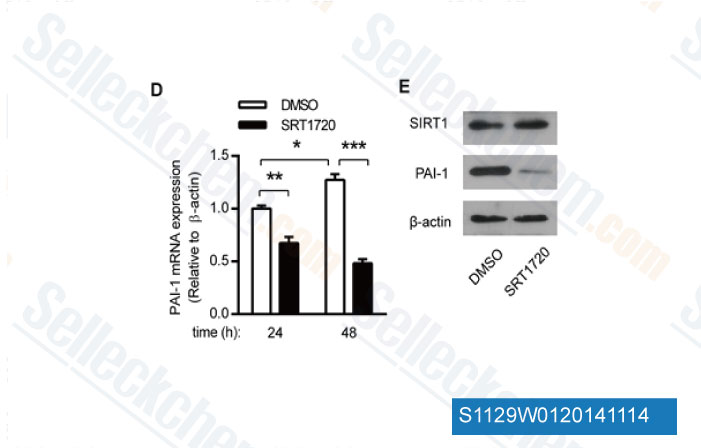
-
Data from [ Aging Cell , 2014 , 13(5), 890-9 ]
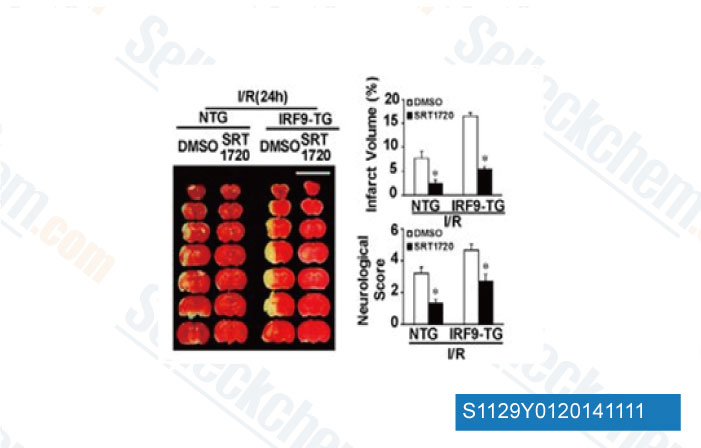
-
Data from [ J Neurosci , 2014 , 34(36), 11897-912 ]
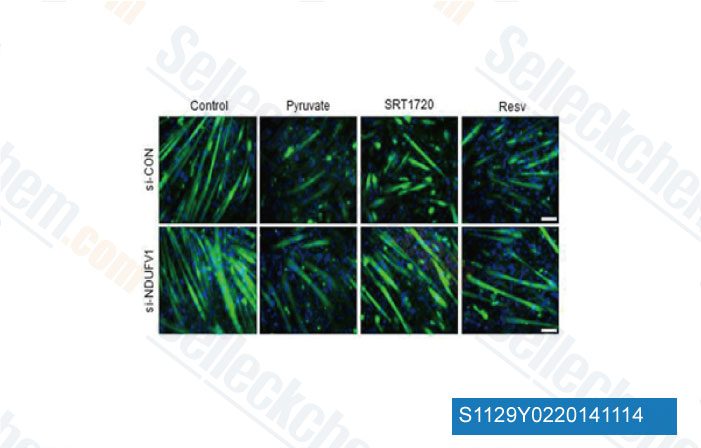
-
Data from [ J Biol Chem , 2014 , 289(29), 20012-25 ]
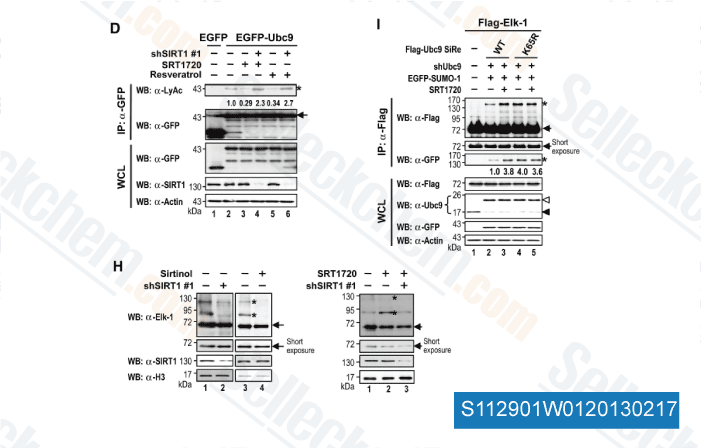
-
Data from [ EMBO J , 2013 , 32, 791-804 ]
Selleck's SRT 1720 Hydrochloride Has Been Cited by 196 Publications
| Intraperitoneal injection of the SIRT1 activator SRT1720 attenuates the progression of experimental osteoarthritis in mice [ Bone & Joint Research, May 5, 2018, 252-262] | PubMed: 29922443 |
| The Sirt1 activator, SRT1720, attenuates renal fibrosis by inhibiting CTGF and oxidative stress [ International Journal of Molecular Medicine, March 22, 2017, 1317-1324] | PubMed: 28339034 |
| An Agonist of the Protective Factor SIRT1 Improves Functional Recovery and Promotes Neuronal Survival by Attenuating Inflammation after Spinal Cord Injury [ Journal of Neuroscience, March 15, 2017, 2916-2930] | PubMed: 28193684 |
| Zinc Alleviates Diabetic Muscle Atrophy via Modulation of the SIRT1/FoxO1 Autophagy Pathway Through GPR39 [ Journal of Cachexia, Sarcopenia and Muscle, February 11, 2025, e13771] | PubMed: 40026072 |
| Zinc Alleviates Diabetic Muscle Atrophy via Modulation of the SIRT1/FoxO1 Autophagy Pathway Through GPR39 [ J Cachexia Sarcopenia Muscle, 2025, 16(2):e13771] | PubMed: 40026072 |
| SIRT1 and its SUMOylation attenuate hyperoxia-induced lung injury by improving mitochondrial biogenesis and fusion [ Free Radic Biol Med, 2025, 236:98-115] | PubMed: 40403939 |
| A novel SIRT1 activator attenuates neuropathic pain by inhibiting spinal neuronal activation via the SIRT1-mGluR1/5 pathway [ Cell Biol Toxicol, 2025, 41(1):24] | PubMed: 39779529 |
| The Sirt1 Activator SRT1720 Mitigates Human Monocyte Activation and Improves Outcome During Gram-Negative Pneumosepsis in Mice [ Int J Mol Sci, 2025, 26(19)9309] | PubMed: 41096578 |
| A Decoy Oligodeoxynucleotides Disturbing Forkhead Box O3 Mediated ctnna2 Transcriptional Repression Prevents Postoperative Neurocognitive Disorder in Mice [ CNS Neurosci Ther, 2025, 31(8):e70454] | PubMed: 40859434 |
| Liu Wei Di Huang Decoction Alleviates Renal Fibrosis by Inhibiting Endothelial Mesenchymal Transitions via Upregulating Sirt1 Expression and Inhibiting the Wnt/β-Catenin Signaling Pathway [ Drug Des Devel Ther, 2025, 19:6587-6603] | PubMed: 40761667 |
RETURN POLICY
Selleck Chemical’s Unconditional Return Policy ensures a smooth online shopping experience for our customers. If you are in any way unsatisfied with your purchase, you may return any item(s) within 7 days of receiving it. In the event of product quality issues, either protocol related or product related problems, you may return any item(s) within 365 days from the original purchase date. Please follow the instructions below when returning products.
SHIPPING AND STORAGE
Selleck products are transported at room temperature. If you receive the product at room temperature, please rest assured, the Selleck Quality Inspection Department has conducted experiments to verify that the normal temperature placement of one month will not affect the biological activity of powder products. After collecting, please store the product according to the requirements described in the datasheet. Most Selleck products are stable under the recommended conditions.
NOT FOR HUMAN, VETERINARY DIAGNOSTIC OR THERAPEUTIC USE.