
|
How to Cite 1. For In-Text Citation (Materials & Methods): 2. For Key Resources Table: |
||
|
Toll Free: (877) 796-6397 -- USA and Canada only -- |
Fax: +1-832-582-8590 Orders: +1-832-582-8158 |
Tech Support: +1-832-582-8158 Ext:3 Please provide your Order Number in the email. We strive to reply to |
Technical Data
| Formula | C20H24O2 |
|||
| Molecular Weight | 296.4 | CAS No. | 107868-30-4 | |
| Solubility (25°C)* | In vitro | DMSO | 54 mg/mL (182.18 mM) | |
| Water | Insoluble | |||
| Ethanol | '15 mg/mL | |||
|
* <1 mg/ml means slightly soluble or insoluble. * Please note that Selleck tests the solubility of all compounds in-house, and the actual solubility may differ slightly from published values. This is normal and is due to slight batch-to-batch variations. * Room temperature shipping (Stability testing shows this product can be shipped without any cooling measures.) |
||||
Preparing Stock Solutions
Biological Activity
| Description | Exemestane is an aromatase inhibitor, inhibits human placental and rat ovarian aromatase with IC50 of 30 nM and 40 nM, respectively. | ||||
|---|---|---|---|---|---|
| Targets |
|
||||
| In vitro | Exemestane competitively inhibits and time-dependently inactivates of human placental aromatase with Ki of 4.3 nM. This compound displaces [3H]DHT from rat prostate androgen receptor with IC50 of 0.9 μM. This chemical (1 μM) increases alkaline phosphatase activity in hFOB and Saos-2 cells and induces the expression of MYBL2, OSTM1, HOXD11, ADCYAP1R1, and glypican 2 in hFOB cells. It causes aromatase degradation in a dose-responsive manner in MCF-7aro cells. |
||||
| In vivo | Exemestane increases lumbar spine BMD by 14.0% in OVX rats at dose of 100 mg/kg. This compound (100 mg/kg) and 17-hydroexemestane (20 mg/kg) significantly reduces an ovariectomy-induced increase in serum pyridinoline and serum osteocalcin in rats and causes significant reductions of serum cholesterol and low-density lipoprotein cholesterol inOVX rats. This chemical (20 mg/kg/day s.c.) induces 26% complete (CR) and 18% partial (PR) tumor regressions in rats with 7,12-dimethylbenzanthracene (DMBA)-induced mammary tumors. |
||||
| Features | 17-hydroexemestane is the principal metabolite of Exemestane. |
Protocol (from reference)
| Kinase Assay: |
|
|---|---|
| Cell Assay: |
|
| Animal Study: |
|
References
|
Customer Product Validation
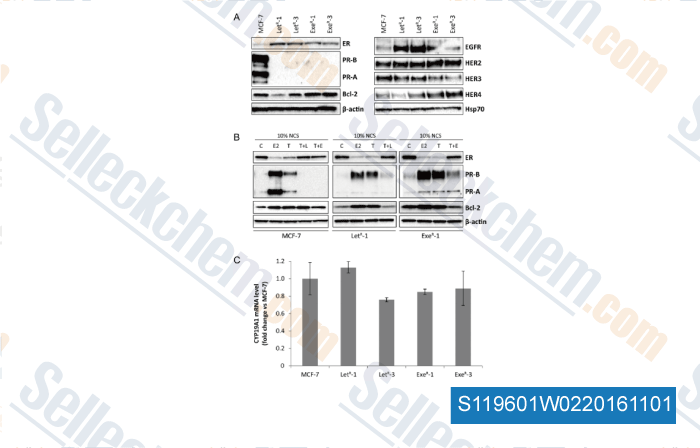
-
, , Int J Oncol, 2015, 46(4):1481-90.

-
Data from [ , , Cell Physiol Biochem, 2017, 42(1):1-12 ]
Selleck's Exemestane Has Been Cited by 26 Publications
| SERPINA3-ANKRD11-HDAC3 pathway induced aromatase inhibitor resistance in breast cancer can be reversed by HDAC3 inhibition [ Commun Biol, 2023, 6(1):695] | PubMed: 37414914 |
| Predicting clinical response to everolimus in ER+ breast cancers using machine-learning [ Front Mol Biosci, 2022, 9:981962] | PubMed: 36304922 |
| Predicting clinical response to everolimus in ER+ breast cancers using machine-learning [ Frontiers in Molecular Biosciences, 2022, 981962] | PubMed: 36304922 |
| Establishment and Characterization of NCC-PMP1-C1: A Novel Patient-Derived Cell Line of Metastatic Pseudomyxoma Peritonei [ J Pers Med, 2022, 12(2)258] | PubMed: 35207746 |
| Establishment and characterization of NCC-UPS4-C1: a novel cell line of undifferentiated pleomorphic sarcoma from a patient with Li-Fraumeni syndrome [ Hum Cell, 2022, 10.1007/s13577-022-00671-y] | PubMed: 35118583 |
| Characterization of the Major Single Nucleotide Polymorphic Variants of Aldo-Keto Reductase 1C3 (Type 5 17β-Hydroxysteroid Dehydrogenase) [ J Steroid Biochem Mol Biol, 2022, S0960-0760(22)00072-3] | PubMed: 35489629 |
| Systems Pharmacology-Based Precision Therapy and Drug Combination Discovery for Breast Cancer [ Cancers, 2021, 3586] | PubMed: 34298802 |
| Systems Pharmacology-Based Precision Therapy and Drug Combination Discovery for Breast Cancer [ Cancers (Basel), 2021, 13(14)3586] | PubMed: 34298802 |
| Establishment and characterization of the NCC-GCTB4-C1 cell line: a novel patient-derived cell line from giant cell tumor of bone [ Hum Cell, 2021, 10.1007/s13577-021-00639-4] | PubMed: 34731453 |
| Establishment and characterization of novel patient-derived cell lines from giant cell tumor of bone [ Hum Cell, 2021, 10.1007/s13577-021-00579-z] | PubMed: 34304386 |
RETURN POLICY
Selleck Chemical’s Unconditional Return Policy ensures a smooth online shopping experience for our customers. If you are in any way unsatisfied with your purchase, you may return any item(s) within 7 days of receiving it. In the event of product quality issues, either protocol related or product related problems, you may return any item(s) within 365 days from the original purchase date. Please follow the instructions below when returning products.
SHIPPING AND STORAGE
Selleck products are transported at room temperature. If you receive the product at room temperature, please rest assured, the Selleck Quality Inspection Department has conducted experiments to verify that the normal temperature placement of one month will not affect the biological activity of powder products. After collecting, please store the product according to the requirements described in the datasheet. Most Selleck products are stable under the recommended conditions.
NOT FOR HUMAN, VETERINARY DIAGNOSTIC OR THERAPEUTIC USE.