
|
How to Cite 1. For In-Text Citation (Materials & Methods): 2. For Key Resources Table: |
||
|
Toll Free: (877) 796-6397 -- USA and Canada only -- |
Fax: +1-832-582-8590 Orders: +1-832-582-8158 |
Tech Support: +1-832-582-8158 Ext:3 Please provide your Order Number in the email. We strive to reply to |
Technical Data
| Formula | C29H32N6O4S |
|||
| Molecular Weight | 560.67 | CAS No. | 950769-58-1 | |
| Solubility (25°C)* | In vitro | |||
|
* <1 mg/ml means slightly soluble or insoluble. * Please note that Selleck tests the solubility of all compounds in-house, and the actual solubility may differ slightly from published values. This is normal and is due to slight batch-to-batch variations. * Room temperature shipping (Stability testing shows this product can be shipped without any cooling measures.) |
||||
Preparing Stock Solutions
Biological Activity
| Description | Quizartinib (AC220) is a second-generation FLT3 inhibitor for Flt3(ITD/WT) with IC50 of 1.1 nM/4.2 nM in MV4-11 and RS4;11 cells, respectively, 10-fold more selective for Flt3 than KIT, PDGFRα, PDGFRβ, RET, and CSF-1R. Quizartinib (AC220) induces apoptosis of tumor cells. Phase 3. | ||||
|---|---|---|---|---|---|
| Targets |
|
||||
| In vitro | AC220, a unique, potent and selective inhibitor of FLT3, has high affinity for FLT3 with a Kd value of 1.6 nM. This compound inhibits the autophosphorylation of FLT3 in the human leukemia cell lines MV4-11 which harbor a homozygous FLT3-ITD mutation and is FLT3 dependent, and RS4;11 which expresses wild-type FLT3 with IC50 values of 1.1 nM and 4.2 nM, respectively. It is the most potent cellular FLT3-ITD inhibitor, leading to the most significant inhibition of MV4-11 cell proliferation with IC50 of 0.56 nM compared to all other FLT3 inhibitors whose IC50 values range from 0.87 nM to 64 nM. This chemical has no inhibitory activity against the proliferation of A375 cells which harbor an activating mutation in BRAF and are not FLT3 dependent, indicating a large window between FLT3 inhibition and general cytotoxic effects. | ||||
| In vivo | Oral administration of AC220 (10 mg/kg) induces time-dependent inhibition of FLT3 autophosphorylation in the FLT3-ITD–dependent MV4-11 tumor xenograft mouse model; the inhibition being 90% at 2 hours and 40% at 24 hours. This compound significantly extends survival in a mouse model of FLT3-ITD AML with doses as low as 1 mg/kg given orally once a day. Treatment with this chemical at 10 mg/kg for 28 days results in rapid and complete regression of tumors in all mice with no tumor regrowth during the 60-day posttreatment period. It displays more significant efficacy compared to sunitinib treatment which causes tumors to shrink slowly and resume growth immediately upon discontinuation of treatment in all but one of the mice. | ||||
| Features | The most potent cellular FLT3-ITD inhibitor. |
Protocol (from reference)
| Kinase Assay:[1] |
|
|---|---|
| Cell Assay:[1] |
|
| Animal Study:[1] |
|
References
|
Customer Product Validation

-
Data from [ Mol Cancer Ther , 2014 , 13(10), 2315-27 ]
![Crude membranes from High-Five insect cells expressing ABCB1 and MCF-7 FLV1000 cells expressing ABCG2 were incubated with 0–30 uM quizartinib for 5 minutes at 21–23°C in 50 mM Tris-HCl, pH 7.5 and 3–6 nM [125I]-IAAP (2200 Ci/mmole) was added. Representative autoradiograms from one experiment are shown in the upper panels; similar results were obtained in two additional experiments. In the lower panels, incorporation of [125I]-IAAP (from autoradiogram, Y-axis) into the ABCB1 and ABCG2 bands was plotted as a function of quizartinib concentration (X-axis). Quizartinib inhibited [125I]-IAAP binding to ABCB1 and ABCG2 with IC50’s of 3.3 uM and 0.07 uM, respectively, and the latter correspond to a therapeutically relevant plasma concentration. Values are from a representative experiment among three independent experiments.](https://file.selleckchem.com/downloads/review/700px/AC220-S1526W0220141117.gif)
-
Data from [ PLoS One , 2013 , 8(8), e71266 ]
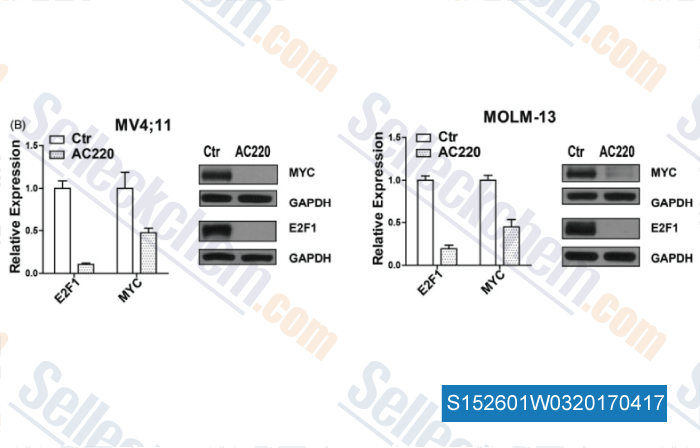
-
, , Leuk Lymphoma, 2017, 58(10):2426-2438
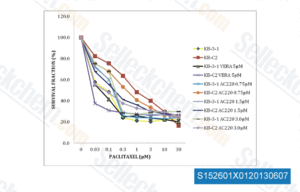
-
,
Selleck's Quizartinib (AC220) Has Been Cited by 159 Publications
| High mtDNA content identifies oxidative phosphorylation-driven acute myeloid leukemias and represents a therapeutic vulnerability [ Signal Transduct Target Ther, 2025, 10(1):222] | PubMed: 40653487 |
| ADH5/ALDH2 dehydrogenases and DNA polymerase theta protect normal and malignant hematopoietic cells from formaldehyde challenge: therapeutic implications [ Leukemia, 2025, 39(9):2152-2162] | PubMed: 40640557 |
| Dual targeting of CDK6 and LSD1 is synergistic and overcomes differentiation blockade in AML [ EMBO Mol Med, 2025, 10.1038/s44321-025-00296-2] | PubMed: 40883610 |
| Chaperone-mediated autophagy regulates the metastatic state of mesenchymal tumors [ EMBO Mol Med, 2025, 17(4):747-774] | PubMed: 40055574 |
| FLT3 inhibitors induce p53 instability, driven by STAT5/MDM2/p53 competitive interactions in acute myeloid leukemia [ Cancer Lett, 2025, 611:217446] | PubMed: 39756787 |
| Inhibition of NLRP3 enhances pro-apoptotic effects of FLT3 inhibition in AML [ Cell Commun Signal, 2025, 23(1):53] | PubMed: 39875995 |
| FLT3-ITD promotes immune checkpoint CD80 via ROS elevation in acute myeloid leukemia [ Front Immunol, 2025, 16:1577313] | PubMed: 40746567 |
| Conventional type 1 dendritic cells in the lymph nodes aggravate neuroinflammation after spinal cord injury by promoting CD8+ T cell expansion [ Mol Med, 2025, 31(1):37] | PubMed: 39901071 |
| Anti-Tumor Effects of Gilteritinib on FLT3 Mutations: Insights into Resistance Mechanisms in Ba/F3 Cell Models [ Onco Targets Ther, 2025, 18:489-501] | PubMed: 40196870 |
| Multi-selective RAS(ON) Inhibition Targets Oncogenic RAS Mutations and Overcomes RAS/MAPK-Mediated Resistance to FLT3 and BCL2 Inhibitors in Acute Myeloid Leukemia [ bioRxiv, 2025, 2025.06.10.658786] | PubMed: 40661530 |
RETURN POLICY
Selleck Chemical’s Unconditional Return Policy ensures a smooth online shopping experience for our customers. If you are in any way unsatisfied with your purchase, you may return any item(s) within 7 days of receiving it. In the event of product quality issues, either protocol related or product related problems, you may return any item(s) within 365 days from the original purchase date. Please follow the instructions below when returning products.
SHIPPING AND STORAGE
Selleck products are transported at room temperature. If you receive the product at room temperature, please rest assured, the Selleck Quality Inspection Department has conducted experiments to verify that the normal temperature placement of one month will not affect the biological activity of powder products. After collecting, please store the product according to the requirements described in the datasheet. Most Selleck products are stable under the recommended conditions.
NOT FOR HUMAN, VETERINARY DIAGNOSTIC OR THERAPEUTIC USE.