
|
How to Cite 1. For In-Text Citation (Materials & Methods): 2. For Key Resources Table: |
||
|
Toll Free: (877) 796-6397 -- USA and Canada only -- |
Fax: +1-832-582-8590 Orders: +1-832-582-8158 |
Tech Support: +1-832-582-8158 Ext:3 Please provide your Order Number in the email. We strive to reply to |
Technical Data
| Formula | C13H16N4O |
||||||
| Molecular Weight | 244.29 | CAS No. | 912444-00-9 | ||||
| Solubility (25°C)* | In vitro | DMSO | 49 mg/mL (200.58 mM) | ||||
| Water | Insoluble | ||||||
| Ethanol | Insoluble | ||||||
| In vivo (Add solvents to the product individually and in order) |
|
||||||
|
* <1 mg/ml means slightly soluble or insoluble. * Please note that Selleck tests the solubility of all compounds in-house, and the actual solubility may differ slightly from published values. This is normal and is due to slight batch-to-batch variations. * Room temperature shipping (Stability testing shows this product can be shipped without any cooling measures.) |
|||||||
Preparing Stock Solutions
Biological Activity
| Description | Veliparib (ABT-888, NSC 737664) is a potent inhibitor of PARP1 and PARP2 with Ki of 5.2 nM and 2.9 nM in cell-free assays, respectively. This compound is inactive to SIRT2 and increases autophagy and apoptosis. Phase 3. | ||||
|---|---|---|---|---|---|
| Targets |
|
||||
| In vitro | Veliparib (ABT-888) is inactive to SIRT2 (>5 μM). It inhibits the PARP activity with EC50 of 2 nM in C41 cells. This compound could decrease the PAR levels in both irradiated and nonirradiated H460 cells. It also reduces clonogenic survival and inhibits DNA repair by PARP-1 inhibition in H460 cells. When combined with radiation, it increases apoptosis and autophagy in H460 cells. It also inhibits PARP activity in H1299, DU145 and 22RV1 cells and the inhibition is independent of p53 function. At 10 μM, it suppresses the surviving fraction (SF) by 43% in the clonogenic H1299 cells. It shows effective radiosensitivity in oxic H1299 cells. Furthermore, it could attenuate the SF of hypoxic-irradiated cells including H1299, DU145 and 22RV1. |
||||
| In vivo | Veliparib (ABT-888) has an oral bioavailability of 56%-92% in mice, Sprague-Dawley rats, beagle dogs, and cynomolgus monkeys after oral administration. This compound (25 mg/kg i.p.) could improve tumor growth delay in a NCI-H460 xenograft model with well tolerated. Combination with radiation, it decreases the tumor vessel formation. It reduces intratumor PAR levels by more than 95% at a dose of 3 and 12.5 mg/kg in A375 and Colo829 xenograft models and the suppression could be maintained over time. |
||||
| Features | Increases the efficacy of common cancer therapies such as radiation and alkylating agents. |
Protocol (from reference)
| Kinase Assay: |
|
|---|---|
| Animal Study: |
|
References
|
Customer Product Validation
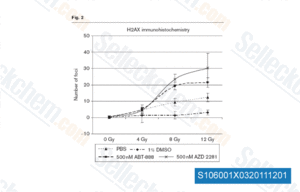
-
Data from [ Nucl Med Commun , 2011 , 32, 1046-1051 ]
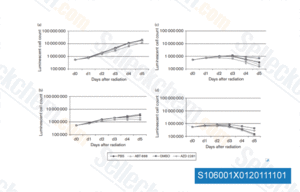
-
Data from [ Nucl Med Commun , 2011 , 32(11), 1046-51 ]
![<p>Colorimetric poly(ADP-ribose) polymerase (PARP) activity assay showing the relative activity of the PARP-1 enzyme in Raji lymphocyte tumor cells. Results show a highly significant difference in PARP activity in the controls [PBS and dimethyl sulfoxide (DMSO)] compared with 24 h incubation with 500 nmol/l of ABT-888 and 500 nmol/l of AZD-2281. A significant increase in PARP enzyme activity is shown in DMSO-incubated cells compared with PBS control.* P < 0.05.</p>](https://file.selleckchem.com/downloads/review/700px/ABT-888-S106001Z0120111101.gif)
-
Data from [ Nucl Med Commun , 2011 , 32(11), 1046-51 ]
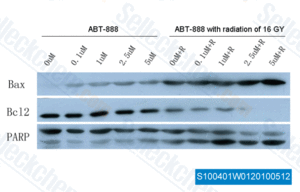
-
, , Dr.Zhang of Tianjin Medical University
Selleck's Veliparib (ABT-888) Has Been Cited by 268 Publications
| Selective small molecule targeting of KDM4 as a therapeutic strategy to reduce proliferation of acute myeloid leukaemia [ Br J Haematol, 2026, 208(4):1240-1251] | PubMed: 41622589 |
| Noncovalent PAR Binding Guides Proteins to PARP1-Mediated PARylation [ ACS Chem Biol, 2026, 21(4):779-789] | PubMed: 41824896 |
| PARP inhibitors induce a senescence phenotype in non-small cell lung carcinoma cell lines [ FEBS Open Bio, 2026, 10.1002/2211-5463.70206] | PubMed: 41714887 |
| EXO1 as a therapeutic target for Fanconi Anaemia, ZRSR2 and BRCA1-A complex deficient cancers [ Nat Commun, 2025, 16(1):8476] | PubMed: 41006228 |
| CHD6 has poly(ADP-ribose)- and DNA-binding domains and regulates PARP1/2-trapping inhibitor sensitivity via abasic site repair [ Nat Commun, 2025, 16(1):1026] | PubMed: 39863586 |
| PARP7 inhibits type I interferon signaling to prevent autoimmunity and lung disease [ J Exp Med, 2025, 222(5)e20241184] | PubMed: 39969510 |
| Combining Multiplexed CRISPR/Cas9-Nickase and PARP Inhibitors Efficiently and Precisely Targets Cancer Cells [ Cancer Res, 2025, 10.1158/0008-5472.CAN-24-2938] | PubMed: 40327605 |
| ZNF251 haploinsufficiency confers PARP inhibitors resistance in BRCA1-mutated cancer cells through activation of homologous recombination [ Cancer Lett, 2025, 613:217505] | PubMed: 39892701 |
| Role of KLF5 in enhancing ovarian cancer stemness and PARPi resistance: mechanisms and therapeutic targeting [ J Transl Med, 2025, 23(1):492] | PubMed: 40307891 |
| Poly ADP Ribose Polymerase Inhibitors Potentiate Proton Therapy End-of-Range Effects by Accelerating Replication Forks and Promoting Transcription Conflict [ Int J Radiat Oncol Biol Phys, 2025, S0360-3016(25)06197-8] | PubMed: 40882877 |
RETURN POLICY
Selleck Chemical’s Unconditional Return Policy ensures a smooth online shopping experience for our customers. If you are in any way unsatisfied with your purchase, you may return any item(s) within 7 days of receiving it. In the event of product quality issues, either protocol related or product related problems, you may return any item(s) within 365 days from the original purchase date. Please follow the instructions below when returning products.
SHIPPING AND STORAGE
Selleck products are transported at room temperature. If you receive the product at room temperature, please rest assured, the Selleck Quality Inspection Department has conducted experiments to verify that the normal temperature placement of one month will not affect the biological activity of powder products. After collecting, please store the product according to the requirements described in the datasheet. Most Selleck products are stable under the recommended conditions.
NOT FOR HUMAN, VETERINARY DIAGNOSTIC OR THERAPEUTIC USE.