
|
How to Cite 1. For In-Text Citation (Materials & Methods): 2. For Key Resources Table: |
||
|
Toll Free: (877) 796-6397 -- USA and Canada only -- |
Fax: +1-832-582-8590 Orders: +1-832-582-8158 |
Tech Support: +1-832-582-8158 Ext:3 Please provide your Order Number in the email. We strive to reply to |
Technical Data
| Formula | C6H7N5 |
||||||||||
| Molecular Weight | 149.15 | CAS No. | 5142-23-4 | ||||||||
| Solubility (25°C)* | In vitro | DMSO (warmed with 60ºC water bath) | 16 mg/mL (107.27 mM) | ||||||||
| Water (warmed with 60ºC water bath) | 10 mg/mL (67.04 mM) | ||||||||||
| Ethanol | 8 mg/mL (53.63 mM) | ||||||||||
| In vivo (Add solvents to the product individually and in order) |
|
||||||||||
|
* <1 mg/ml means slightly soluble or insoluble. * Please note that Selleck tests the solubility of all compounds in-house, and the actual solubility may differ slightly from published values. This is normal and is due to slight batch-to-batch variations. * Room temperature shipping (Stability testing shows this product can be shipped without any cooling measures.) |
|||||||||||
Preparing Stock Solutions
Biological Activity
| Description | 3-Methyladenine (3-MA) is a selective PI3K inhibitor for Vps34 and PI3Kγ with IC50 of 25 μM and 60 μM in HeLa cells. It blocks class I PI3K consistently, whereas suppression of class III PI3K is transient, and also inhibits autophagosome formation. Solutions are unstable and should be fresh-prepared. | ||||||
|---|---|---|---|---|---|---|---|
| Targets |
|
||||||
| In vitro | The slight preference for Vps34 prevention by 3-Methyladenine (3-MA) probably arises from a hydrophobic ring specific to Vps34, which encircles the 3-methyl group of this compound. It has been reported to cause cancer cell death under both normal and starvation conditions, and could also suppress cell migration and invasion independently of its ability to inhibit autophagy, implying that it possesses functions other than autophagy suppression. This compound elicits caspase-dependent cell death that is independent of autophagy inhibition. Treatment with 5 mM of it reduces the percentage of glucose-starved HeLa cells displaying GFP-LC3 puncta to 23%. The levels of LC3-I are increasing and the levels of LC3-II are decreasing between 12 and 48 hours in cells that are treated with 3-MA. Conversion of LC3-I to LC3-II is suppressed by the compound. Treatment of HeLa cells with it at 2.5 mM or 5 mM for one day does not affect cell viability, whereas treatment with 10 mM for one day causes a 25.0% decrease in cell viability. Treatment of cells with 2.5, 5 or 10 mM for two days causes 11.5%, 38.0% and 79.4% decrease in viability, respectively. It decreases cell viability in a time- and dose-dependent manner, and significantly shortens the duration of nocodazole-induced-prometaphase arrest. Suppression of autophagy by 3-MA inhibits SU11274-induced cell death. Prolonged treatment with it (up to 9 hours) induces significant LC3 I to II conversion in wild type MEFs. Prolonged treatment with 3-MA, but not wortmannin, markedly increases GFP-LC3 punctuation/aggregation. Its induced LC3 conversion and free GFP liberation are ATG7-dependent. Treatment with it leads to evident increase of p62 protein level. The compound increases the p62 level even in Atg5−/− MEFs as well as in cells with DOX-mediated deletion of ATG5. It inhibits class I and class III PI3K in different temporal patterns. Its induced LC3 I to LC3 II conversion is dramatically compromised in Tsc2−/− cells compared with wild type cells. This compound disrupts the anti-autophagic function of mTOR complex 1. |
||||||
| In vivo | 3-Methyladenine (3-MA) blocks autophagy through its effect on class III phosphatidylinositol 3-kinase (PI3K). Treatment with this compound does not alter the degree of hemorrhage compared with the subarachnoid hemorrhage (SAH) group. Its pretreatment significantly aggravates neurological symptoms when compared with the SAH + vehicle group. Autophagy is decreased when it is applied. Conversely, cleaved caspase-3 is markedly up-regulated in the SAH + 3-MA group. In line with the up-regulation of cleaved caspase-3 expression, the number of TUNEL-positive cells in the right cortex is significantly increased in the SAH + 3-MA group compared with the SAH + vehicle group. |
Protocol (from reference)
| Kinase Assay: |
|
|---|---|
| Cell Assay: |
|
| Animal Study: |
|
References
|
Customer Product Validation
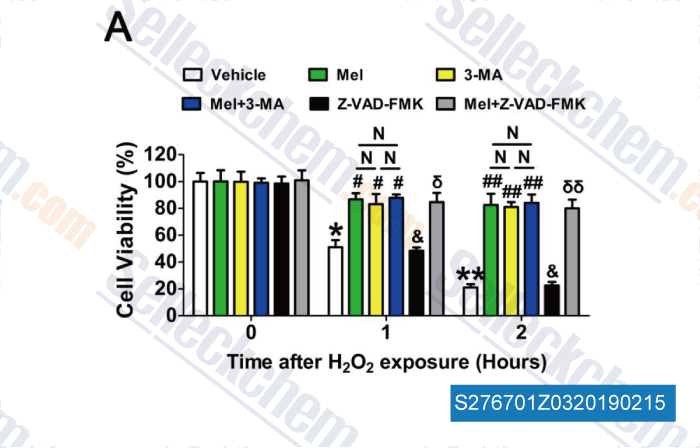
-
Data from [ , , Redox Biol, 2018, 18:138-157 ]
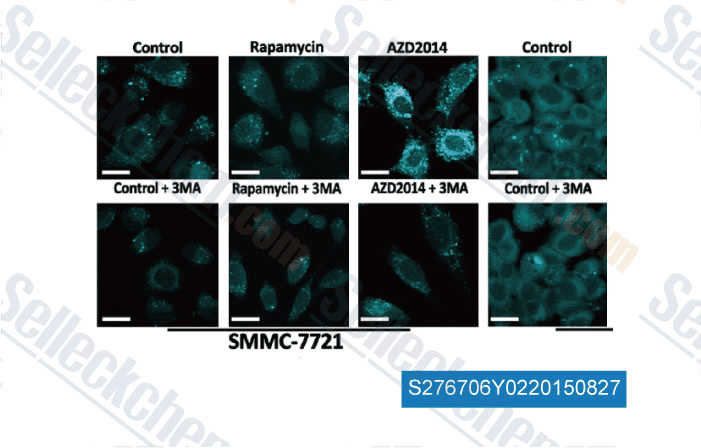
-
Data from [ , , Am J Cancer Res, 2015, 5(1): 125-139 ]
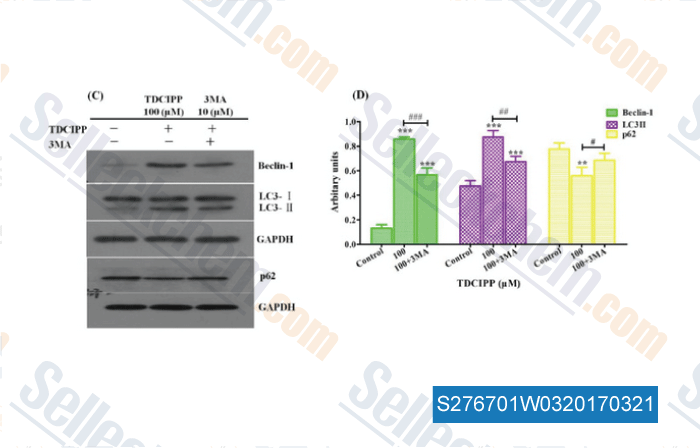
-
Data from [ , , Food Chem Toxicol, 2017, 100:183-196 ]
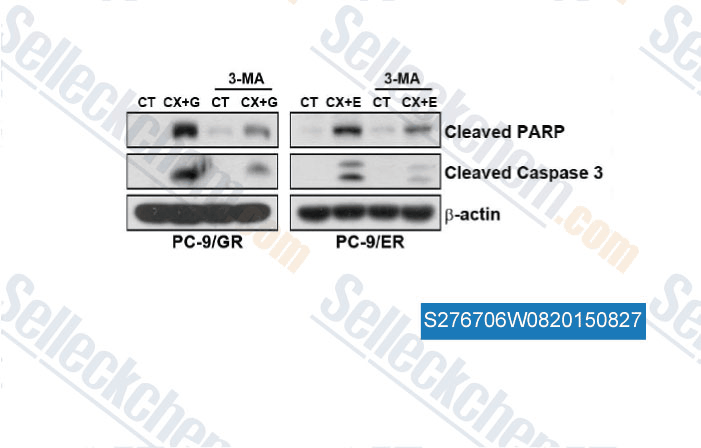
-
Data from [ , , PLoS One, 2014, 9(12): e114000 ]
Selleck's 3-Methyladenine (3-MA) Has Been Cited by 990 Publications
| Linc00673-V3 positively regulates autophagy by promoting Smad3-mediated LC3B transcription in NSCLC [ Life Science Alliance, March 25, 2024, e202302408] | PubMed: 38527804 |
| Dinaciclib Improves Treatment Response in Chemoresistant Hepatoblastoma [ Scientific Reports, December 5, 2025, 31141] | PubMed: 41345303 |
| Autophagy-mediated ferroptosis is involved in development of severe acute pancreatitis [ BMC Gastroenterology, August 1, 2024, 245] | PubMed: 39090535 |
| The alternative androgen receptor isoform A mitigates toxicity of polyglutamine-elongated mutant androgen receptor in spinal and bulbar muscular atrophy [ J Adv Res, 2026, S2090-1232(26)00076-7] | PubMed: 41564929 |
| Turnip crinkle virus coat protein subverts DRB7-mediated compensatory RNAi through ubiquitin-proteasome-dependent degradation [ Plant Commun, 2026, S2590-3462(26)00058-1] | PubMed: 41635079 |
| In vivo visualization of lipophagy dynamics using the tfLiveDrop reporter mice [ J Lipid Res, 2026, 67(5):101033] | PubMed: 41935632 |
| Circular RNA circMagi1 regulates the host immune response in respiratory Pseudomonas aeruginosa infection through G3BP2 [ mBio, 2026, 17(4):e0361725] | PubMed: 41870066 |
| PDCoV NSP5 cleaves the selective autophagy receptor CCDC50 to disrupt autophagic degradation of the viral envelope protein [ mBio, 2026, 17(4):e0025926] | PubMed: 41817175 |
| HSPA5 induces autophagy targeting VP2 through the PERK-eIF2α signaling pathway to inhibit SVA replication [ J Virol, 2026, 100(5):e0210325] | PubMed: 41973539 |
| LncRNA SNHG1 Knockdown Ameliorates HIV-1 gp120V3 Loop-Induced Microglial Neuroinflammation by Regulating the Autophagy Process [ Inflammation, 2026, 49(1):26] | PubMed: 41489751 |
RETURN POLICY
Selleck Chemical’s Unconditional Return Policy ensures a smooth online shopping experience for our customers. If you are in any way unsatisfied with your purchase, you may return any item(s) within 7 days of receiving it. In the event of product quality issues, either protocol related or product related problems, you may return any item(s) within 365 days from the original purchase date. Please follow the instructions below when returning products.
SHIPPING AND STORAGE
Selleck products are transported at room temperature. If you receive the product at room temperature, please rest assured, the Selleck Quality Inspection Department has conducted experiments to verify that the normal temperature placement of one month will not affect the biological activity of powder products. After collecting, please store the product according to the requirements described in the datasheet. Most Selleck products are stable under the recommended conditions.
NOT FOR HUMAN, VETERINARY DIAGNOSTIC OR THERAPEUTIC USE.
- 3-Methyladenine (3-MA) Mechanism of Action: PI3K Inhibition in Cancer Cell Research
- 3-Methyladenine (3-MA) Clinical Trials
- 3-Methyladenine (3-MA) Working Concentration | Cell Culture | Treatment
- 3-Methyladenine (3-MA) Solubility in DMSO
- 3-Methyladenine (3-MA) Stock Solution
- 3-Methyladenine (3-MA) Storage
- 3-Methyladenine (3-MA) Stability
- 3-Methyladenine (3-MA) Combination Database
- 3-Methyladenine (3-MA) Molecular Weight
- 3-Methyladenine (3-MA) SMILES
- 3-Methyladenine (3-MA) CAS Number
- 3-Methyladenine (3-MA) Chemical Structure (2D and 3D)
- 3-Methyladenine (3-MA) IC50 for Cell-based and Cell-free Assays
- 3-Methyladenine (3-MA) Sigma (M9281)? Try a better option.
- 3-Methyladenine (3-MA) MedChemExpress (HY-19312)? Try a better option.
- 3-Methyladenine (3-MA) Cayman (9001916)? Try a better option.
- 3-Methyladenine (3-MA) SDS|MSDS