Proton-Coupled Electron Transfer (PCET)
Overview: Proton-coupled electron transfer (PCET) reactions play a critical role in a variety of chemical and biological processes, including photosynthesis, various enzyme reactions, and energy devices such as solar cells. We have developed a general theoretical formulation for PCET and have applied this theory to a wide range of experimentally studied reactions in solution, proteins, and electrochemistry. We have written several reviews on PCET (Refs: 43, 106, 132, 152, 194).
PCET Theoretical Formulation & Methods
General Theory & Analytical Expressions
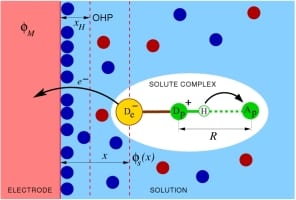
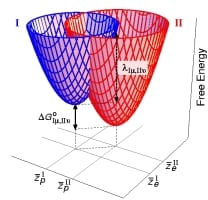
We have developed a general theoretical formulation for PCET reactions. This theory includes the quantum mechanical effects of the active electrons and transferring protons, as well as the motions of the proton donor-acceptor mode and solvent or protein environment. We have derived analytical nonadiabatic rate constant expressions in various well-defined regimes. The original formulation was based on a multistate continuum theory with fixed proton donor-acceptor distance.30, 35 Subsequent extensions included the dynamical effects of an explicit molecular solvent or protein environment, as well as the proton donor-acceptor vibrational motion.69, 74, 77, 200, 216 We have also extended this theory to electrochemical systems.102, 104, 115
Diabatization Schemes & Regimes
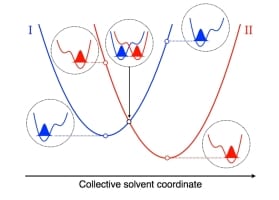
In addition, we have developed diabatization schemes for generating charge-localized diabatic electron-proton vibronic states136, 144 and methods for calculating the vibronic coupling between these states.90, 136, 152, 197 We have also identified hydrogen atom transfer (HAT) and electron-proton transfer (EPT) with electronically adiabatic and nonadiabatic proton transfer, respectively,90, 136, 152, 197 and have devised quantitative diagnostics for determining whether systems are in the electronically adiabatic or nonadiabatic regime.90, 136, 152, 197
Molecular Dynamics & QM/MM Simulations
We have also developed the methodology for mixed quantum/classical molecular dynamics simulations with explicit solvent for PCET reactions.15, 18, 19, 27, 47, 74, 77 In addition, we have developed nonadiabatic dynamics methods for simulating the ultrafast nonequilibrium dynamics of photoinduced PCET reactions for model systems.119, 122, 130, 135, 147 Recently we extended these methods to enable the study of experimentally relevant molecular systems embedded in explicit solvent with mixed quantum mechanical/molecular mechanical (QM/MM) potential energy surfaces computed on-the-fly using multiconfigurational QM methods.189, 195, 205, 218
Resource References: PCET Theory Summary Tutorial [PPT] | Tutorial (PDF)
webPCET Platform Archive
webPCET: Web site providing general information about PCET, interactive Java applets allowing users to perform calculations on model PCET systems and visualize results, and programs that are relevant to PCET and can be downloaded.
Targeted Applications in Chemical & Biological Systems
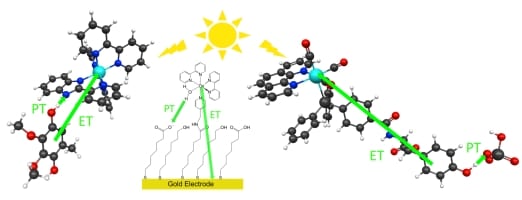
We have applied these theories to a wide range of chemical, biological, and electrochemical systems (Refs: 33, 44, 45, 52, 53, 60, 64, 93, 97, 114, 120, 124, 139).
Artificial Photosynthesis Systems
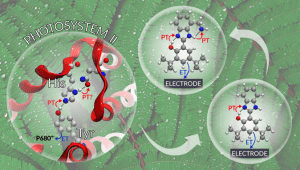
We are designing PCET systems with multiple concerted proton transfers upon oxidation to transport protons in water oxidation cells.229
Photoreduced ZnO Nanocrystals
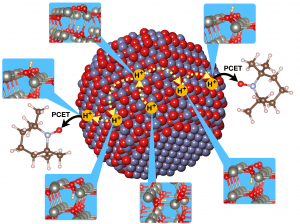
We are studying interfacial PCET from the ZnO surface of the photoreduced nanocrystal to TEMPO radical in solution,233 as well as proton diffusion from the bulk to the surface of the nanocrystal.234
BLUF photoreceptor proteins
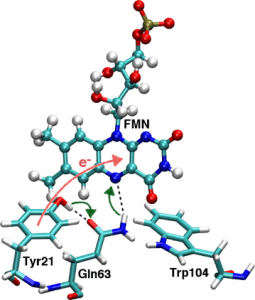
We are studying photoinduced PCET processes in BLUF photoreceptor proteins and are characterizing the resulting light-induced signaling state for transmitting long-range signals relevant to optogenetics.221
Photoinduced PCET in Solvated Molecular Systems
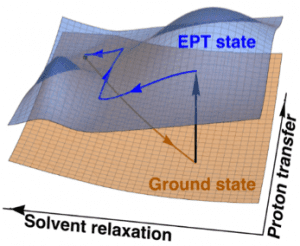
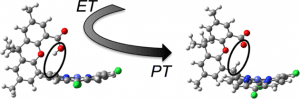
We are elucidating the roles of solvent dynamics, solute dynamics, and vibrational relaxation in solvated molecular systems, such as a hydrogen-bonded phenol-amine complex.189, 195, 205, 218
Electrochemical PCET in Molecular Electrocatalysts
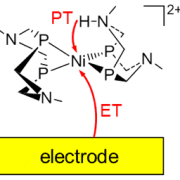
We are using theory to guide the design of molecular electrocatalysts for H2 oxidation and production, O2 reduction, and water oxidation.146, 148, 157, 160, 166, 177, 180, 181, 183, 186, 201, 202, 206, 207, 209, 211, 230
Soybean lipoxygenase
We are investigating the basis for unusually high kinetic isotope effects (KIEs) at room temperature for wild-type (KIE=80) and for mutants (KIEs up to 700), as well as their temperature dependences.64, 93, 126, 182, 213, 216, 219, 226