Nuclear-electronic orbital (NEO) method
Core Framework: We have developed the nuclear-electronic orbital (NEO) method for the incorporation of nuclear quantum effects into electronic structure calculations. In the NEO approach, specified nuclei are treated quantum mechanically on the same level as the electrons, and mixed nuclear-electronic wavefunctions are calculated with molecular orbital techniques. For hydrogen transfer and hydrogen bonding systems, typically the key hydrogen nuclei and all electrons are treated quantum mechanically. This approach naturally includes nuclear quantum effects such as proton delocalization and zero point energy as well as non-Born-Oppenheimer effects between the electrons and quantum protons.
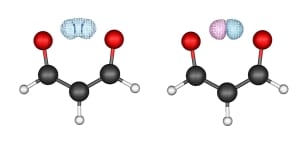
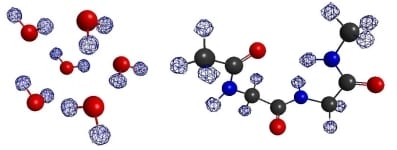
Wavefunction Methods & Correlation Frameworks
Electron-Proton Dynamical Correlation
Electron-proton dynamical correlation is highly significant and challenging to describe because of the attractive electrostatic interaction between the electron and the proton. We have developed the following wavefunction methods within the NEO framework: perturbation theory (MP2),70 multiconfigurational self-consistent-field (MCSCF) and configuration interaction (CI),54 nonorthogonal configuration interaction (NOCI),75 and explicitly correlated methods with Gaussian-type geminal functions (XCHF and RXCHF).86, 103, 108, 142, 167, 192, 193 The explicitly correlated methods have also been successful in describing positron systems.100, 112, 154, 168, 220
Method Extensions & Vibronic Coupling
The NEO method has been extended to treat multiple protons quantum mechanically125 and has been combined with the fragment molecular orbital (FMO) method123 to treat larger systems as well as with vibronic coupling theory111 to incorporate the effects of other vibrational modes in tunneling splitting calculations.
NEO-DFT (Multicomponent DFT)
The most promising approach within the NEO framework is multicomponent density functional theory (NEO-DFT).96, 105, 118 Electron-proton correlation functionals have been developed based on the explicitly correlated electron-proton pair density105, 145, 154 and, more recently, based on the Colle-Salvetti formulation (the epc17 functionals).231, 232 NEO-DFT/epc17 has been shown to produce accurate proton densities231 as well as energetic quantities such as proton affinities and optimized geometries.232
Current NEO-DFT Projects & Applications
Current Theory & Method Development
Current theory and method development projects are focusing on developing more accurate electron-proton correlation functionals and developing NEO-TDDFT (time-dependent DFT) for computing excited electron-proton vibronic states. Understanding the fundamental nature of the nuclear quantum effects, such as zero point energy and proton delocalization, and non-Born-Oppenheimer effects is also of great interest.
Project Diagrams Reference: [neo_1b] [neo_1a] [neo_2]
Targeted Fields of Application
Applications of interest include:
- Calculating pKa’s for molecular electrocatalysts.
- Generating reaction paths for proton, hydride, and proton-coupled electron transfer reactions.
- Calculating hydrogen tunneling splittings and vibronic couplings.
- Characterizing photoinduced proton-coupled electron transfer systems.