
|
How to Cite 1. For In-Text Citation (Materials & Methods): 2. For Key Resources Table: |
||
|
Toll Free: (877) 796-6397 -- USA and Canada only -- |
Fax: +1-832-582-8590 Orders: +1-832-582-8158 |
Tech Support: +1-832-582-8158 Ext:3 Please provide your Order Number in the email. We strive to reply to |
Biological Description
| Specificity | WT1 Antibody [J23C5] detects endogenous levels of total WT1 protein. |
|---|---|
| Background | Wilms’ tumor 1 (WT1) is a transcription factor encoded by the WT1 gene and is widely expressed during development, particularly in tissues of the genitourinary system, mesothelium, and hematopoietic compartments, where it exerts essential regulatory functions in organ formation and cell‑type specification. It belongs to a family of C2H2‑type zinc‑finger DNA‑binding proteins and contains multiple transcriptional regulatory domains, including an N‑terminal proline‑ and glutamine‑rich region with separable activation and repression motifs, as well as four C‑terminal zinc‑finger repeats that mediate sequence‑specific DNA binding and RNA‑interaction surfaces. Alternative splicing and post‑translational modifications generate multiple WT1 isoforms that differ in their N‑terminal sequence, inclusion of a 17‑amino‑acid insert, and presence or absence of the KTS triplet between the third and fourth zinc fingers, each of which can influence target‑gene selection and transcriptional output. WT1 can function as both a transcriptional activator and repressor, modulating expression of genes involved in proliferation, differentiation, and apoptosis, and it interfaces with coregulatory complexes that include histone‑modifying enzymes and RNA‑processing factors, thereby coupling transcriptional control to chromatin architecture and post‑transcriptional regulation. WT1 coordinates the balance between survival and proliferation of metanephric mesenchyme and promotes nephron differentiation, and in mesothelial and sex‑cord‑derived tissues, it regulates lineage identity and structural integrity. Mutations and dysregulation of WT1 are associated with congenital genitourinary defects such as Denys–Drash, Frasier, and WAGR syndromes, and loss‑of‑function or mislocalized WT1 correlates with Wilms’ tumor and impaired renal morphogenesis, whereas aberrantly expressed or overexpressed WT1 isoforms are detected in leukemias and solid tumors, where they can drive oncogenic gene programs. |
Usage Information
| Application | WB, IP, IHC, IF | Dilution |
|
||||||||
|---|---|---|---|---|---|---|---|---|---|---|---|
| Reactivity | Human | ||||||||||
| Source | Rabbit Monoclonal Antibody | MW | 51-60 kDa | ||||||||
| Storage Buffer | PBS, pH 7.2+50% Glycerol+0.05% BSA+0.01% NaN3 | Storage (from the date of receipt) |
-20°C (avoid freeze-thaw cycles), 2 years | ||||||||
References
|
Application Data
WB
Validated by Selleck
-
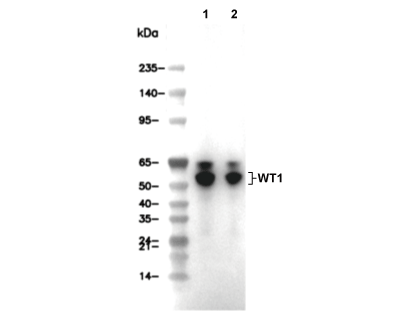 Lane 1: K562, Lane 2: OVCAR-3