
|
How to Cite 1. For In-Text Citation (Materials & Methods): 2. For Key Resources Table: |
||
|
Toll Free: (877) 796-6397 -- USA and Canada only -- |
Fax: +1-832-582-8590 Orders: +1-832-582-8158 |
Tech Support: +1-832-582-8158 Ext:3 Please provide your Order Number in the email. We strive to reply to |
Biological Description
| Specificity | WDR59 Antibody [P9B16] detects endogenous levels of total WDR59 protein. |
|---|---|
| Background | WDR59 belongs to the WD repeat domain family of proteins and functions as a core scaffolding subunit of the GATOR2 complex, a multiprotein assembly localized to the lysosomal surface that senses amino acids to drive mTORC1 pathway activation and thereby regulate cellular growth and anabolic processes. The protein integrates into the large, cage-like architecture of GATOR2 alongside subunits such as WDR24 and MIOS, where its WD repeats facilitate stable complex formation and shield components like Mio and Wdr24 from proteolytic degradation, ensuring intact assembly under nutrient-replete conditions. In the amino acid-sensing arm of mTORC1 signaling, GATOR2, bolstered by WDR59, directly antagonizes the GATOR1 complex to suppress its GAP activity toward RagA/B GTPases, allowing Rag heterodimers to adopt the GTP-bound state that recruits mTORC1 to lysosomes for activation by Rheb and upstream signals. This mechanism couples extracellular amino acid availability, particularly leucine and arginine, to intracellular mTORC1 outputs, including protein synthesis, autophagy inhibition, and metabolic reprogramming, with WDR59 maintaining GATOR2 integrity to sustain these responses during prolonged nutrient stimulation. Experimental disruption of WDR59 destabilizes GATOR2, elevates GATOR1 activity, and impairs mTORC1 signaling, underscoring its non-redundant role in pathway fidelity. WDR59 supports tissue-specific adaptations, as evidenced by tissue-restricted effects in Drosophila, where its loss variably enhances or suppresses growth in structures like the ovary and eye imaginal disc, reflecting context-dependent modulation of mTORC1. Dysregulation through biallelic mutations manifests in early-onset autosomal recessive dilated cardiomyopathy, where diminished GATOR2 function likely disrupts cardiac mTORC1-dependent homeostasis, hypertrophy, and energy metabolism. |
Usage Information
| Application | WB, IP | Dilution |
|
||||
|---|---|---|---|---|---|---|---|
| Reactivity | Human, Monkey | ||||||
| Source | Rabbit Monoclonal Antibody | MW | 110 kDa | ||||
| Storage Buffer | PBS, pH 7.2+50% Glycerol+0.05% BSA+0.01% NaN3 | Storage (from the date of receipt) |
-20°C (avoid freeze-thaw cycles), 2 years | ||||
References
|
Application Data
WB
Validated by Selleck
-
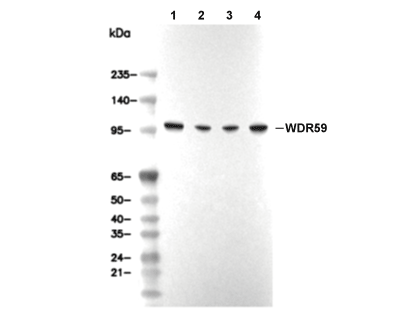 Lane 1: MCF7, Lane 2: Hela, Lane 3: Jurkat, Lane 4: ACHN