
|
How to Cite 1. For In-Text Citation (Materials & Methods): 2. For Key Resources Table: |
||
|
Toll Free: (877) 796-6397 -- USA and Canada only -- |
Fax: +1-832-582-8590 Orders: +1-832-582-8158 |
Tech Support: +1-832-582-8158 Ext:3 Please provide your Order Number in the email. We strive to reply to |
Technical Data
| Formula | C19H14Cl2N2O3S |
||||||||||
| Molecular Weight | 421.3 | CAS No. | 879085-55-9 | ||||||||
| Solubility (25°C)* | In vitro | DMSO | 84 mg/mL (199.38 mM) | ||||||||
| Water | Insoluble | ||||||||||
| Ethanol | Insoluble | ||||||||||
| In vivo (Add solvents to the product individually and in order) |
|
||||||||||
|
* <1 mg/ml means slightly soluble or insoluble. * Please note that Selleck tests the solubility of all compounds in-house, and the actual solubility may differ slightly from published values. This is normal and is due to slight batch-to-batch variations. * Room temperature shipping (Stability testing shows this product can be shipped without any cooling measures.) |
|||||||||||
Preparing Stock Solutions
Biological Activity
| Description | Vismodegib (GDC-0449) is a potent, novel and specific hedgehog inhibitor with IC50 of 3 nM and also inhibits P-gp with IC50 of 3.0 μM in a cell-free assay. | ||
|---|---|---|---|
| Targets |
|
||
| In vitro | Vismodegib (GDC-0449) targets the Hedgehog signaling pathway, blocking the activities of the Hedgehog-ligand cell surface receptors PTCH and/or SMO and suppressing Hedgehog signaling. This compound prevents multiple ATP-binding cassette (ABC) transporters and also blocks ABCG2, Pgp, and MRP1—important ABC transporters associated with MDR. It is a potent inhibitor of ABC transporters, ABCG2/BCRP and ABCB1/Pgp, and is a mild inhibitor of ABCC1/MRP1. In ABCG2-overexpressing HEK293 cells, it increases retention of the fluorescent ABCG2 substrate BODIPY and resensitizes these cells. In Madin-Darby canine kidney II cells engineered to overexpress Pgp or MRP1, it increases the retention of calcein-AM and resensitizes them. It also resensitizes human non-small cell lung carcinoma cells NCI-H460/par and NCI-H460/MX20, which overexpress ABCG2 in response to SN-38. The IC50 values for prevention of ABCG2 and Pgp are about 1.4 μM and 3.0 μM, respectively. Additionally, it alters intracellular Ca2+ homeostasis and inhibits cell growth in resistant lung cancer cells. |
||
| In vivo | Vismodegib (GDC-0449) has been used to treat medulloblastoma in animal models. It prevents the growth of primary pancreatic xenografts without non-specifically inhibiting pancreatic cell proliferation. Oral dosing of this compound causes tumor regressions in the Ptch(+/-) allograft model of medulloblastoma at doses ≥25 mg/kg and tumor growth inhibition at doses up to 92 mg/kg dosed twice daily in two ligand-dependent colorectal cancer models, D5123, and 1040830. Analysis of Hh pathway activity and PK/PD modeling reveals that it inhibits Gli1 with a similar IC50 in both the medulloblastoma and D5123 models (0.165 μM and 0.267 μM, respectively). Pathway modulation is linked to efficacy using an integrated PK/PD model revealing a steep relationship where > 50% of the activity of GDC-0449 is associated with >80% repression of the Hh pathway. |
Protocol (from reference)
| Cell Assay: |
|
|---|---|
| Animal Study: |
|
References
|
Customer Product Validation
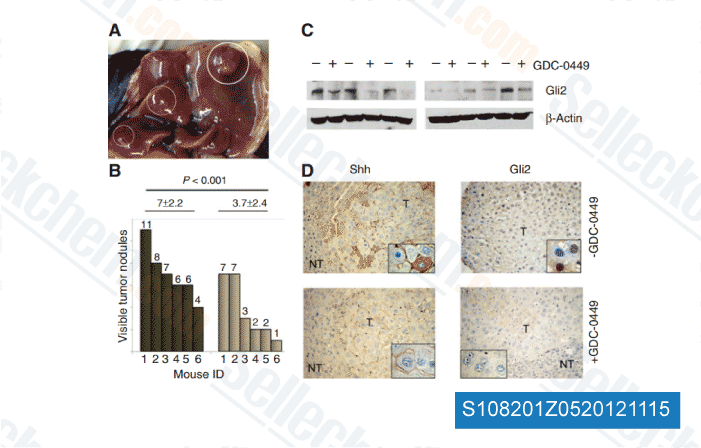
-
Data from [ Cancer Res , 2014 , 72, 5912-20 ]
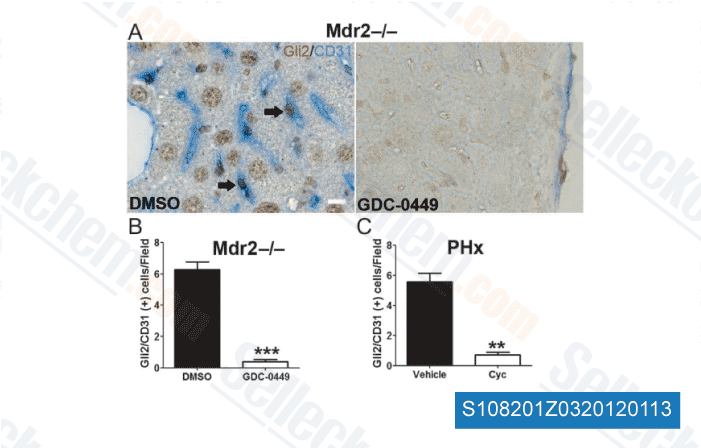
-
Data from [ Gut , 2013 , 62, 299-309 ]
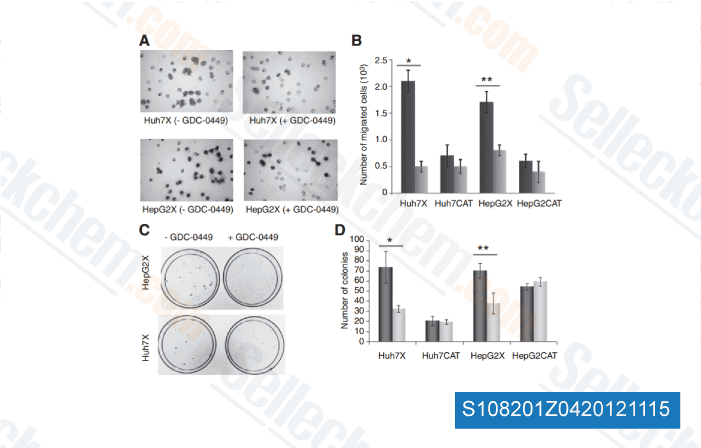
-
Data from [ Cancer Res , 2013 , 72, 5912-20 ]
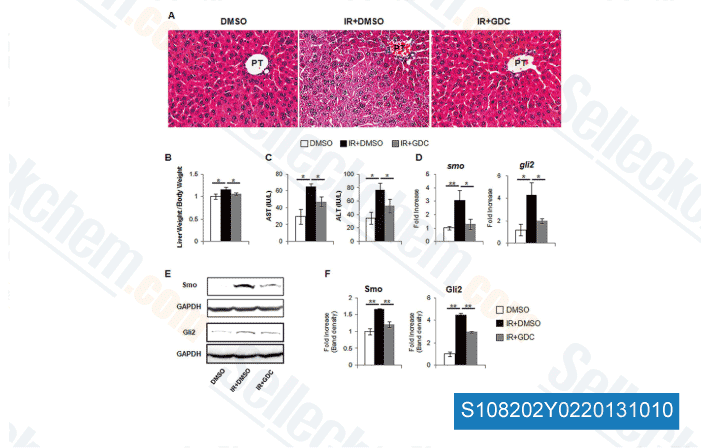
-
Data from [ PLoS One , 2013 , 8, e74141 ]
Selleck's Vismodegib (GDC-0449) Has Been Cited by 229 Publications
| Signaling pathway inhibitors target breast cancer stem cells in triple-negative breast cancer [ Oncology Reports, October 18, 2018, 437-446] | PubMed: 30365081 |
| Inhibition of CAL27 Oral Squamous Carcinoma Cell by Targeting Hedgehog Pathway With Vismodegib or Itraconazole [ Frontiers in Oncology, November 10, 2020, 563838] | |
| Disruption of SHH signaling cascade by SBE attenuates lung cancer progression and sensitizes DDP treatment [ Scientific Reports, May 15, 2017, 1899] | PubMed: 28507311 |
| AMBRA1 enhances Sonic Hedgehog signaling during cerebellar development and in medulloblastoma [ Dev Cell, 2026, S1534-5807(26)00120-6] | PubMed: 41980781 |
| Sonic hedgehog medulloblastomas are dependent on Netrin-1 for survival [ Nat Commun, 2025, 16(1):5137] | PubMed: 40461501 |
| OLIG2 mediates a rare targetable stem cell fate transition in sonic hedgehog medulloblastoma [ Nat Commun, 2025, 16(1):1092] | PubMed: 39904987 |
| The O-glycosyltransferase C1GALT1 promotes EWSR1::FLI1 expression and is a therapeutic target for Ewing sarcoma [ Nat Commun, 2025, 16(1):1267] | PubMed: 39894896 |
| BBS8-dependent ciliary Hedgehog signaling governs cell fate in the white adipose tissue [ EMBO J, 2025, 10.1038/s44318-025-00524-y] | PubMed: 40836034 |
| GPR137-RAB8A activation promotes ovarian cancer development via the Hedgehog pathway [ J Exp Clin Cancer Res, 2025, 44(1):22] | PubMed: 39856733 |
| BCL2 drives castration resistance in castration-sensitive prostate cancer by orchestrating reciprocal crosstalk between oncogenic pathways [ Cell Rep, 2025, 44(6):115779] | PubMed: 40448998 |
RETURN POLICY
Selleck Chemical’s Unconditional Return Policy ensures a smooth online shopping experience for our customers. If you are in any way unsatisfied with your purchase, you may return any item(s) within 7 days of receiving it. In the event of product quality issues, either protocol related or product related problems, you may return any item(s) within 365 days from the original purchase date. Please follow the instructions below when returning products.
SHIPPING AND STORAGE
Selleck products are transported at room temperature. If you receive the product at room temperature, please rest assured, the Selleck Quality Inspection Department has conducted experiments to verify that the normal temperature placement of one month will not affect the biological activity of powder products. After collecting, please store the product according to the requirements described in the datasheet. Most Selleck products are stable under the recommended conditions.
NOT FOR HUMAN, VETERINARY DIAGNOSTIC OR THERAPEUTIC USE.
- Vismodegib (GDC-0449) Mechanism of Action: SMO Inhibition in Basal Cell Carcinoma Cells Research
- Vismodegib (GDC-0449) Clinical Trials
- Vismodegib (GDC-0449) Working Concentration | Cell Culture | Treatment
- Vismodegib (GDC-0449) Solubility in DMSO
- Vismodegib (GDC-0449) Stock Solution
- Vismodegib (GDC-0449) Storage
- Vismodegib (GDC-0449) Stability
- Vismodegib (GDC-0449) Combination Database
- Vismodegib (GDC-0449) Molecular Weight
- Vismodegib (GDC-0449) SMILES
- Vismodegib (GDC-0449) CAS Number
- Vismodegib (GDC-0449) Chemical Structure (2D and 3D)
- Vismodegib (GDC-0449) IC50 for Cell-based and Cell-free Assays
- Vismodegib (GDC-0449) MedChemExpress (HY-10440)? Try a better option.
- Vismodegib (GDC-0449) Sigma (CDS025407)? Try a better option.
- Vismodegib (GDC-0449) SDS|MSDS