
|
How to Cite 1. For In-Text Citation (Materials & Methods): 2. For Key Resources Table: |
||
|
Toll Free: (877) 796-6397 -- USA and Canada only -- |
Fax: +1-832-582-8590 Orders: +1-832-582-8158 |
Tech Support: +1-832-582-8158 Ext:3 Please provide your Order Number in the email. We strive to reply to |
Biological Description
| Specificity | Syntenin-1/MDA9 Antibody [B6B6] detects endogenous levels of total Syntenin-1/MDA9 protein. |
|---|---|
| Background | Syntenin-1, also designated MDA-9 or SDCBP, belongs to the PDZ-domain scaffold adaptor family pivotal for assembling multimolecular complexes that orchestrate membrane trafficking and signal transduction across diverse cellular contexts. Its architecture centers on two tandem PDZ domains flanked by unstructured N- and C-terminal regions, enabling high-affinity binding to C-terminal motifs of transmembrane partners like syndecans while recruiting endosomal sorting machinery through direct ALIX interaction via conserved LYPX(n)L sequences. Within the syndecan-syntenin-ALIX pathway, heparanase cleavage of syndecan heparan sulfate chains triggers syntenin-1 multimerization and ALIX recruitment, driving intraluminal budding of late endosomal compartments into multivesicular bodies that mature into exosomes enriched with syndecan fragments, CD63, and bioactive cargos such as FGFR1 or miR-494-3p. This cascade amplifies exosome biogenesis in a concentration-dependent manner, with proheparanase internalization processing to active enzyme enhancing syntenin-ALIX association and subsequent vesicle release. Syntenin-1 further modulates FAK-Src signaling by linking integrins to pro-invasive actin dynamics, activates mTOR via Rheb binding in its GDP-bound state to regulate proliferation, and intersects Wnt/β-catenin through syndecan-2 competition that displaces CASK, stabilizing dendritic spines while promoting excitatory shaft synapses via ephrinB3. In neuronal development, Rheb nucleotide status governs syntenin levels, with active Rheb dissociation elevating free syntenin to bind syndecan-2 tails, suppressing spine maturation in TSC models. Overexpression drives metastasis and angiogenesis in lung, breast, and melanoma by elevating exosome-mediated miRNA transfer that reprograms stromal cells, while oncogenic Ras sustains this axis to load pro-tumorigenic cargos. |
Usage Information
| Application | WB, IP, IF, FCM | Dilution |
|
||||||||
|---|---|---|---|---|---|---|---|---|---|---|---|
| Reactivity | Human | ||||||||||
| Source | Rabbit Monoclonal Antibody | MW | 30 kDa | ||||||||
| Storage Buffer | PBS, pH 7.2+50% Glycerol+0.05% BSA+0.01% NaN3 | Storage (from the date of receipt) |
-20°C (avoid freeze-thaw cycles), 2 years | ||||||||
References
|
Application Data
WB
Validated by Selleck
-
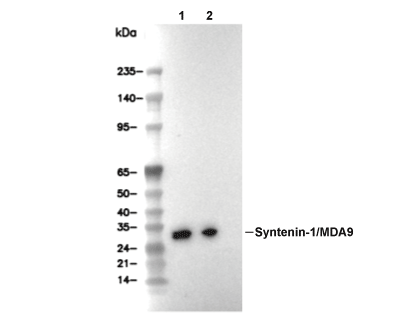 Lane 1: A172, Lane 2: MCF7