
|
How to Cite 1. For In-Text Citation (Materials & Methods): 2. For Key Resources Table: |
||
|
Toll Free: (877) 796-6397 -- USA and Canada only -- |
Fax: +1-832-582-8590 Orders: +1-832-582-8158 |
Tech Support: +1-832-582-8158 Ext:3 Please provide your Order Number in the email. We strive to reply to |
Biological Description
| Specificity | Strep-tag II Antibody [C20H20] detects exogenous levels of total Strep-tag II. |
|---|---|
| Background | Strep‑tag II is a short synthetic peptide affinity tag derived from the core binding epitope of streptavidin ligands that is fused to recombinant proteins to enable highly specific, reversible interaction with engineered streptavidin derivatives for purification, immobilization, and detection under near‑physiological conditions. The tag consists of an eight– to nine–amino acid sequence (WSHPQFEK or closely related variants) placed at either the N‑ or C‑terminus of a protein, and this linear peptide provides a defined binding interface that fits into the biotin‑binding pocket of Strep‑Tactin or optimized streptavidin mutants with micromolar affinity that is about two orders of magnitude higher than the interaction of the same peptide with wild‑type streptavidin. Interaction with Strep‑Tactin is highly selective and largely independent of the fused protein’s structure, which allows Strep‑tag II fusion proteins to be captured from complex lysates by passing the sample over agarose or sepharose matrices coupled to Strep‑Tactin; Strep‑tagged proteins bind specifically while most host proteins flow through or are removed by brief washes in physiological buffer. Elution occurs competitively using desthiobiotin or biotin, which displaces the tag from the Strep‑Tactin binding pocket without harsh pH or denaturants, preserving native conformation, enzymatic activity, labile cofactors, and multiprotein complex integrity, and enabling direct use of eluates for functional and structural studies. This mild, one‑step enrichment yields highly purified target protein and often outperforms immobilized metal affinity chromatography for sensitive or metalloenzyme targets, as shown for hydrogenase precursors and basic helix–loop–helix–zipper domains where Strep‑tag II purification delivered active proteins and intact complexes suitable for downstream binding assays and structural analysis. The tag also supports applications beyond bulk purification: Strep‑tag II cassettes introduced at endogenous loci or added to subunits of native complexes permit gentle isolation of large multi‑protein assemblies and functional complexes from yeast or mammalian cells, and the same tag–ligand pair can be exploited for oriented immobilization on solid supports in biosensing, enzyme engineering, and single‑molecule experiments. |
Usage Information
| Application | WB, IP, IHC, IF, FCM, ChIP | Dilution |
|
||||||||||
|---|---|---|---|---|---|---|---|---|---|---|---|---|---|
| Reactivity | All | ||||||||||||
| Source | Rabbit Monoclonal Antibody | MW | |||||||||||
| Storage Buffer | PBS, pH 7.2+50% Glycerol+0.05% BSA+0.01% NaN3 | Storage (from the date of receipt) |
-20°C (avoid freeze-thaw cycles), 2 years | ||||||||||
References
|
Application Data
WB
Validated by Selleck
-
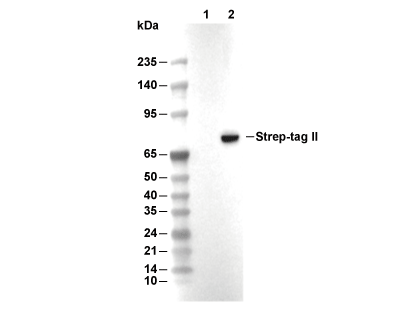 Lane 1: 293T, Lane 2: 293T (GNA13(human)-EGFP-StrepII transfected)