
|
How to Cite 1. For In-Text Citation (Materials & Methods): 2. For Key Resources Table: |
||
|
Toll Free: (877) 796-6397 -- USA and Canada only -- |
Fax: +1-832-582-8590 Orders: +1-832-582-8158 |
Tech Support: +1-832-582-8158 Ext:3 Please provide your Order Number in the email. We strive to reply to |
Biological Description
| Specificity | Spry2 Antibody [A12L7] detects endogenous levels of total Spry2 protein. |
|---|---|
| Background | Sprouty homolog 2 (Spry2) is a cytosolic membrane‑associated regulator of receptor tyrosine kinase signaling that belongs to the sprouty family of inducible feedback inhibitors and modulates growth factor–driven pathways controlling proliferation, differentiation, migration, and survival. The protein contains an N‑terminal region with multiple regulatory motifs and a C‑terminal cysteine‑rich domain required for membrane localization and inhibitory activity, which becomes palmitoylated and targets Spry2 to membrane ruffles and signaling microdomains where it can interact with key components of RTK pathways. Expression is induced by ligands such as fibroblast growth factor and epidermal growth factor, positioning Spry2 in a feedback loop where RTK activation upregulates Spry2, and the resulting protein attenuates further signaling. In FGF and EGF pathways, Spry2 binds components at or downstream of activated receptors, including Grb2, Raf, and PLCγ, and interferes with assembly of signaling complexes that connect RTKs to Ras and the Raf–MEK–ERK cascade, thereby limiting ERK1/2 phosphorylation and dampening mitogenic and migratory responses. Interaction with the E3 ubiquitin ligase CBL and its partner CIN85 alters receptor trafficking and degradation; Spry2 can sequester CBL and modulate its availability for EGFR downregulation, giving Spry2 a context‑dependent dual role in which it either suppresses or supports ERK signaling depending on receptor, cell type, and expression level. Regulatory control of Spry2 abundance involves ubiquitin‑dependent proteasomal degradation controlled by specific proline‑directed motifs and prolyl hydroxylation, linking its protein stability to cellular oxygen tension and growth factor signaling state. In neuronal systems, Spry2 inhibits BDNF‑induced TrkB–ERK signaling and modulates dendritic complexity and neuronal excitability, placing it as a regulator of neurotrophin‑dependent circuit maturation and plasticity. In immune contexts, Spry2 regulates TCR‑proximal signaling by modulating the activity of the Src family kinase Lck and tuning ERK1/2 activation, which shapes T cell effector function and cytokine production and contributes to control of airway inflammation. Altered Spry2 expression or mutation is reported in multiple cancers, including colorectal and lung carcinomas and gliomas, where loss or downregulation removes a key brake on RTK–ERK and PI3K–Akt pathways, while in some settings aberrant Spry2 can also participate in oncogenic signaling, indicating a context‑dependent tumor‑suppressive and tumor‑modifying role. |
Usage Information
| Application | WB, IHC, IF | Dilution |
|
||||||
|---|---|---|---|---|---|---|---|---|---|
| Reactivity | Rat, Human | ||||||||
| Source | Rabbit Monoclonal Antibody | MW | 35 kDa | ||||||
| Storage Buffer | PBS, pH 7.2+50% Glycerol+0.05% BSA+0.01% NaN3 | Storage (from the date of receipt) |
-20°C (avoid freeze-thaw cycles), 2 years | ||||||
References
|
Application Data
WB
Validated by Selleck
-
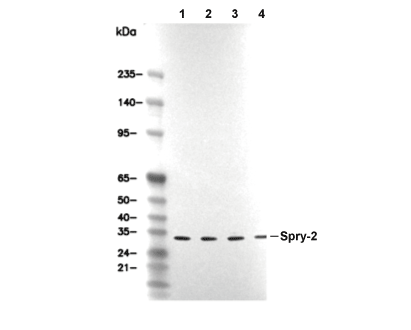 Lane 1: HeLa, Lane 2: SH-SY5Y, Lane 3: Mouse liver, Lane 4: Rat liver