
|
How to Cite 1. For In-Text Citation (Materials & Methods): 2. For Key Resources Table: |
||
|
Toll Free: (877) 796-6397 -- USA and Canada only -- |
Fax: +1-832-582-8590 Orders: +1-832-582-8158 |
Tech Support: +1-832-582-8158 Ext:3 Please provide your Order Number in the email. We strive to reply to |
Biological Description
| Specificity | SOX17 Antibody [F21M23] detects endogenous levels of total SOX17 protein. |
|---|---|
| Background | SOX17 belongs to the SOX family of transcription factors distinguished by their HMG-box DNA-binding domain, playing essential roles in endoderm specification and cardiovascular morphogenesis during embryonic development. The protein features a conserved high-mobility-group domain flanked by transactivation and repression motifs that enable sequence-specific binding to 5'-AACAAT-3' or 5'-AACAAAG-3' consensus sites on target promoters, facilitating chromatin remodeling through cooperative interactions with β-catenin and other cofactors. Activated in prospective definitive endoderm progenitors prior to gastrulation, SOX17 drives their egress from the visceral endoderm epithelium by promoting cell polarity and epithelialization, while directing basement membrane assembly at the mesoderm-endoderm interface through transcriptional regulation of extracellular matrix components like laminin and collagen IV. SOX17 cooperates with canonical Wnt signaling by co-occupying enhancers with β-catenin to pattern endoderm territories and suppress mesodermal fates, ensuring germ layer segregation during gut tube formation. Within cardiac mesoderm, SOX17 acts upstream of Mesp1/2 to specify progenitors destined for myocardial lineages, with loss disrupting primitive mesoderm transition into contracting cardiomyocytes. Postnatally redundant with SOX18, SOX17 sustains endothelial integrity in pulmonary arteries and microvasculature, where endothelial-specific ablation yields vessel dilation, reduced capillary networks, and perinatal lethality from circulatory failure. Hematopoietic stem cell emergence in the aorta-gonad-mesonephros region relies on SOX17 stabilization of hemogenic endothelium, linking it to fetal blood production. Dysregulated silencing through hypermethylation occurs in colorectal and gastric cancers, correlating with Wnt hyperactivation and metastatic competence, while overexpression enforces endodermal identity in stem cell differentiation protocols. |
Usage Information
| Application | WB, IP, IHC, IF | Dilution |
|
||||||||
|---|---|---|---|---|---|---|---|---|---|---|---|
| Reactivity | Mouse, Rat, Human | ||||||||||
| Source | Rabbit Monoclonal Antibody | MW | 44 kDa | ||||||||
| Storage Buffer | PBS, pH 7.2+50% Glycerol+0.05% BSA+0.01% NaN3 | Storage (from the date of receipt) |
-20°C (avoid freeze-thaw cycles), 2 years | ||||||||
References
|
Application Data
WB
Validated by Selleck
-
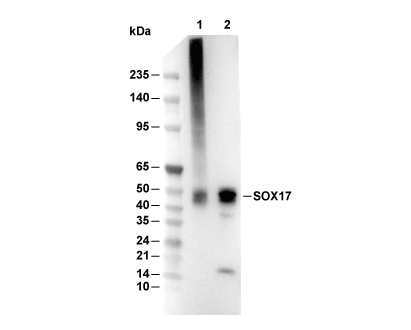 Lane 1: SK-OV-3, Lane 2: OVCAR-3