
|
How to Cite 1. For In-Text Citation (Materials & Methods): 2. For Key Resources Table: |
||
|
Toll Free: (877) 796-6397 -- USA and Canada only -- |
Fax: +1-832-582-8590 Orders: +1-832-582-8158 |
Tech Support: +1-832-582-8158 Ext:3 Please provide your Order Number in the email. We strive to reply to |
Biological Description
| Specificity | SNAT1/SLC38A1 Antibody [G3B8] detects endogenous levels of total SNAT1/SLC38A1 protein. |
|---|---|
| Background | SNAT1/SLC38A1 is a system A sodium‑coupled neutral amino acid transporter of the SLC38 family that mediates electrogenic, pH‑sensitive cotransport of glutamine and Na⁺ with 1:1 stoichiometry and transports small zwitterionic and aliphatic amino acids such as alanine, serine, asparagine, cysteine, and histidine with lower affinity, using the inward Na⁺ gradient to drive net amino acid uptake across the plasma membrane and generate steep transmembrane concentration gradients. The transporter is a multi‑pass membrane protein predicted to adopt the 5+5 inverted repeat fold characteristic of SLC38 carriers, with eleven transmembrane helices, an intracellular N‑terminus, and an extracellular C‑terminus, and is expressed at the plasma membrane of neurons, placenta, heart, lung, skeletal muscle, spleen, stomach, testis, and multiple tumor types, with particularly high levels in cerebral cortex neurons and lower expression in astrocytes. SNAT1/SLC38A1 functions as a major route for glutamine uptake into glutamatergic and GABAergic neurons, supplying precursor for synthesis of the neurotransmitters glutamate and GABA within the glutamate–glutamine cycle, and contributes to general amino acid homeostasis in tissues with high anabolic demand, consistent with the broader SLC38 family role in liver ammonia detoxification, gluconeogenesis, and renal acid–base regulation. Transport by system A subtypes including SNAT1 is rheogenic and pH‑sensitive, with Na⁺‑coupled uptake generating inward currents and dependence on extracellular pH, and SLC38 carriers respond dynamically to amino acid depletion, hypertonicity, and hormonal stimuli, indicating that SNAT1 participates in amino acid–sensing and may act as a transceptor linking substrate availability to intracellular signaling pathways such as mTORC1. Expression of SNAT1/SLC38A1 becomes markedly elevated in a range of human solid tumors, including malignant melanoma and osteosarcoma, where cancer cells rely on increased glutamine import from the microenvironment despite the capacity for de novo synthesis, and functional inhibition of SNAT1 with the competitive system A inhibitor MeAIB or siRNA‑mediated knockdown in melanoma reduces glutamine‑dependent growth, migration, and invasion and induces senescence, demonstrating that SNAT1‑mediated glutamine transport is essential for tumor cell proliferation and motility. In osteosarcoma, SNAT1 is highly expressed in the majority of primary tumors, correlates strongly with pulmonary metastasis, and associates with shorter overall survival, while silencing SNAT1 in osteosarcoma models suppresses proliferation, colony formation, and migration and reduces levels of MMP9, vimentin, fibronectin, phosphorylated Akt, phosphorylated mTOR, and VEGF, indicating that SNAT1‑dependent amino acid influx supports epithelial–mesenchymal transition‑like programs, matrix remodeling, PI3K–Akt–mTOR activation, and pro‑angiogenic signaling. These mechanistic links between SNAT1‑driven glutamine uptake, metabolic reprogramming, and growth‑factor signaling place SNAT1/SLC38A1 as both a critical neuronal glutamine supplier in the CNS and a metabolic vulnerability in rapidly proliferating tumors, where its expression level and transport activity inform target selection for therapies aiming to restrict glutamine availability and blunt oncogenic signaling outputs. |
Usage Information
| Application | WB, IP | Dilution |
|
||||||
|---|---|---|---|---|---|---|---|---|---|
| Reactivity | Human, Mouse, Rat | ||||||||
| Source | Rabbit Monoclonal Antibody | MW | 54 kDa | ||||||
| Storage Buffer | PBS, pH 7.2+50% Glycerol+0.05% BSA+0.01% NaN3 | Storage (from the date of receipt) |
-20°C (avoid freeze-thaw cycles), 2 years | ||||||
References
|
Application Data
WB
Validated by Selleck
-
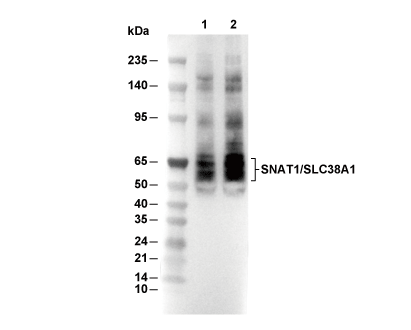 Lane 1: Mouse brain, Lane 2: Rat brain